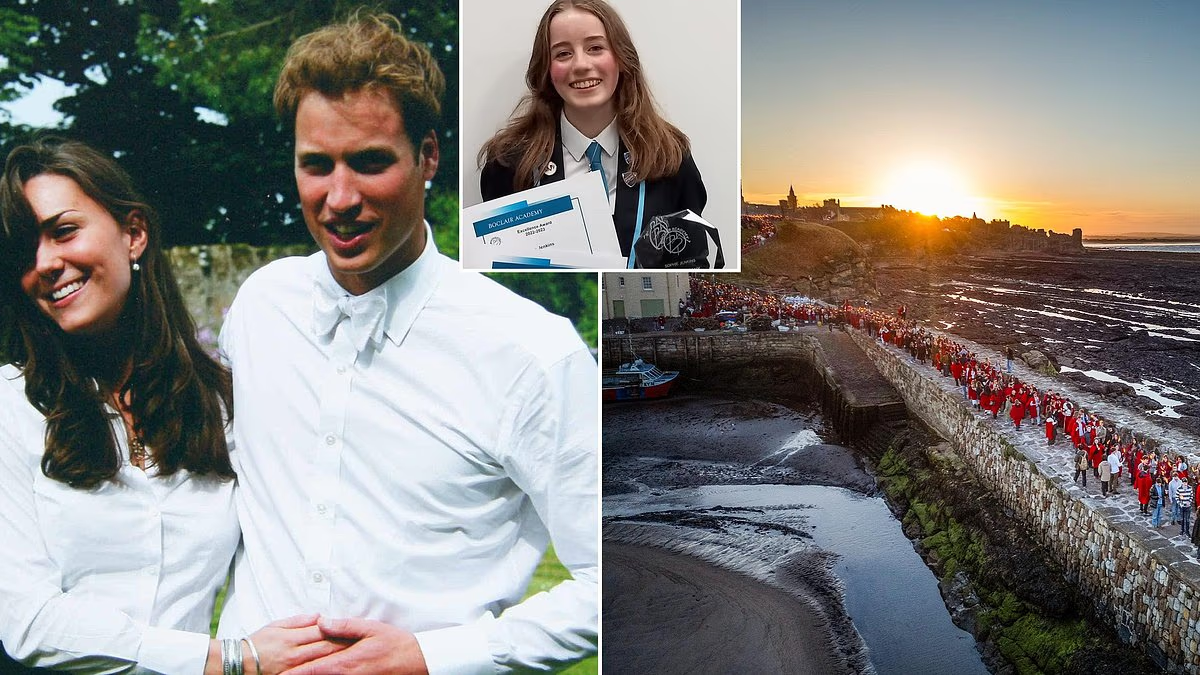

Two weeks ago, hundreds of students at St Andrews gathered along the narrow harbour walls in Fife, their bright red gowns creating a striking display of tradition and camaraderie.
The occasion was the first pier walk of the Martinmas semester, a longstanding ritual that signals the start of the academic year at Scotland’s oldest university. Freshers and returning students turned out in large numbers.
One conspicuous absence, however, set this year’s procession apart.
Sophie Rose Jenkins was expected to begin the third year of her comparative literature and classical studies degree. The scholarship student, who attended a state school in Scotland’s Central Belt, appeared to have both the academic ability and opportunity to thrive.
Instead, her voice was missing from the lively conversation accompanying the procession as it wound from St Salvator’s Chapel towards the waterfront.
Ms Jenkins turned to social media to explain why she had abandoned her course after two years and said she would not return to the university under any circumstances.

Around 3,000 St Andrews students take part in the annual Gaudie, dressed in red robes
At the centre of her decision, she said, was what she regarded as anti-Scottish and class-based bullying by affluent students from elsewhere in the UK and abroad, who comprise much of the university’s population.
She said her Glasgow accent was mocked and that her contributions in tutorials were dismissed or minimised, leaving her feeling like an outsider in the country where she was born.
Her account struck a powerful chord. Within hours, her original LinkedIn post had been viewed more than 200,000 times, while other Scottish students came forward to describe what they said were similar experiences of being patronised at their own universities.
Speaking to the Mail, Ms Jenkins, 20, described how her excitement at winning a place at the prestigious university quickly gave way to disappointment. St Andrews regularly performs strongly in UK university rankings and counts the Prince and Princess of Wales among its former students.
She said non-Scottish students made her feel ‘completely not welcome’ during tutorials. ‘They just kept talking over me and then eventually it got to the point where they said, “I can’t understand what you’re saying”,’ she recalled. ‘Then they just refused to let me talk in the groups.’
Ms Jenkins said the experience left her ‘incredibly embarrassed’ by her accent. ‘I couldn’t finish a sentence without people laughing at me,’ she said.
She also recalled incidents in which teaching staff, she claimed, ‘made digs at people’ from ‘working-class Scottish’ backgrounds.
During her two years at St Andrews, she said, she encountered just one Scottish academic. In her view, that lack of representation ‘might be a factor’ in the wider situation.
She also pointed to what she considered a more significant issue. ‘I, and loads of other Scottish people I’ve talked to,’ she said, ‘have felt completely ignored and completely pushed to the side in favour of [the University] making profit from tuition fees.’
The reference to tuition fees complicates any attempt by Nationalists to present the dispute solely as a case of anti-Scottish prejudice.
At the heart of the controversy is the SNP’s defining policy of free tuition for Scottish students. Introduced in 2008 during the party’s first term in government, the policy quickly became popular, particularly among families with children preparing to leave school.

The ‘Kate and Will effect’ helped raise St Andrews’ profile
Under the system, students from other parts of the UK pay tuition fees at Scottish universities, while international students are charged considerably more. Scottish undergraduates, by contrast, have their fees paid by the Scottish Government through taxation.
An easy vote winner, it left all other parties fearing political annihilation at the polls if they dared attempt to deny youngsters their inalienable right to free university education.
In November 2014, Alex Salmond doubled down on the pledge in his final hours as First Minister by unveiling a monument stone at Edinburgh’s Heriot-Watt University to underline his party’s immovable position on his proudest achievement: ‘The rocks will melt with the sun before I allow tuition fees to be imposed on Scotland’s students,’ read the inscription.
A decade on, both he and the stone are gone; the former SNP leader, estranged from his party, died suddenly in North Macedonia in 2024, while the stone is locked away from public view in ‘secure storage’.
What remains, however, is the SNP’s commitment to its ruinous promise to the Scottish people which neither they nor any other political party feels brave enough to break, no matter how damaging the consequences.
A statement on the SNP’s website puts its position bluntly: ‘As long as the SNP is in government there will not be tuition fees in Scotland.’
Yet, far from opening up our world-renowned academic institutions to bright young Scots, regardless of their economic circumstances, the experience of ordinary Scots like Ms Jenkins is that it has made them harder to get into.
In a market where most income could be derived from international students – many paying £30,000 a year or more – and the second-best option was non-Scottish domiciled UK students who pay more than £9,500 a year to study at any of our top universities, homegrown students were the third-class citizens of the arrangement.
Through a combination of direct payments and block grants to universities, the Scottish Government spends a total of around £7,500 per Scottish student per year. It keeps expenditure in check by capping each university’s intake of those wishing to study in their homeland.
To offset the financial hit of educating a fixed number of cheaper Scottish students, our most prestigious universities have increasingly had to rely on attracting lucrative fee-payers from outside Scotland.
The impact on the student body has been dramatic.
Twenty years ago, just under half (46 per cent) of all Edinburgh University students were Scottish domiciled. Today it is around a third. The figure for St Andrews’ undergraduates hovers below 30 per cent, the lowest of any Scottish university.
In this academic war of attrition, even high-achieving Scottish pupils are collateral damage, denied places at their own country’s top universities in favour of English or overseas students with less impressive grades but the means to pay their way.
Even those Scots who do gain entry can struggle with student life at institutions which now predominantly serve other lands.
READ MORE: Canada’s Top Doctors Push to Allow Euthanasia for Newborns
At St Andrews, of course, the ‘Kate and Will effect’ raised the 613-year-old institution’s profile from a well-regarded regional university into an ultra-competitive global choice where applications skyrocketed by more than 40 per cent following the heir to the throne’s stay.
Given the town’s population almost doubles during term-time, with students arriving from 120 countries, Scots can feel easily isolated. Those who responded to Ms Jenkins’ post certainly think so.
One former St Andrews student told the Mail: ‘I think I masked my accent a lot and made it palatable to people, so whenever I did slip into my accent people would make comments.
‘But I am lucky that I was never singled out in a tutorial or seminar – maybe because I felt a lot of imposter syndrome and so rarely spoke up. I genuinely interacted as little as I could with very privileged people in St Andrews. There was such a class divide.’
Another said: ‘As someone from Ayrshire who has come through the system, I think this extends beyond St Andrews.’
A third added: ‘Edinburgh uni was also exactly like this. It’s insane to be discriminated against in your own city.’
Last year, it emerged that staff at the University of Edinburgh underwent training sessions to help tackle ‘accent bias’ when teaching students.
It came after the Scottish Social Mobility Society, a student-formed anti-discrimination pressure group, received dozens of reports of lecturers and non-Scottish students mocking Scots over their backgrounds and accents.
The University of Edinburgh was forced to issue guidance on tackling ‘socioeconomic microaggressions’ by asking students not to be ‘snobs’.

Sophie Rose Jenkins complained of her experience at St Andrews
St Andrews said it was ‘concerned and sorry’ to hear of Ms Jenkins’ experience and insisted it has equality, diversity and inclusion training in place that is designed to address classism and accents.
A spokesman said inclusivity was important to the university, saying: ‘Commenting on someone’s accent or background can amount to bullying, harassment or exclusion, and that sort of behaviour will not be tolerated.
‘We’re a Scottish university, Scottish students are our heritage and lifeblood, and every year we take in the maximum number of Scots we’re allowed to under the Scottish government rules.’
Regardless, the statistics suggest otherwise, although recently, the challenge to Scottish institutions of relying on fee-paying UK and international students to prop up their finances has become an existential one.
Last year, Professor Iain Gillespie, convenor of umbrella body Universities Scotland, told MSPs that numbers of international students have dropped recently by an average of 20 per cent across Scottish institutions. Not good news for universities reliant on overseas fees to balance the books.
The SNP resorted to the standard playbook tactic of deflection, blaming the UK Government’s removal of the dependants’ visa for overseas students on most courses – meaning family members could not accompany them to the UK.
It doubtless played a part, but critics of Scottish ministers also argue that their slavish devotion to the principle of free tuition fees for Scots had left higher education chronically underfunded and reliant on foreign cash.
Yet nobody seems to be benefitting – the minority of Scots students who do manage to find a place seem to be having a miserable time of it, as are the university bursars struggling to find ways to make ends meet.
More than half the nation’s universities are now believed to be running at a loss and unrest is growing as cuts bite.
Last week, lecturers at Dundee University began an unprecedented five-week strike in a long-running dispute over the threat of compulsory redundancies after announcing a £30million deficit two years ago. It has already shed 675 jobs through voluntary redundancy and has only survived through multi-million-pound bailouts from the Scottish Government and the Scottish Funding Council.
Aberdeen University, meanwhile, has cut courses and is seeking voluntary redundancies after admitting in 2024 that, at one point, there was ‘significant doubt’ that it could survive.
In the same city, Robert Gordon University has placed 135 positions ‘at risk’.
Edinburgh University needs to cut £140million over the next 18 months while St Andrews is overhauling its financial strategy in the face of a ‘substantial increase’ in its forecast deficit.

St Andrews said it was ‘concerned and sorry’ to hear of Ms Jenkins’ experience
As the sector slides perilously close to the abyss, some in academe are calling for a new approach after arguing that abolishing fees has not widened access or reduced the social inequalities of participation.
‘There is no doubt that the policy of “no fees” restricts the opportunity for Scottish students to enter those Scottish universities that are best at attracting students from outside Scotland,’ Lindsay Paterson, Emeritus Professor of Education Policy, told the Mail.
‘It is not enough for the Scottish government to say that Scottish students can get places at other Scottish universities. The unfairness is about access to the best courses with the strongest international reputation.’
He described the present funding model as ‘unsustainable’, adding that it relies on attracting high-fees students from outside. ‘That is unfair to everyone, and long-term ruinous to Scottish public finances,’ he said.
Professor Paterson believes in a twin-track approach of introducing a graduate tax for all UK students while maintaining fees for overseas students.
He said: ‘The only sustainable way of changing this is to move to a graduate tax, where entry to undergraduate courses is still free at the point of entry, but where graduates from anywhere in the UK would pay back the cost over the long term.’
Of course, it would take a bold politician to try to smash Alex Salmond’s rock-solid pledge on tuition fees.
But it didn’t help Sophie Rose Jenkins achieve her academic potential. And if the faultlines seem obvious to the Scottish students it is meant to support, perhaps it has finally run its course.


