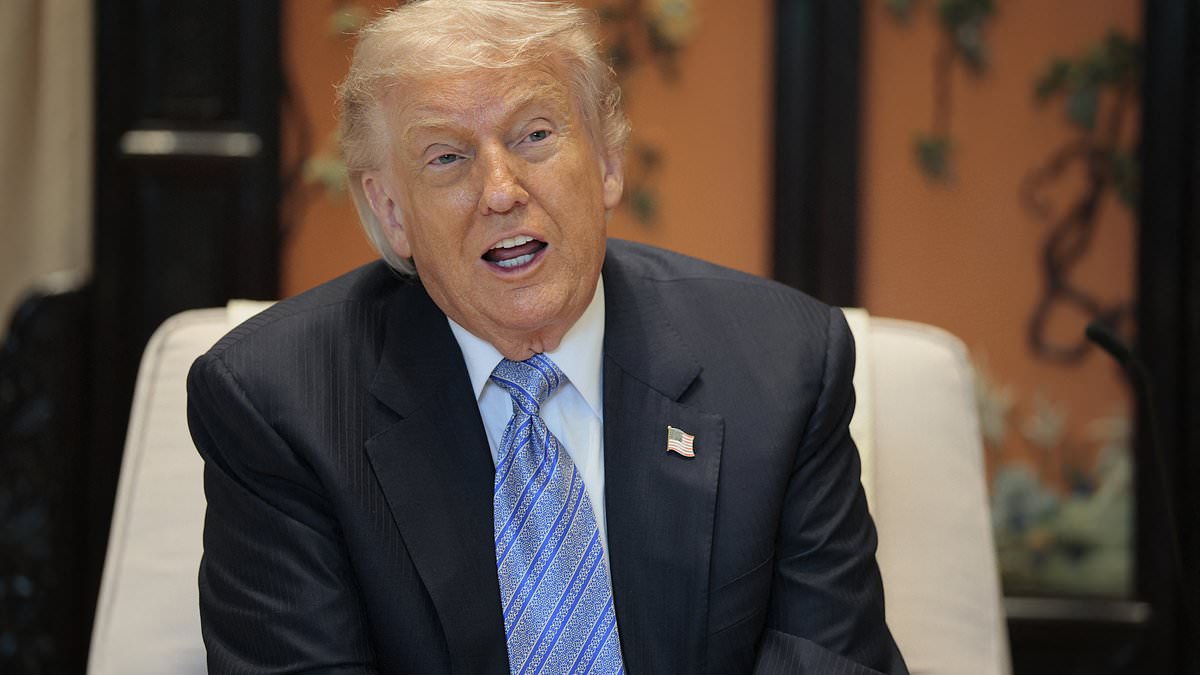

Donald Trump has revealed that a joint operation by American and Nigerian forces resulted in the death of the world’s “most active terrorist.”
The individual in question, Abu-Bilal al-Minuki—whose full name is Abu Bakr ibn Muhammad ibn ‘Ali al-Mainuki—served as the second in command for the Islamic State of Iraq and Syria (ISIS). He was reportedly “eliminated” during a mission in Africa on Friday night.
“Tonight, under my direction, courageous American forces alongside the Armed Forces of Nigeria successfully carried out a meticulously planned and highly complex mission to remove the most active terrorist from the battlefield,” Trump shared on Truth Social on Friday night.
He further explained that Abu-Bilal al-Minuki had been “hiding” in Africa, with U.S. officials receiving information about his location from various sources.
“He will no longer pose a threat to the people of Africa or aid in orchestrating attacks against Americans,” Trump stated.
“With his elimination, the global operations of ISIS are significantly weakened. A special thanks to the Government of Nigeria for their invaluable partnership in this mission,” he concluded.
Abu-Bilal al-Minuki is a Nigerian national and was sanctioned by the Office of Foreign Assets Control.
Former Secretary of State Antony Blinken designated him a Specially Designated Terrorist in 2023.
Donald Trump, pictured above on Friday on the White House lawn, announced that Abu-Bilal al-Minuki, the second in command of ISIS, was killed in Africa on Friday
Nigerian forces worked with American troops to locate and kill Abu-Bilal al-Minuki. Pictured above is a Nigerian Security Forces vehicle
Trump said that sources in Nigeria informed officials of Abu-Bilal al-Minuki’s whereabouts. Pictured above are Nigerian soldiers in 2015
ISIS- West Africa is one of the most significant and lethal branches of the terror group.
The National Counterterrorism Center estimates that there are between 4,000 and 7,000 fighters affiliated with ISIS in the region.
The group is concentrated in northeastern Nigeria, with operations throughout the Lake Chad region, including Cameroon, Chad and Niger.
The branch was formed in 2015 when Boko Haram, a violent Islamist insurgency, pledged its allegiance to ISIS.
Abu-Bilal al-Minuki was the leading official in the Lake Chad division of ISIS’s General Directorate of Provinces (GDP, according to the Counter Extremism Project.
He reportedly has held a high-ranking position in the terror group since 2018. Abu-Bilal al-Minuki was described as a ‘hardline militant.’
He ascended through the ranks of the terror group after the execution of Boko Haram leader Mamman Nur.
Nur was reportedly killed by subordinates shortly after he released abducted schoolgirls without demanding ransom, according to the Counter Extremism Project.
Join the discussion
What impact do you think targeting ISIS leaders has on long-term security in Africa and beyond?
ISIS has a significant following in Nigeria, called ISIS- West Africa. Pictured above are soldiers patrolling the streets in Kebbi
Abu-Bilal al-Minuki reportedly ascended through the ranks after the execution of Mamman Nur, pictured above
It was believed that Nur was executed because other members of ISIS disagreed with his ‘soft’ approach. Abu-Bilal al-Minuki was Nur’s primary rival.
Nur was believed to be the mastermind behind a suicide bombing in 2011 that killed 21 people at the United Nations headquarters in Nigeria.
ISIS grew out of Sunni Iraqis during the Iraq War in the early 2000s as an affiliate of al-Qaeda.
The terror group expanded outward in Syria and had branched off to conflict zones in Africa, the Middle East and Central Asia by 2015.
Insurgent groups, including Boko Haram, the Tehreek-e Taliban Pakistan (TTP), and factions of the Taliban in Afghanistan, pledged allegiance to ISIS.
ISIS-WA uses military assaults, roadside bombs, kidnappings and targeted killings to equip fighters, according to the National Counterterrorism Center.
ISIS members in Nigeria grew from the Islamist extremist group Boko Haram. Pictured above is a screengrab released by Boko Haram in 2014

ISIS gained prominence during the Iraq War in the early 2000s. Pictured above is a group allegedly tied to the Islamic State in 2014
‘The branch mainly attacks regional military targets and civilian defense forces and frequently attacks government personnel and infrastructure; foreign aid workers for kidnapping and hostage-taking; Christians; and other civilians whom ISIS-WA perceives as working against the branch or opposing its interpretation of sharia,’ the NCC said.
Although ISIS’s influence in the Middle East has decreased significantly since the war in Iraq, insurgent groups in Africa have remained prominent, exploiting poor economic conditions in countries like Nigeria.
The Trump administration targeted ISIS groups in Nigeria on Christmas Day last year, killing ‘multiple ISIS terrorists.’
The Daily Mail has reached out to the White House and the Pentagon for more information.


