The Commonwealth could gradually disappear if Prince William declines to become its next leader, a prominent historian has warned.
The Prince of Wales attracted criticism four years ago after a difficult Caribbean tour, when he indicated that taking charge of the Commonwealth was not a priority for him. “Who the Commonwealth chooses to lead its family in the future isn’t what’s on my mind,” he said at the time.
With growing speculation that King Charles may be the final royal to serve as head of the 56-member organisation, Professor Philip Murphy, the former director of the Institute of Commonwealth Studies, believes its future could be at risk.
“William had his fingers burned by that very problematic visit in 2022,” Professor Murphy said.
“But if the Commonwealth loses the royal headship, it will lose a lot of its power and I think it will gradually fade from view.
“For decades, the British Government has been wondering what to do with the Commonwealth but has never really come up with a convincing explanation.
“If we lose King Charles, there will be a ‘cliff edge’ decision to be made. It is entirely possible the Palace will say, ‘We don’t think it’s any longer necessary or appropriate for there to be a royal head’.”

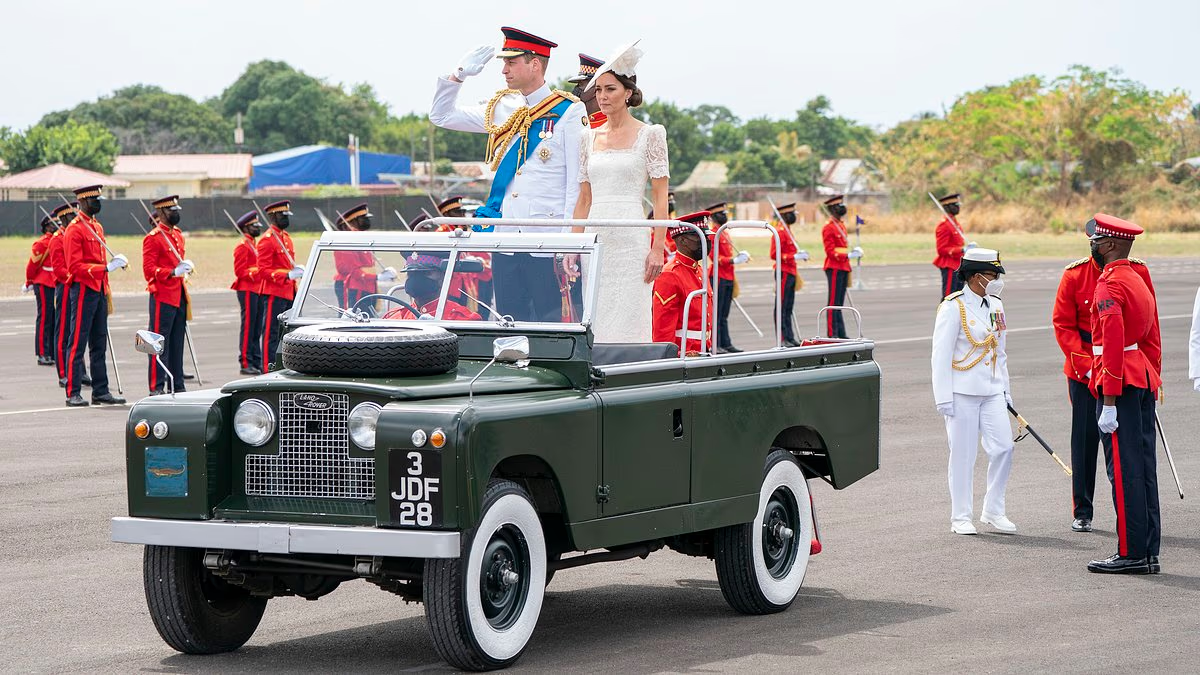
The Duke and Duchess of Cambridge attended the first commissioning parade for Caribbean service personnel in Kingston, Jamaica, in 2022

Prince William and Catherine visited Jamaica, the birthplace of reggae, during their Platinum Jubilee tour of the Caribbean four years ago

King Charles III addressed the opening ceremony of the Commonwealth Heads of Government Meeting in Samoa in October 2024

King Charles III arrived in the rain for Antigua and Barbuda’s annual Independence Ceremonial Parade in early November, marking 45 years of independence
Such a move, he argued, would leave the Commonwealth “fatally flawed”.
“It’s not feasible to have a separate individual doing it because there would be too much competition among members.”
The Commonwealth was reportedly among the issues discussed when Prince William met Prime Minister Andy Burnham at Downing Street last week, although no details of the conversation have been made public.
Founded by Queen Elizabeth’s father, George VI, the Commonwealth was a particular passion of the late Queen Elizabeth II.
However, attitudes within its member states are shifting, with increasing calls for its leadership to reflect the changing balance of global power.
The organisation is also operating against a backdrop of rising criticism of Britain’s imperial history.
During his latest Caribbean tour, King Charles faced demands for slavery reparations as well as calls to remove the monarchy from the region.
READ MORE: Unions turn on each other over Labor demolition ‘greed’
The King has described the Commonwealth as “one of the world’s more improbable organisations”.

The Prince of Wales arrived at No 10 Downing Street in London for a meeting with Prime Minister Andy Burnham

Prince William and Mr Burnham discussed shared priorities, including efforts to tackle homelessness
Royal sources say King Charles intends to leave the decision over his successor to the member nations and the Commonwealth secretary general.
That has prompted speculation about which non-royal figures could be considered if Prince William or the Commonwealth’s members decide to end the organisation’s connection with the monarchy.
One name being mentioned is Leena Nair, the Indian-born British chief executive of Chanel, who has established strong links with the Royal Household.
Ms Nair has met the King several times this year, including at one of his “dine and sleep” gatherings at Windsor Castle.
Professor Sue Onslow, a Commonwealth specialist and editor of The Round Table journal, suggested that a member of The Elders could be a suitable choice if the organisation were to appoint a non-royal head.
The Elders is an international group of independent leaders founded by Nelson Mandela.

Speculation is growing over potential non-royal leaders for the Commonwealth, with Indian-born British Chanel chief executive Leena Nair among the names being discussed

Ms Nair has built close ties with the Royal Household and has met King Charles several times this year
Its members include Helen Clark, the former prime minister of New Zealand, and Hina Jilani, the Pakistani human rights lawyer and pro-democracy campaigner.
King Charles has received praise for his commitment to the Commonwealth. For now, however, Prince William appears reluctant to take on the same role.
Robert Hardman, a Mail writer and author of the biography Elizabeth II, shares Professor Murphy’s concerns. “Severing the royal connection would be a lose-lose for the monarchy and the Commonwealth,” he said.
“The royal presence lends gravitas, glamour and media interest to Commonwealth events.
“Remove royalty and you’ll find the leaders of the big Commonwealth nations soon stop turning up to things.
“It’s a great network for royal causes. King Charles gets that. He grew up knowing Commonwealth leaders as a boy and was immersed in its ways years before he became its head. That has not been the case for Prince William.”


