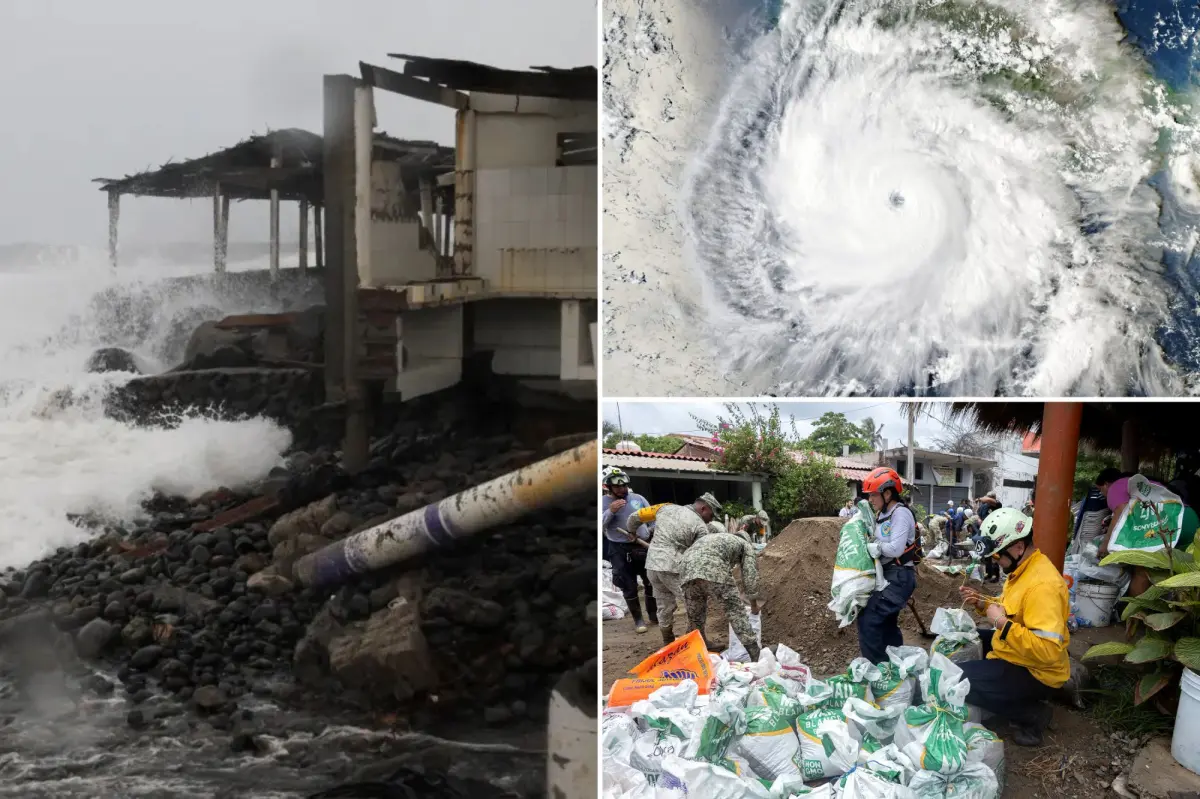
MEXICO CITY — Residents along Mexico’s western coast piled sandbags around beachfront businesses and fled their homes as two separate Pacific hurricanes threatened widespread destruction. On Hawaii’s Big Island and Maui, officials warned of potentially catastrophic flooding while the storms churned across the ocean Thursday.
Nolo strengthened into a hurricane in the Pacific on Thursday night and was forecast to intensify as it turned toward Hawaii’s Big Island, the National Hurricane Center said.
Forecasters said the Big Island could receive 15 to 30 inches (38 to 76 centimeters) of rain, with even higher totals possible through Saturday.
Maui was also at risk of life-threatening flooding, according to the hurricane center.
At the same time, powerful Hurricane Polo was drenching Mexico, bringing the threat of torrential flooding and landslides, the U.S. hurricane center said.
In the port city of Lázaro Cárdenas, seawater pushed into homes Thursday, leaving wooden boards, furniture and other debris scattered across the streets.
Polo has repeatedly shifted between Category 4 and Category 5 intensity, both classifications for major hurricanes. The storm was expected to regain Category 5 strength Friday before gradually weakening Friday night and Saturday, the hurricane center said.
After passing near Mexico’s coastline, Polo was forecast to move farther offshore Thursday night and Friday, then curve back toward land to the north on Saturday.
The succession of powerful storms comes as El Niño drives major weather changes around the globe, contributing to drought in some regions and flooding in others.
El Niño typically suppresses Atlantic hurricane activity, but it can intensify tropical cyclone development in the Pacific by producing moist air and reducing wind shear.
Hawaii has already endured major spring flooding, an earthquake and two other hurricanes since mid-August.
“In my 20 years of experience here, I’ve never seen three hurricane watches for the islands in the same year,” said John Bravender of the National Weather Service in Honolulu.
Polo could trigger flooding and mudslides in Mexico
In Mexico, authorities opened shelters and cleared people from beaches as residents along the coast worked to shield their businesses from the surging water.
Officials were evacuating people from high-risk areas, although they did not immediately disclose how many residents had been moved.
The concern reflects the devastation caused by previous hurricanes along Mexico’s Pacific coast. In 2023, Hurricane Otis unexpectedly plunged Acapulco into weeks of chaos.
“So many people said it wouldn’t happen and then it did. After that, you’re left on edge,” said Gonzalo Ramírez, a bartender in the city.
MUST READ: Massachusetts Officials Push Mandatory Postpartum Nurse Home Visits for New Mothers
Polo posed its greatest threat to Guerrero and Michoacán, neighboring states in southwestern Mexico whose long coastline includes small ports, tourist destinations and fishing communities.
Much of the region is impoverished, and residents frequently say they are left to cope on their own when natural disasters strike.
Mexican authorities deployed 15,000 security personnel along the coast and suspended classes.
In Lázaro Cárdenas, a Michoacán port city battered by high surf, residents and government workers cleared piles of wooden boards from several destroyed ramadas and shoveled away the thick mud covering much of the town.
Alicia Contreras said the walls and roof of her restaurant had been severely damaged by 15-foot (4.5-meter) waves.
As officers and family helped pick through the damaged house, Contreras worried about how she would economically recover.
“This is huge because we have no other source of income. Now we’re just surviving,” Contreras said.
Nolo could flood parts of Hawaii still recovering from other storms
While the Big Island is expected to bear the brunt of Nolo, its full path remains uncertain, according to Bravender, the weather service’s warning coordination meteorologist in Hawaii.
Most concerning, he said Thursday, is that the heaviest rain is likely to fall over the same southeastern region of the Big Island hit in August by Hurricane Lala and where grounds are still wet from additional precipitation.
“There are several communities that were isolated, flooded, roads that were washed out,” he said. “It’s that same area that is most under threat,” Bravender said.
Hawaii officials told residents to put together emergency kits and the governor issued an emergency proclamation, activating more than 230 Hawaii National Guard members.
Schools were closed for the rest of the week.
Hawaiian Electric, the state’s primary utility, said crews that had been helping restore power in Kauai after this month’s Hurricane Lowell would return to Oahu, Maui and the Big Island in preparation for the coming storm.
Odalys and Fay are not near land
A third storm in the Pacific, Hurricane Odalys, was centered far from land, roughly 1,110 miles (1,785 kilometers) west-southwest of the southern tip of Mexico’s Baja California peninsula.
In the northern Atlantic Ocean, Tropical Storm Fay re-formed early Thursday, the US hurricane center said. It was nearly 1,000 miles (1,600 kilometers) west-southwest of the Azores.
Tropical Storm Gonzalo formed in the Atlantic Ocean late Thursday, about 190 miles (306 kilometers) southeast of the Cape Verde Islands off the coast of West Africa.
The US hurricane center said that if it stays on its current track, the storm will pass near or over portions of the islands Friday.