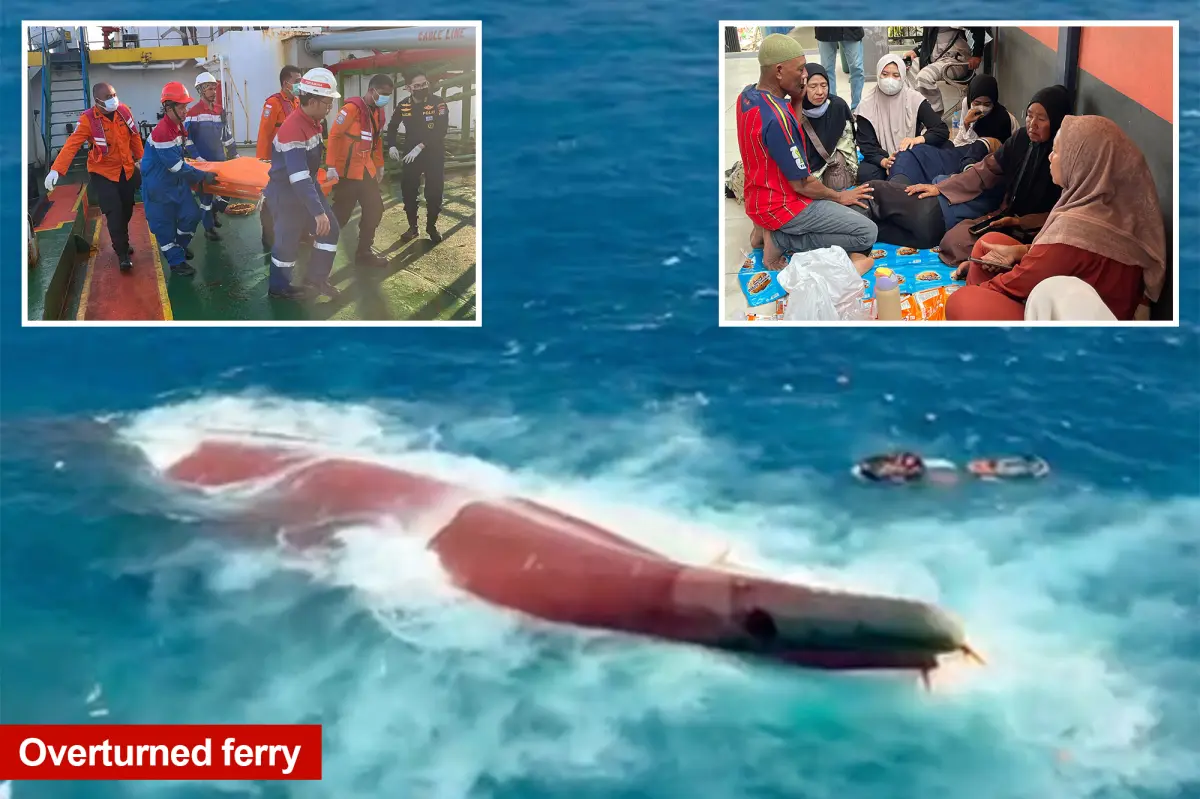

Indonesian authorities stepped up the search Monday for 129 people still missing after a ferry overturned in rough weather in the Java Sea a day earlier. At least six passengers died in the disaster.
The Virgo Transport 8 was carrying more than 240 people when its captain sent a distress call, reporting that the vessel was listing in turbulent seas with waves reaching up to 10 feet. The ferry was traveling from Surabaya in East Java to Banjarmasin in South Kalimantan, on the island of Borneo.
Authorities lost contact with the ferry at around 2 a.m. Sunday. About two hours later, they received reports that the ship had overturned in the Masalembo waters of the Java Sea, roughly 92 miles from Banjarmasin.
Footage released Sunday by the National Search and Rescue Agency showed the overturned ferry drifting in choppy water as a helicopter conducted an aerial search.
Divers deployed with underwater drones
On Monday, 17 ships and aircraft joined the operation, with about 655 personnel from the military, police and other agencies taking part, National Search and Rescue Agency chief Mohammad Syafii said.
Authorities were also sending specialized underwater teams and navy-operated underwater thermal drones to expand the search and help accelerate the recovery of victims, Syafii said.
“We remain hopeful of finding more survivors,” Syafii said during a video briefing.
Search crews, aided by nearby tugboats and other passing vessels, rescued 108 people and recovered six bodies on Sunday.
The ferry’s manifest listed 243 people on board, including 213 passengers and 30 crew members. However, passenger totals in Indonesia often differ from official manifests.
The 390-foot ferry, built in Japan in 1987, was also carrying 89 vehicles.
The cause of the accident remains undetermined.
Survivors recount harrowing moments as ferry overturns
Survivor Ahmad Saudi said the ferry appeared overcrowded. With all cabins occupied, many passengers were reportedly sleeping in hallways and shared areas.
Saudi, a bus driver traveling with a vehicle he was transporting, recalled how the ferry suddenly listed without warning, triggering panic among passengers as rough seas battered the vessel in the Java Sea.
Passengers initially tried to hold on before scrambling to the higher side of the ship as it tilted further, he said, speculating the ferry’s balance may have been affected by trucks loaded on one side.
“The women staying in the economy-class cabins likely didn’t survive because the ferry listed so quickly,” Saudi said.
“There were no alarms or announcements warning passengers about what was happening, many people in the cabins may not have had enough time to get out.”
Faisal, another survivor who goes by one name, said he and 14 other passengers clung to a section of the overturned ferry that remained above water after it capsized.
“After the ship listed, people panicked and rushed to the upper deck, but eventually the ferry rolled over completely,” he said. “Fourteen of us were left stranded there.”
The group repeatedly recited the Islamic call to prayer, or adhan, while battling exhaustion and rough seas as awaiting rescue.
A wave later swept Faisal toward a lifeboat, helping him survive, he said.
Indonesia is an archipelago of more than 17,000 islands.
Ferries are a common method of travel and accidents occur regularly, in part due to weak enforcement of safety standards.


