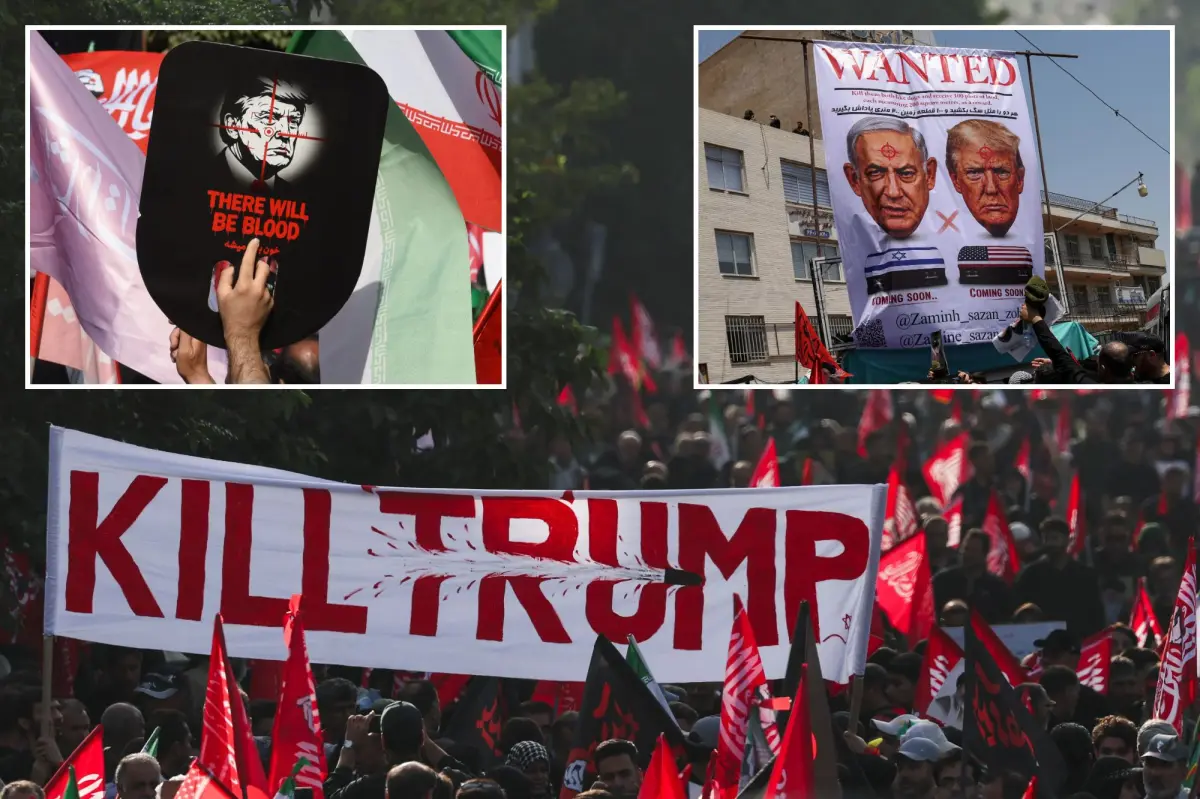
Regime supporters in Iran called for President Trump to be killed during Monday’s funeral procession for slain Supreme Leader Ayatollah Ali Khamenei.
Video from Tehran showed mourners and loyalists paying tribute to Khamenei while throwing stones at a billboard depicting Trump with a bullet aimed at his head, as demonstrators demanded retaliation.
“The US killed our father,” the banner said. “We won’t let you go!”
Crowds in the procession were also seen carrying placards featuring images of the American president alongside the words “KILL TRUMP” in large, bold lettering.
Other groups marched with lengthy banners displaying the same threat directed at Trump and Israeli Prime Minister Benjamin Netanyahu.
Some demonstrators carried threatening signs showing Trump, Netanyahu, Vice President JD Vance and Defense Secretary Pete Hegseth in gun-sight crosshairs, accompanied by the warning: “There will be blood.”
Calls for retaliation over Khamenei’s killing have intensified in recent days, after Iran’s most senior clerics last week urged the assassinations of both Trump and Netanyahu.
The 88-member Assembly of Experts released a 10-point statement declaring that killing “the wicked prime minister of the Zionist regime” and “the criminal American president” was a religious obligation to be carried out “under any circumstances.”
The statement was issued just two days after hardliners in the assembly claimed it was a moral obligation for anyone with access to Trump to take revenge “on American soil.”
Iran and the US currently have a cease-fire in place for Khamenei’s six-day funeral procession, which began on Friday in a national procession led by the slain ayatollah’s casket.
Khamenei’s coffin, which was displayed in the holy city of Qom, will travel to two Shi’ite shrine cities near Iraq before returning for a burial in Mashhad, officials said.
ALSO READ: October 7 Hostage Says Hamas Doctors Tortured Her and Reattached Foot at 90 Degrees
The supreme leader was killed in Israel airstrikes within the first hours of the Iran War. The strikes also badly wounded his son, Mojtaba Khamenei and killed his family.
Mojtaba, whom US intelligence believes is “probably gay,” took over the top role from his dad and is believed to have strong ties to the hardline Iranian Revolutionary Guard Corps.
He has not been seen in public since the war began.
Trump said over the weekend that peace talks with Iran had been delayed for a week by the funeral ceremonies. On Monday he reiterated that the US would either reach a deal with Iran or “finish the job,” renewing his threat of military action.
Israel’s defense minister, Israel Katz, said on Monday that the elder Khamenei had been killed because he led a program to destroy Israel.
“Any Iranian leader who will again try to pursue plans to destroy Israel will be killed as well,” Katz said.
While Tehran was filled with thousands of mourners on Monday, analysts — and even senior Iranian officials — cautioned that the crowd size cannot be equated to a popular endorsement of continued theocratic rule.
“If anyone’s thinking this is a litmus test for the popularity of the Islamic Republic, history tells us otherwise. It’s a funeral, and Iranians do funerals very well,” said Ali Ansari, professor of modern history at St. Andrews University in Scotland.
Reuters spoke to people attending the rallies who said they were only there as spectators or were motivated by a sense of religious duty in a country of strong Shi’ite Muslim tradition, rather than to display political allegiance.
“My attendance does not mean that I am pro-regime, this big event happened in my country and I wanted to witness history,” said Hamidreza, 63, a retired teacher in Tehran who said he always attends funerals of major national figures and asked to withhold his family name.
The authorities can count on a steady base of ideological support that analysts often put at around 15-20% of the population of 93 million, based on support for hardline candidates in elections. During the last presidential vote in 2024, the hardline candidate Saeed Jalili received around 13.5 million votes.
The funeral is a rare national event — the first of a supreme leader since 1989 when Khamenei’s predecessor Ayatollah Ruhollah Khomeini, the father of the 1979 revolution, was buried at a moment of high ideological fervor. His burial, two days after his death, drew millions of people in scenes that sometimes verged on chaos.
With Post Wires


