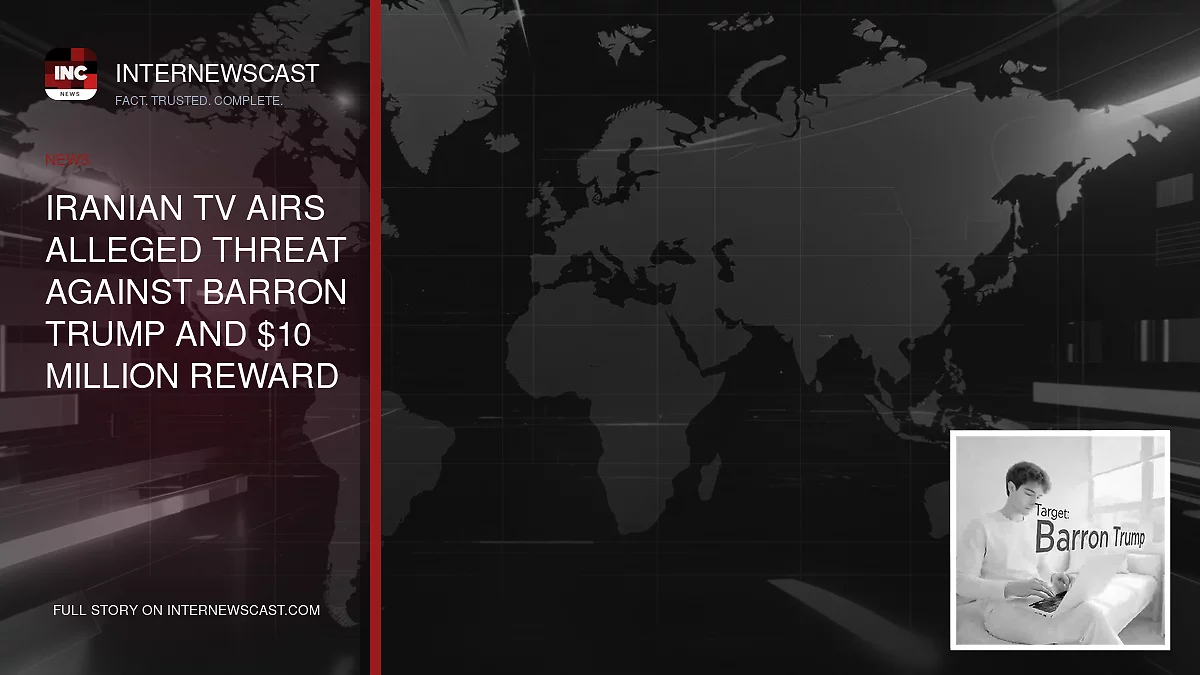

Iranian state television is facing criticism after allegedly airing a segment that appeared to outline threats involving Barron Trump, the youngest son of Donald Trump.
The roughly three-minute video centers on Barron, 20, and, according to Iran International, uses dramatic, highly produced visuals to suggest efforts to find ways of reaching the NYU student inside the United States.
The broadcast reportedly claimed to trace Barron to a number of prominent locations, identify several of his social media accounts, chart his circle of friends and explore possible ways to get around Secret Service security.
A large portion of the footage appears to have been created with artificial intelligence, including scenes depicting Barron in an Arsenal jersey and playing Xbox.
Another AI-style sequence seemingly shows a hooded, masked hacker seated at a computer while searching for information about the president’s youngest son.
The segment also mentioned a $10 million reward, although it was not made clear who had allegedly put up the money or for what specific purpose.
Iran International said there is currently no evidence that any real-world attempt has been made against Barron Trump.
Iran has previously produced similar videos targeting Donald Trump and his wife, Melania Trump, but this latest broadcast is being described as one of the most direct and explicit threats aimed at members of the Trump family and those close to them.

The three-minute clip focuses on Barron, 20, and menacingly shows attempts to identify ways of reaching him in the US
In 2024, the US offered a $20million reward for information leading to the arrest of an Iranian man accused of plotting to assassinate Donald Trump’s former National Security Adviser John Bolton.
Shahram Poursafi, a member of Iran’s Islamic Revolution Guard Corps (IRGC), was accused of trying to hire US-based criminals to kill Mr Bolton – who has long criticised Iran – in exchange for $300,000.
Officials said that Mr Poursafi tried to hire ‘criminal elements within the United States’ between October 2021 and April 2022 to kill Mr Bolton in either Washington DC or Maryland.
And in March of this year, an IRGC-trained operative was convicted of trying to commit an act of terror.
Asif Merchant admitted at a trial that the IRGC sent him to the US to arrange to carry out political assassinations and steal documents, but law enforcement foiled the plot before any attack could be carried out.
Former Attorney General Pam Bondi said at the time: ‘This man landed on American soil hoping to kill President Trump. Instead, he was met with the might of American law enforcement.
‘The Department of Justice will remain ever-vigilant to protect Americans, prosecute terrorists, and halt acts of terrorism before they happen.’
Overnight, Iran dismissed Trump’s threats of economic warfare as ’empty talk’ while warning neighbouring countries not to help Washington squeeze Tehran.
Iran’s powerful security chief Mohsen Rezaei threatened retaliation against any nearby nation that joins the US crackdown and warned Tehran could stop oil from flowing through the Persian Gulf.

A woman walks next to an anti-Trump billboard in Tehran, Iran, on August 19 2026

Birds perch near an anti-US billboard featuring US President Donald Trump in southern Tehran, Iran, on August 24 2026
‘If countries neighbouring Iran cooperate with the Americans in the economic war, we will target their interests,’ Mr Rezaei declared.
‘The world has realised that Trump’s bluster is nothing but empty talk,’ Mr Rezaei said in an interview with Iranian state media on Saturday.
He then turned his fire on countries surrounding Iran, warning that Tehran could dramatically widen its economic confrontation if they side with Washington.
Iran does not want to expand the war across the Middle East, Mr Rezaei insisted, but he delivered a threat to his neighbours.
‘If they start such an action, we will not allow a single drop of oil to pass through the Persian Gulf,’ Rezaei added.
The warning potentially puts major Gulf energy producers on notice as Trump prepares to ratchet up his campaign of economic pressure against Tehran.
Saudi Arabia and the United Arab Emirates have spent years developing and expanding alternative export routes that reduce their reliance on the Strait of Hormuz, allowing oil to reach ports on the Red Sea and Gulf of Oman.
But Mr Rezaei indicated those routes may not necessarily be beyond Tehran’s reach either, threatening alternative pathways used to move Gulf oil to international markets.
His comments amount to one of the clearest warnings yet that Iran’s hardline security establishment could increasingly regard co-operation with Washington’s economic campaign as participation in the wider conflict.
Mr Rezaei also insisted that Iran would ‘neutralize the economic war’ being waged by the US, with the Trump administration expected to unveil details of tougher sanctions on Monday.