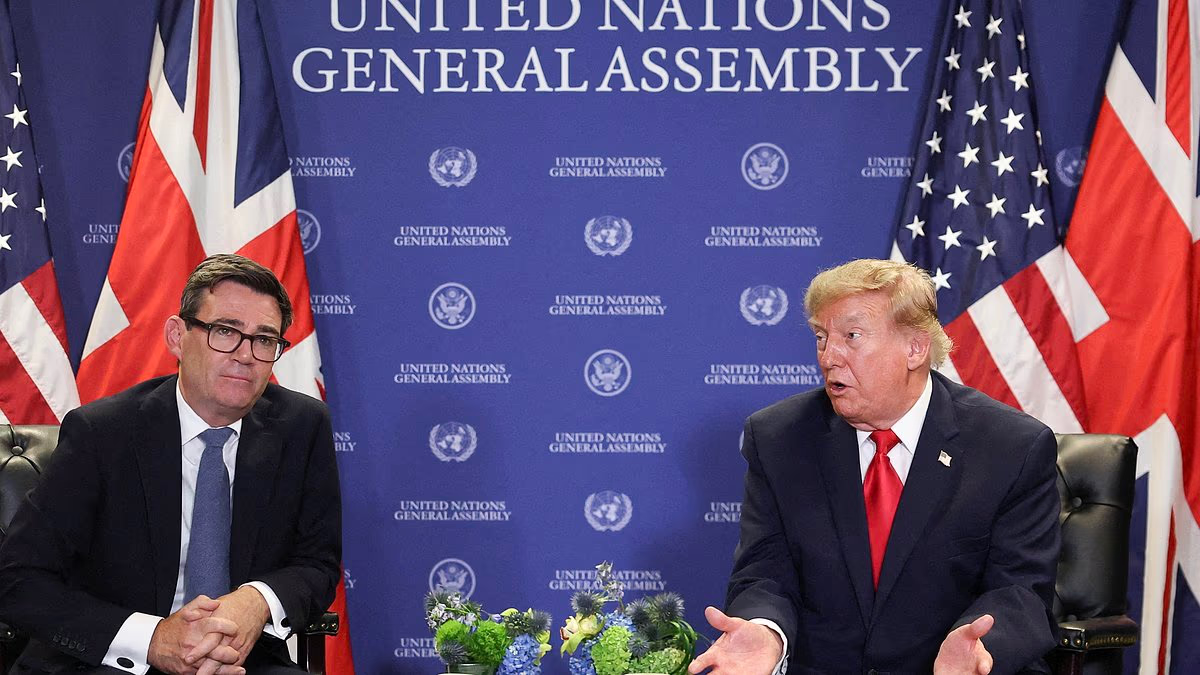

Andy Burnham’s first meeting with Donald Trump appeared to be unfolding smoothly—until a reporter brought up the contentious issue of the Chagos Islands.
The unpredictable US President seemed determined to keep his temper in check. Unlike his explosive Oval Office confrontation with Volodymyr Zelensky, there were no personal attacks—and no repeat of the “he’s no Churchill” jibes once directed at Keir Starmer as their relationship deteriorated.
Instead, Mr Trump warmly forecast that Mr Burnham would become a “great Prime Minister”, adding: “We’re with you all the way!”
The PM did not challenge Mr Trump as the US President congratulated him on a “great election win” and described the lifelong politician as a “natural businessman”.
Even potentially sensitive subjects, including immigration and the Middle East, passed without provoking an outburst from the President.
That calm atmosphere changed when the questions shifted to the controversial Chagos agreement, prompting a grimace from Mr Burnham.
Foreign Secretary Ed Miliband responded with a steely stare, while National Security Adviser Jonathan Powell—who negotiated the agreement with Mauritius—sat impassively as Mr Trump condemned the arrangement as a “terrible deal”.
“I don’t support it, I think it’s terrible,” he said, before adding: “I think the Prime Minister is going to be looking at it.”

Prime Minister Andy Burnham and US President Donald Trump during their first face-to-face meeting in New York yesterday. The unpredictable President appeared determined to remain on his best behaviour

Mr Burnham reacted uneasily as the discussion turned to the controversial Chagos agreement
Sure enough, the PM later suggested for the first time that the deal he had defended only the previous evening could be abandoned if he fails to secure President Trump’s support.
For Downing Street, the intervention was an unwelcome blemish on an otherwise positive trip. Privately, aides were pleased with the meeting, arguing that Mr Burnham’s relaxed manner had helped him establish a rapport with a president who places greater value on personal connections than intricate policy detail.
The PM casually remarked that he had merely “inherited” the agreement—a statement unlikely to silence Westminster speculation that Mr Powell could be forced out.
The visit also came at a difficult moment for the new PM, just days after his father’s death and on the eve of his first Labour conference as leader.
“I’m all right,” he told reporters during the flight to New York. “I’ve not had the easiest [week]… I’m OK.”
During a 40-minute question-and-answer session over the Atlantic, the PM—wearing dark jeans and a suit jacket—projected the image of a politician enjoying the demands of the job despite the scale of the challenges ahead.
“I’m really excited about it, because I’m going to be talking about British leadership in a new era,” he said.
There is an unwritten rule at diplomatic gatherings: world leaders are always keen to meet the newcomer. How did they rise to the top? What will they do to remain there? And what will their arrival mean for everyone else?

Foreign Secretary Ed Miliband gave the questioner a steely stare after they raised the issue of the Chagos Islands

Behind the scenes, aides welcomed the meeting with Mr Trump, saying Mr Burnham’s relaxed approach had helped build a connection with a President who prioritises personal relationships over detailed policy
And so, No 10 had no trouble organising a string of one-to-one meetings with senior figures including EU chief Ursula von der Leyen, President Zelensky, Australian PM Anthony Albanese and a walk and talk with Spanish PM and fellow socialist Pedro Sanchez in New York’s Central Park.
In all, he met 25 leaders in 24 hours – a form of international speed-dating he hopes will limit the need to emulate Sir Keir’s endless foreign travel.
But it was the Trump encounter – described by one of the PM’s team as ‘white-water rafting’ – that focused attention.
Two British Prime Ministers have flown out for their first presidential audience with Donald Trump in the last couple of years.
British foreign policy has barely changed over the period, bar a hardening of the stance on Israel.
But the approach of the two men could barely be more different.
When Sir Keir visited Washington DC in February last year, the travelling party was gripped by tension and fear.
Flying out on Monday night from Stansted Airport, Mr Burnham was anxious to make what he called a ‘good connection’ with a president he once described as ‘poisonous’. But the atmosphere on the flight out was far less fraught.
In part, this was due to Mr Burnham’s more laid-back style. Although new to the role, he appears more comfortable in his skin than Sir Keir ever did.
But the circumstances have also moved on.
One diplomatic source said the ‘situation around the President has changed’, adding: ‘People used to think that the way to get on with Trump was to kiss the ring – and that is no longer the case. I think there’s a view now Trump doesn’t really respect you until you’ve fallen out with him. So there is less walking on eggshells than there was.’
But, as Sir Keir can attest, falling out with Mr Trump is not much fun either. For now, at least, Mr Burnham is fixed with keeping him onside.


