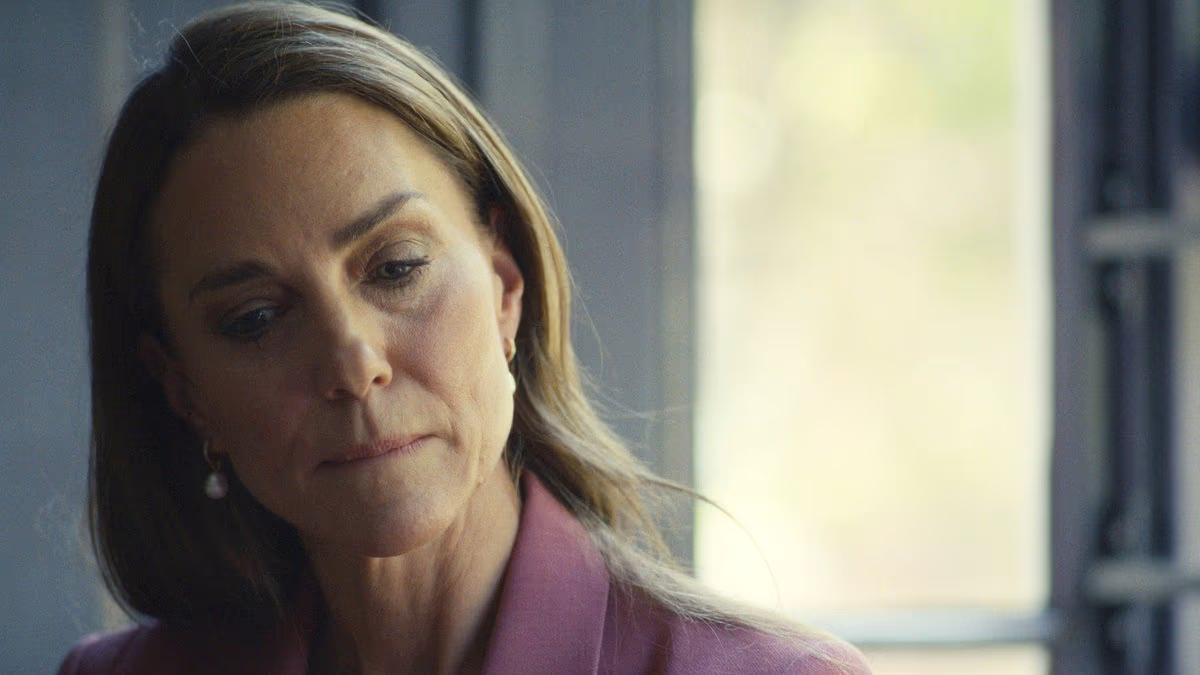
When the Princess of Wales announced her cancer diagnosis, she understandably asked for privacy.
Seated on a garden bench at Windsor, with daffodils behind her, Catherine addressed the public directly. It was March 2024. Her words brought the country to a standstill and echoed around the world.
Now, in a film created to support others, Catherine delivers a powerful message: no one should have to face cancer or a long-term illness alone. In the weeks before she revealed her diagnosis, speculation about her absence had spiralled. Much of it was absurd, and some of it was cruel.
Stephen Colbert joked about her disappearance from public life on The Late Show. Andy Cohen told his followers that footage of Catherine with William at Windsor Farm Shop was not really her. Presenters on The View joked about consulting a medium to locate her. Kim Kardashian made the bizarre claim that she was going to find the princess.
Then Catherine spoke, and the speculation ended. Cohen and The View apologised. Colbert acknowledged that he had caused offence but did not apologise.
From that Windsor bench, Catherine asked for “time, space and privacy”. She received all three. Heal, a BBC film about her recovery, represents her most personal public project to date.
The documentary follows Catherine as she takes on the National Three Peaks Challenge, an endurance test involving the highest mountains in Scotland, England and Wales within 24 hours. She undertook it to raise money for The Royal Marsden, the specialist cancer hospital and research centre in London.
Yet beneath that straightforward premise lies an unprecedented invitation into the private world of Catherine, perhaps the most guarded member of the Royal Family.

In March 2024, the Princess of Wales told a stunned nation that she had been diagnosed with cancer. She asked for “time, space and privacy”

Catherine has now made a film for others, built around her message that nobody should face cancer or long-term illness alone
In 1957, historian Ernst Kantorowicz wrote about the sovereign’s “two bodies”. The body politic — the Crown — is immortal. The natural body ages, becomes ill and eventually fails. For centuries, royalty preserved its mystique by showing the first while concealing the second.
Catherine has opened that curtain.
“Cancer does change you,” she says. “But there’s a much deeper part to what a cancer diagnosis shifts in you.” At the summit of the final peak, Yr Wyddfa, exhausted and soaked, she talks to her body as if it were an old companion. “Oh my gosh. Well done, body.” It is funny, moving and suggestive of a new kind of royal openness.
Walter Bagehot, the influential Victorian constitutional writer, argued that the Crown depended on mystery and that too much exposure could destroy its magic. The Windsors took that lesson seriously. “Never complain, never explain” became their guiding principle. But the silence had a price. Princess Diana endured it for years, and the public learned about her bulimia only when Andrew Morton’s book revealed the story in 1992, long after the harm had been done.
When the light did break through, it came via moments of rupture: Diana’s interview on Panorama in 1995, followed by Harry and Meghan’s conversation with Oprah in 2021. Both included deeply personal revelations, but also amounted to indictments of the Royal Family and the institution. In Heal, the only adversary is cancer.
Diana’s story was told in opposition to the family. Catherine speaks from within it. Diana expressed her emotions openly; Catherine kept hers tightly guarded. That has now changed. It is an act of considerable courage.
Saying nothing would have been much easier. Instead, Catherine has shared intensely private experiences in the hope of helping others. Bagehot might well have choked on his vintage port.

Diana’s story was presented in opposition to the Royal Family, beginning with her 1995 interview on the BBC’s Panorama

Harry and Meghan’s 2021 interview with Oprah placed the Royal Family and the institution under intense scrutiny
Susan Sontag, author of Illness as Metaphor (1978), wrote that every person holds dual citizenship: one in the kingdom of the healthy and another in the kingdom of the sick.
Catherine, who is destined to become Queen, takes viewers into the second of those worlds. “I think I was sort of in and out of consciousness. It was a really dark time. But also then, somewhere through that too, I became aware of someone holding my hand.
KEEP READING: DHS Chief Says Long Beach Police Left ICE Officers to Fend Alone
“They weren’t trying to fix anything. They were just there. It does open you up. I think it softens your heart. And once you experience something like that, it’s very hard to go back to the person you were before.”
Illness appears to have softened both Catherine herself and the public’s perception of her. She has long been admired; now, she is loved. Even so, she remains deliberate about what she reveals. She does not identify whose hand she felt. The Palace has said it represented a genuine moment of comfort and care — and, more broadly, the feeling of being supported by love.
Nor does Catherine name the type of cancer she had, despite speculation that she might do so, just as King Charles has never identified his diagnosis. That seems entirely fair. She can share the experience without surrendering her medical records.
That is discernment, not evasiveness.
What Catherine does reveal reaches into the institution’s deepest values. “You just need to be there,” she says. “And that’s what love looks like.” She adds: “We spend so much time doing and not being.” The modern monarchy often defines itself through action: visits, walkabouts, ribbon-cuttings and diaries planned months in advance. Catherine gently suggests that simply being present may matter more. It is a lesson likely to shape the Queen she becomes.
She has also discovered strength in the same place as her father-in-law. “Nature has really been my sanctuary and my refuge,” she says.

Neither Catherine nor her father-in-law, the King, has disclosed the type of cancer diagnosed in each case

Catherine’s documentary follows her completion of the Three Peaks Challenge, scaling the highest mountains in Scotland, England and Wales within 24 hours
The King was mocked decades ago for speaking to his plants. No one is laughing now. Both were undergoing cancer treatment at the same time and found solace among the trees and wildflowers of the countryside.
In a west London pub, Catherine meets a group of people living with cancer. “Navigating cancer or any long-term illness is a lonely road, but it’s clear we’re not meant to carry life’s challenges alone,” she says. Then comes the admission that perhaps tells us the most: “I haven’t really explored this outside my family walls, really.” The Princess of Wales sits quietly in a pub, saying little and listening closely.
At The Royal Marsden, patients mark the end of treatment by ringing a bell. Walking with her brother, James Middleton, Catherine says: “Yeah. But I didn’t ring the bell.” He replies: “Maybe this is your ringing of the bell.” Perhaps the mountains became her rite of passage, and she completed every step herself.
At a summit, James plays messages from Catherine’s children, sent by Prince William. Prince Louis expresses the sentiment most simply: “Hello, Mummy. I really love you and I hope you do well going up the mountain. Remember, I’m always in your heart with you and I love you very much.” It is deeply affecting.
“They gave me the reason to get out of hospital. They’re going to give me the reason to finish this challenge,” Catherine says. “This is for the kiddies.” She also recognises that her experience is not universal: “I’m aware my story is different to so many others, and I don’t pretend that what I say in any way reduces the grief and pain that so many face.”

While making the film, Catherine met a support group for people living with cancer in a west London pub

The Princess of Wales said she had not previously shared her experience with anyone beyond her immediate family
Why make the film? Raising money for The Royal Marsden in London is one reason. But another purpose is unmistakable: “My hope is that this film will encourage compassion, showing the real value in standing alongside one another in the hardest of times.”
The documentary offers an insight into the future Queen unlike anything Catherine has shared before. No royal won hearts and minds quite like Diana. But Catherine offers something different: hope, and perhaps the beginning of a royal renewal. Was Bagehot entirely wrong? Not at all. Some mystery remains. But the distance has narrowed, and the Crown may be stronger for it.
Watch the documentary, then contact someone living with a long-term illness.
As Catherine says: “For the days given back to me, I do hope to remind people that whatever road you face, whatever challenge ahead, you are not alone… You just need to be there.”
Robert Jobson is the author of the No. 1 Sunday Times bestseller and New York Times bestseller Catherine, the Princess of Wales: The Biography.


