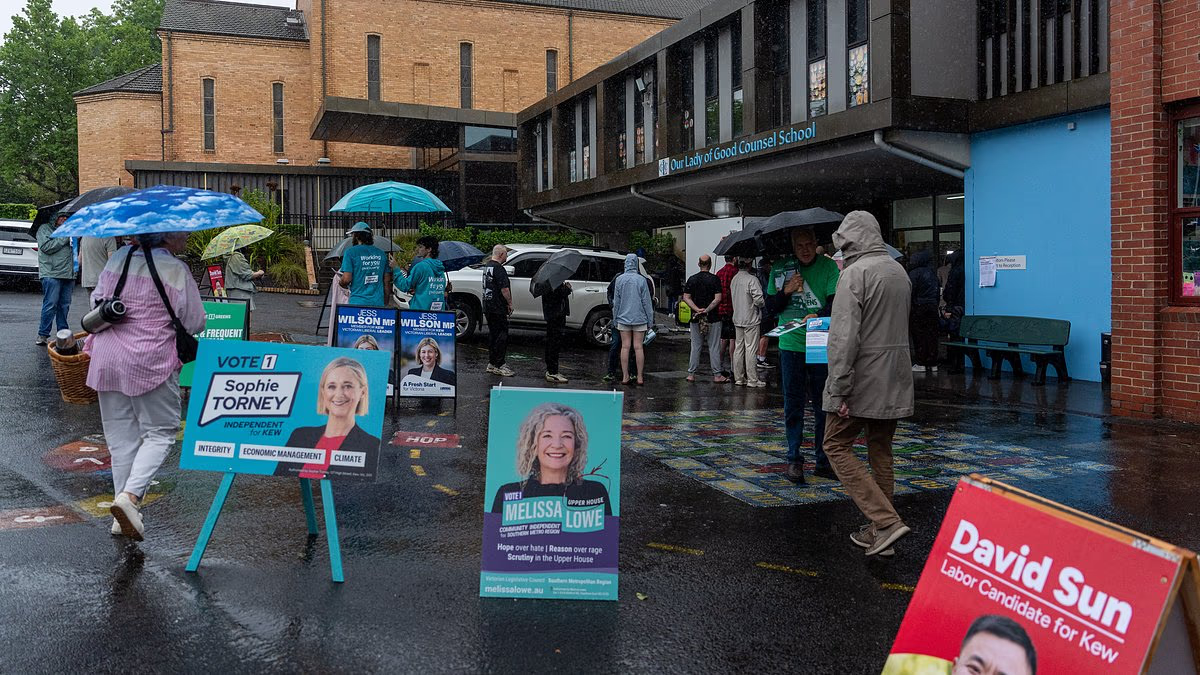
If you want an early indication tonight of whether Jess Wilson is heading for a comfortable majority or an extraordinary result, watch Box Hill rather than Pakenham.
That may seem counterintuitive, given Labor holds Box Hill by 7.2 per cent, while its margin in Pakenham is just 0.4 per cent.
Surely the most marginal seats should be the first places to watch? Not necessarily.
Wilson needs 45 seats to govern in her own right, while Pakenham is being contested by One Nation’s Victorian leader, Warren Pickering.
YouGov modelling gives Pickering and the Liberal candidate an equal chance of winning. Either way, Labor is almost certain to lose Pakenham.
The same largely applies to Bass, where Labor’s margin is even narrower at 0.2 per cent. One Nation is also in the contest there.
Among the seats Labor won narrowly last time, Hastings—with a margin of 1.4 per cent—is a more useful early gauge of whether Liberal gains are taking shape. Even so, a Liberal victory in Hastings would reveal little about the potential scale of a Coalition win.

Given Labor’s poor performance, these seats represent the obvious early gains.
In Melbourne’s eastern suburbs, attention will turn to seats such as Glen Waverley, which requires a 3.3 per cent swing to change hands, and Bayswater, where the required swing is 4.2 per cent.
The key is to compare the Liberals’ performance at booths that also reported results in 2022. A Liberal lead at a booth the party normally wins is hardly surprising.
More revealing would be a series of booths where Labor won comfortably four years ago but now finds itself behind, even if only a small share of the overall vote has been counted. That is the pattern I expect to see.
YOU MIGHT ALSO LIKE: Aaron Rodgers Responds After Tom Brady Calls Out Ex-Steelers Star
From there, attention will shift back to Box Hill and its 7.2 per cent margin, as well as to seats farther south.
Bentleigh, for instance, is held by Labor with an 8 per cent margin. If the Liberals are taking seats of that kind, a majority government will be almost certain.
The question then will be whether Labor is facing a wipeout.
To answer that, we will need to look further up the electoral pendulum at the ministers who may be searching for new jobs once every vote has been counted.
Premier Ben Carroll is far from secure in Niddrie, which he holds by a margin of 6.7 per cent.
If a premier loses a seat in Melbourne’s north-west on the same night the Liberals reclaim seats across the east, Carroll’s successor will face an unenviable decision about where to begin the rebuilding effort.
My first question after 6pm will be how many seats the Liberals are winning directly from Labor.
And who is capturing the rest? Are the Greens taking Labor seats in the inner city? Is One Nation managing to win lower house seats in traditionally safe Labor areas where voters seeking to register a protest would never support the Liberals?
Then there are the Nationals. Can they hold their regional seats against One Nation?
In some three-cornered contests, the result may not be clear until late in the night.
But the early trends in the seats outlined above should quickly show that Wilson has won—and whether her victory is merely decisive or truly overwhelming.


