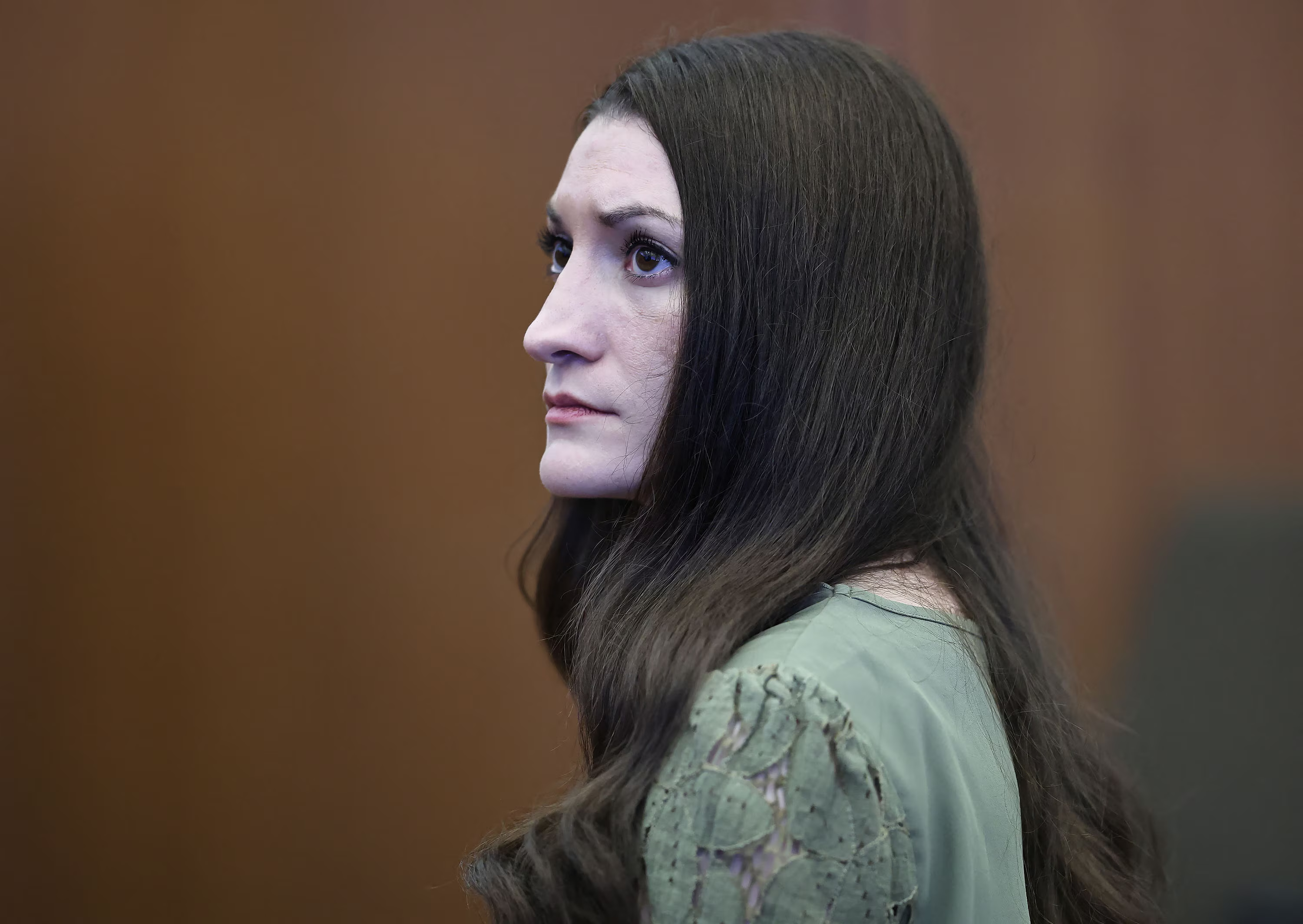

A juror from the Lindsay Clancy murder trial is offering new insight into the lone holdout whose refusal to join the rest of the panel ultimately led to a mistrial.
Paula Devlin, who served on the 12-person jury, described the holdout as a “quiet” man who spent some of his time watching videos on his phone and speaking with his wife, according to an interview published Sept. 11 by the Daily Mail.
“The main thing he focused on is sometimes we would all want to talk at once, and that was very upsetting to him,” Devlin told the outlet. “He would get upset and say, ‘Listen to what she’s saying, listen to what he’s saying, be respectful.’”
Devlin said other jurors tried to explain that they were not intending to be dismissive or rude during deliberations.
“We were trying to say to him that sometimes somebody says something and they get lost in their thought or they can’t find the right word, and somebody else puts that word in there for them or finishes their thought,” she said. “That’s how normal conversation works.”
But Devlin said those moments repeatedly derailed the discussion. “But when that would happen,” she added, “he would get upset and just take all this time lecturing us about not being respectful.”
Clancy admitted to strangling her three children—5-year-old Cora, 3-year-old Dawson and 8-month-old Callan—in January 2023. Her defense argued she was suffering from postpartum psychosis, while prosecutors contended the killings were deliberate.
The jury deliberated for seven days and reported being deadlocked three separate times. “He admitted he had reasonable doubt and I started filling out the forms, I was so excited,” jury foreperson Roni Carlson told NBC10 on Sept. 9. Carlson said the holdout then added, “But I’m still not going to say that she’s not guilty by reason of insanity.”
Devlin said no one objected to a juror reaching a different conclusion, but the rest of the panel struggled to understand the reasoning behind his vote.
“We asked the lone juror, what are the things that are making you think that she’s guilty, and we asked him, and he didn’t want to write on the board,” Devlin recalled. “He didn’t say a word, and so one of the jurors jumped up and said, ‘I’ll write for you,’ and then he said the things that he said, and then we talked about each one of those things.”
Among the issues he raised, Devlin said, was the volume of blood found inside Clancy’s home. Her lawyer had argued that after killing the children, Clancy cut her neck and wrists before jumping from a window in an attempted suicide.
“He thought there was too much blood in the bedroom,” Devlin said. “We had lots of testimony around the blood. We had a blood expert that was very compelling and she was really good at how she described it to us.”
“He said that he thought there was too much blood for the wounds that she had,” she added. “We all asked him what he meant by that, because we heard experts talk about the blood spatter and explain to us how it all was what it was supposed to be.”
Devlin said jurors were puzzled by the man’s alleged fixation on the subject.
“I feel that he didn’t make any sense,” she told the outlet. “I feel like if he could have pointed to one specific thing to show us, to back up what he was thinking or why he was thinking it, then all of us would have a different feeling.”
Devlin acknowledged how jurors could draw different conclusions from evidence: “That’s part of the process. It’s okay to disagree.”
The man went wrong, Devlin said, by allegedly refusing to apply reasonable doubt to his vote.
“If you say you have doubt, then you have to follow the law,” Devlin said. “And if you don’t follow the law, that’s not right. Can I say whether he understood that or not? I don’t know, because we didn’t have him explain it back to us.”
“We felt defeated,” she said. “And I can’t lie, there was definitely anger.”
On the day of the mistrial, Clancy’s defense attorney Kevin Reddington weighed in on the outcome.
“I don’t know, I don’t know the man,” Reddington told reporters. “I don’t know what his background, his feelings are. I don’t know. I mean, our jury system, we like to say that people have a right to have their opinions and stand by their beliefs. I don’t have a problem with that. I do have a problem where 11 hardworking jurors after all of those days of deliberation in a seven-week trial say that this man had doubt but still would not apply the law.”


