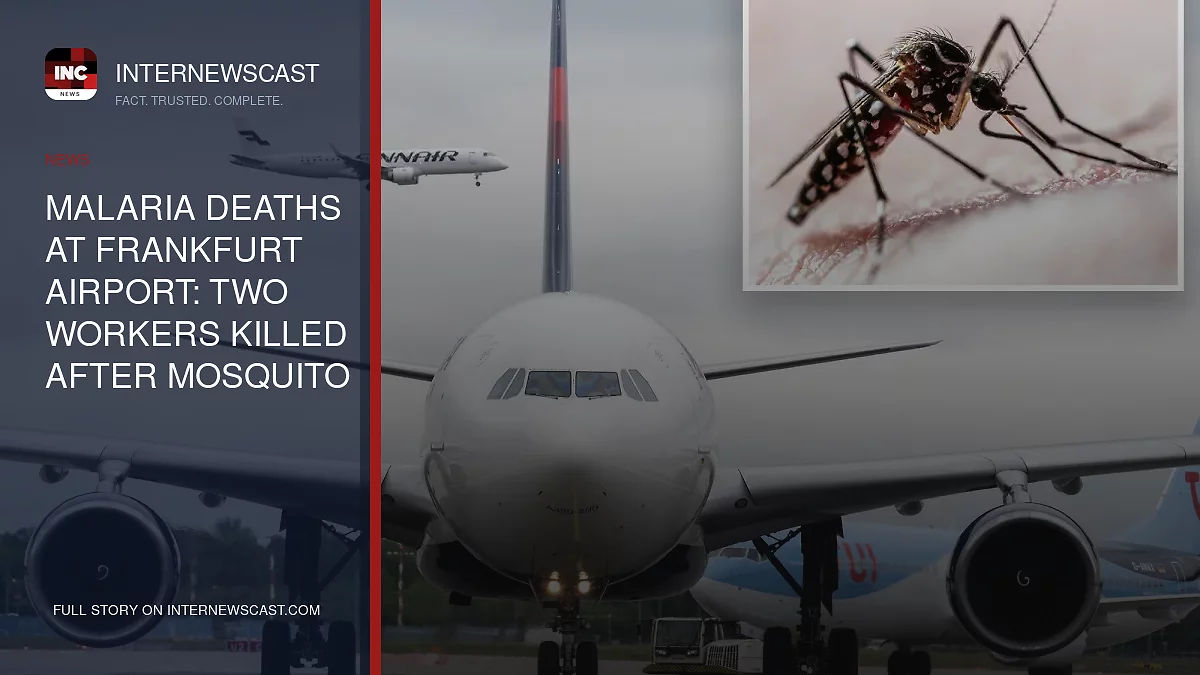

Two employees at Frankfurt Airport, Germany’s largest and busiest aviation hub, have died after contracting malaria in an unusual outbreak that authorities suspect may have been triggered by infected mosquitoes carried in on an aircraft.
A spokesperson for Fraport, the company that runs Frankfurt Airport, confirmed to the BBC on Wednesday night that the two airport workers died after becoming infected with the mosquito-borne disease.
The workers, whose names have not been released, were among those affected in a rare malaria cluster that airport officials said was first identified in July.
In all, six male employees working in different roles and sections of the airport tested positive for malaria during the outbreak, according to the BBC.
The remaining four workers who were infected have since recovered, German magazine Der Spiegel reported.
Health officials believe the infected mosquitoes likely entered the busy international airport aboard a plane, and investigators are now trying to determine whether the cases were caused by one mosquito or several.
Germany’s Robert Koch Institute, the country’s national public health agency, noted in a mid-July bulletin that four Frankfurt Airport employees developed malaria symptoms between July 4 and July 6.
The institute said the infections were presumed to have been transmitted by an infected Anopheles mosquito, commonly referred to as a marsh mosquito, that was likely transported by aircraft.
In Germany, malaria “almost exclusively affects long-distance travelers” who were infected by a mosquito bite in a malaria transmission area.
Airport malaria is rare, and the absence of a travel history in patients can lead to a delayed diagnosis. The last German case of airport malaria was documented at the Frankfurt Airport in 2023, the institute added.
“We have provided comprehensive information to all employees and encourage them to consult a doctor if they experience any symptoms,” the Fraport spokesperson told the BBC.
Traps have been placed throughout the travel hub, and mosquitoes that are caught will be analyzed in a laboratory to determine their species and origin.
Malaria can cause mild or life-threatening symptoms.
Mild symptoms include fever, chills, and headache. Severe symptoms escalate to fatigue, confusion, and difficulty breathing, according to the World Health Organization.
The disease, most common in tropical countries, typically spreads through bites of infected Anopheles mosquitoes. In some cases, it can be transmitted from person to person.
Fraport did not immediately respond to The Post’s request for comment.