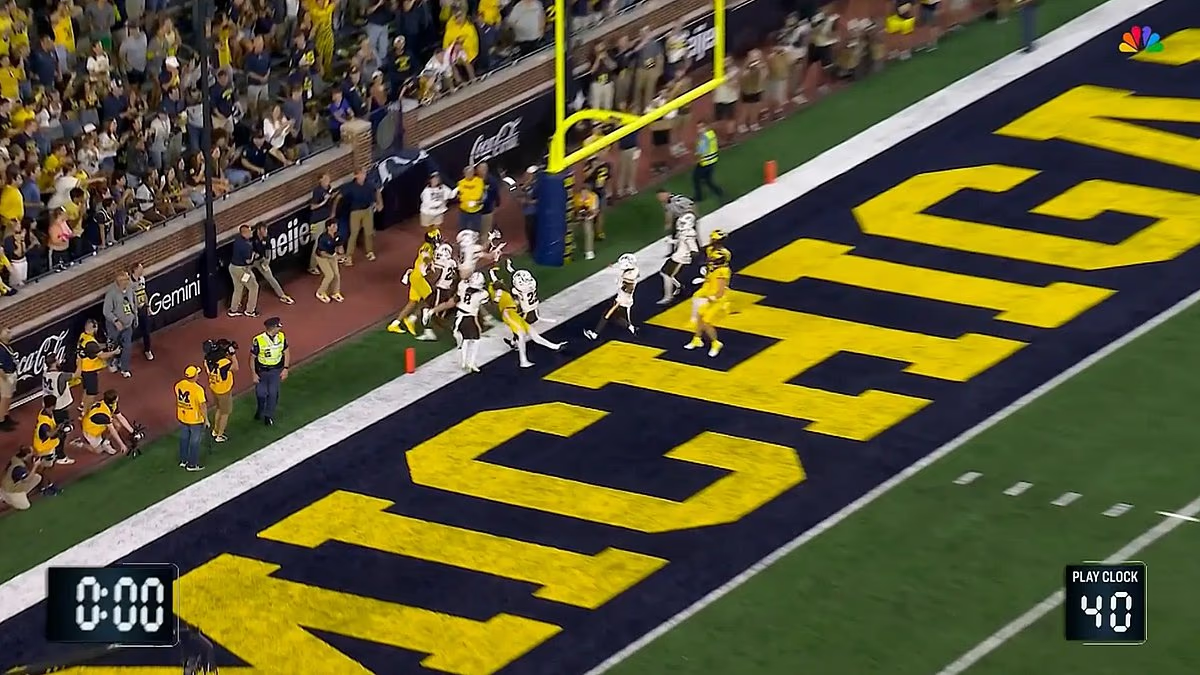

The debate over the chaotic finish to Michigan’s dramatic victory against Western Michigan shows no sign of fading from the college football conversation.
Western Michigan looked to be moments away from a stunning upset of the Wolverines after knocking down a last-gasp Hail Mary attempt as time appeared to run out.
Instead, officials made the surprising call to restore one second to the clock, handing Michigan one final chance. The Wolverines capitalized, as Bryce Underwood heaved a 47-yard pass into the end zone and connected with JJ Buchanan with the clock hitting zero once again.
The result was a stunning 13-12 Michigan win and a roar of celebration inside the Big House in Ann Arbor, though the aftermath has centered almost entirely on the officiating decision that made the final play possible.
Angry college football fans quickly took to social media, with many accusing officials of favoring Michigan, one of the sport’s wealthiest and most influential programs, and claiming the ending had been “rigged.”
The Big Ten later attempted to clarify the situation by releasing audio and video of the officiating crew discussing the call. Still, viewers were quick to point out what appeared to be a difference between the clock officials relied on and the game clock shown to the television audience.

The TV broadcast clock appeared to show 0:00 when the Hail Mary was knocked away

Michigan delivered a walk-off touchdown moments after the disputed clock ruling
The footage showed officials determining that Broncos No.18 Micah Davis had jumped from out of bounds, meaning the play was over as soon as he touched the ball.
They then flicked up the game clock and said, ‘When 18 is touching the football we’ve got one second on the clock’. That was seemingly not the case on the game clock seen by viewers on TV.
A Big Ten statement accompanying the footage said: ‘Following video review, it was determined Western Michigan’s #18 started his jump from an established out-of-bounds position (left foot) and made contact with the ball with one second remaining on the clock.
‘As shown in the provided video of what was viewed during the replay process, a side-by-side view of the play and the game clock, using a direct shot of the game clock in the stadium, was used to determine the final ruling.
‘Eighty-five minutes prior to the game, all broadcast cameras used for the replay system, including the camera on the game clock, are synced using a strobe system to ensure all cameras are aligned,’ it added.
The Big Ten cited NCAA football rule 4-2-3-a that a ‘ball not in player control, other than a kick that scores a field goal, is out of bounds when it touches the ground, a player, a game official or anything else that is out-of-bound, or that is on or outside a boundary line.’
One fan immediately asked: ‘Why is this clock completely misaligned with the clock the broadcast had, which they confirmed was in sync with the official game clock?’ as another said: ‘Oh ya you have a special clock only you can see the rest of us can’t, so that’s all that matters…’.
Despite numerous responses still questioning the explanation, passionate Michigan fan Dave Portnoy responded: ‘It’s objectively hilarious that people thought Michigan, the crown jewel of college football, would blatantly cheat to win a football game. Integrity and character will always come before winning at Michigan. That what makes Michigan Michigan.’

Michigan’s late win sparked bedlam inside the Big House in Ann Arbor after the dramatic finish

Western Michigan was denied one of the biggest college football upsets of all time
And MAC commissioner Jon Steinbrecher said both he and officials from Western Michigan accepted the Big Ten explanation of the decision after reaching out for more information.
‘I commend Western Michigan for the outstanding effort and a well-played game, and I offer my congratulations to Michigan,’ he said in a statement.
‘I also appreciate the collaborative efforts of the Big Ten office and its prompt response in reviewing the play and providing the requested clarification.’
NBC rules analyst Terry McAulay was also confused as to what occurred on the broadcast, offering the new theory that the two game clocks were not aligned related to the Hawkeye system now used to register first downs.
‘Our producer tells us that our in-set clock is in sync, is the actual the stadium clock,’ said McAulay. ‘The ball isn’t even close to touching a player when it goes to zero.
‘Now, their Hawkeye system apparently either had different sync or whatever, and they came up with one second when it touched the player. I don’t see how that happened, assuming our clock is correct. It is clearly not touching a player. The ball is clearly still in the air when the clock goes to zero on our screen.
‘So you know, the Big Ten is gonna have to tell a lot of us, how did they get to one second on this play?’