
‘You can tackle harder.’
When my son Logan was five, he was big and strong for his age and adored football. As his coach, I tried to offer advice that might improve his game. ‘I don’t want to hurt anybody,’ he told me.
That was Logan: gentle, cheerful and easygoing. To us, he was an absolute angel.
In 2015, around the time the right side of his face began to droop, my wife Heather and I feared he had suffered a stroke. Doctors eventually diagnosed him with a rare form of Bell’s palsy.
For a while, Logan couldn’t blink and had to wear an eye patch. He loved it. ‘I’m a pirate,’ he said with a grin. Even a frightening medical episode couldn’t dim his spirit.
By the holiday season, Logan had recovered from Bell’s palsy and was eagerly anticipating Christmas. He had turned six on November 1, and we’d already put up the lights at our Kentucky home. All he wanted was a pair of Hulk hands.
On December 7, Heather was working an overnight shift at the factory. I stayed home with Logan and his siblings: his three older sisters, Koral, 11, Lilly, 8, and Dakota, 7, along with his four-year-old brother, Aiden.
At about 3.30am, Lilly rushed into our bedroom screaming, ‘Daddy, there’s a man upstairs.’

At five years old, Logan (front left) was big and strong for his age and loved football

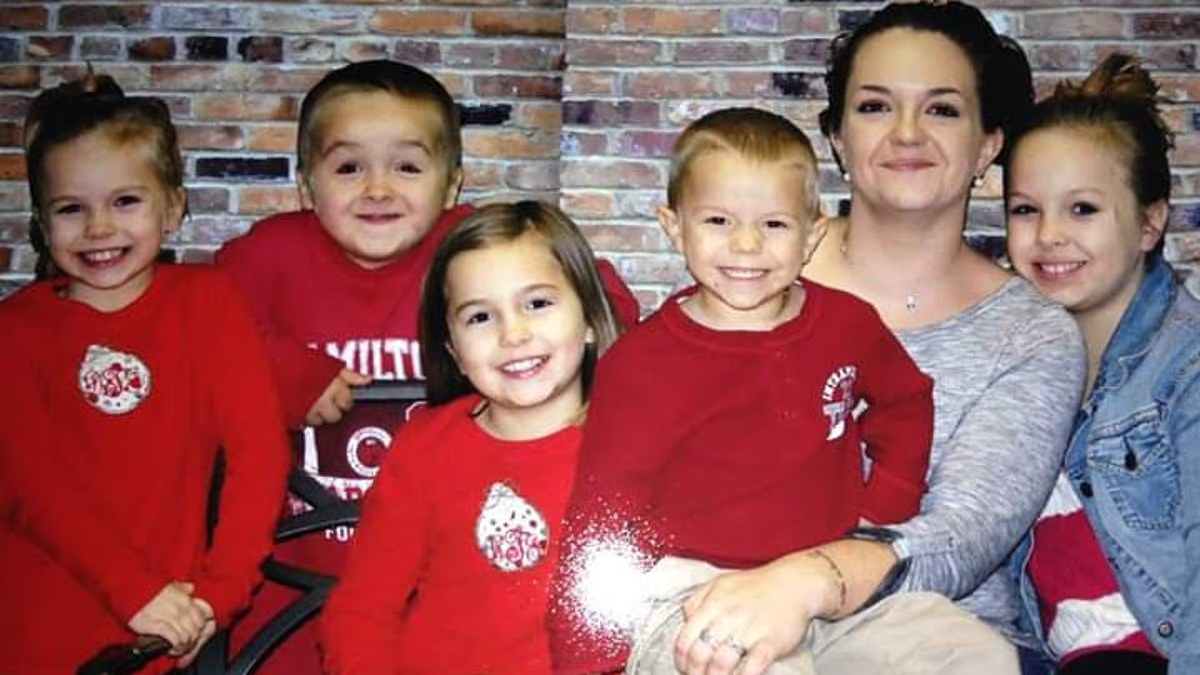
Heather was working overnight at the factory, leaving me to care for Logan (second from left), Koral (far right), 11, Lilly (third from left), 8, Dakota (far left), 7, and Aiden (on his mother’s lap), 4, the night Logan was killed

Logan had turned six on November 1 and was excited for Christmas. But on December 7, 2015, his life was taken
I assumed she had been dreaming. I went to look beneath her bed, intending to prove to her—and to myself—that nobody was there.
As I reached the top of the stairs, I heard a man roar, ‘Clean your f***ing rooms!’ A large, dreadlocked man with glowing yellow eyes then charged at me. He drove a carving knife toward my chest, but I managed to seize his hand.
‘Koral, get everyone into my bedroom and call the police!’ I shouted as I slammed the intruder against the wall. I wrenched the knife away and threw it aside before wrestling him to the floor. Suddenly, Koral appeared with a rolling pin.
The attacker sprang up, grabbed me and hurled me about 15 feet across the room. He then turned toward my daughter. I scrambled up, jumped onto his back and locked my arm around his neck. When he fell face down, I squeezed as hard as I could. The force tore my bicep from the bone.
Police arrived within 90 seconds of Koral’s 911 call and ordered me to get off him. ‘You get control first,’ I yelled. Several officers piled onto the man while I ran downstairs to check on the children. Koral met me halfway. ‘Daddy, I left Logan,’ she sobbed.
Logan could sleep through an earthquake, so I assumed she simply hadn’t been able to wake him.
I ran past five officers struggling to restrain the man, even after tasering him, and entered the bedroom Logan shared with his four siblings. When I lifted him, I saw that he was covered in blood. He gasped horribly for breath. ‘Help!’ I screamed.
I held Logan in my arms as he looked directly at me, drew one long breath and died. An officer began CPR, but I knew we were already too late.
Consumed by rage, I ran back to the handcuffed intruder and tried to kick him. Then I spotted the knife and grabbed it. I was about to kill him when two officers brought me down.
At the hospital, Koral was sobbing with a slash across her nose, while Dakota had a deep cut on her back. I was still in shock but tried to comfort them. When Heather arrived, I heard her cry, ‘Where’s my baby? Take me to my son!’
She had only been told that Logan was injured. When I saw her, I wept, ‘I’m so sorry. Someone broke in and killed Logan.’ She screamed and collapsed to her knees.

Logan was gentle, cheerful and easygoing—the absolute angel of our family

Heather with her sons, Logan (left) and Aiden (right)
The following day, police told me the attacker was Ronald Exantus, an educated and respected dialysis nurse who lived and worked in Indiana. ‘We don’t know why he did this,’ a detective said. ‘All he said was that he saw a sign for “Gray Street,” thought of the television show Grey’s Anatomy and decided he needed to perform surgery.’
None of it made sense.
Exantus, who was 32, had entered through an unlocked door, taken several kitchen utensils—including a butcher knife and a butter knife—and gone upstairs.
He stabbed Logan eight times in the back of the head and the side of his neck. Koral woke to her brother’s screams. Acting bravely, she kicked Exantus, a former semi-professional linebacker, and seized the butter knife before he slashed her.
At some point, Koral handed the knife back to Exantus. He ran it up her stomach and cut her nose with it. During the chaos, he also attacked Dakota, slicing her back.
Logan’s funeral became one of the largest Versailles, a town of just over 9,000 people, had ever witnessed. It had to be moved from the community church to the local football stadium, where more than 4,000 people came to pay their respects.
Earlier that year, when I ordered football jerseys for Logan’s team, two of them had accidentally been printed with his number, 63.
‘Let’s bury him in his jersey,’ I suggested to Heather, and she agreed. She held our traumatized family together with extraordinary strength and love. I could barely function. I wanted to die so I could be with my son.
Some of Logan’s young teammates were so frightened by the attack that they became afraid to go to bed. Their parents called, and I reassured the boys that they were safe and encouraged them to get some sleep.

Police identified the attacker as Ronald Exantus, an educated and respected dialysis nurse who lived and worked in Indiana
Tests found marijuana as the only drug in Exantus’s system. However, defense witnesses acknowledged that he might have taken a substance the laboratories did not test for at the time.
In February 2018, Exantus admitted killing Logan and breaking into the house and assaulting me and the girls. He nevertheless pleaded not guilty by reason of insanity. Even his own expert could not identify a specific mental illness.
A clinical psychologist hired by the defense said Exantus may have been suffering from schizophrenia, schizoaffective disorder, bipolar disorder with psychosis or major depressive disorder with psychosis during the attack. But he could not settle on a definitive diagnosis.
Court documents stated that Exantus’s then-fiancée and other people close to him had noticed that his behavior became ‘erratic and unstable’ in the days before the attack.
The normally ‘responsible’ and ‘dependable’ Exantus had stopped eating and was experiencing sudden, uncontrollable bouts of crying. He struggled to communicate and said things that made no sense to those around him.
An officer testified that Exantus read everything aloud on the drive to the police station. At the jail, another officer said, he continued reading every sign and notice on the walls—’anything that was posted.’
Once in custody, Exantus—who had grown his dreadlocks for 12 years as a tribute to his Haitian heritage—ripped them out with his bare hands, authorities said.
Yet in court, he appeared to be an ordinary man. We were devastated when the jury found him not guilty of murder and burglary by reason of insanity.
The jury did find him guilty of all three assaults, though mentally ill. That meant he was considered criminally responsible for those offenses while also having a mental illness that did not meet the legal standard for insanity.
IN CASE YOU MISSED IT: Jensen Huang Disclosed Additional Matters to Board Before Return
‘How can he be not guilty and guilty at the same time?’ Heather sobbed. Explaining to the children that the man who killed their brother would not be punished for murder was among the hardest things I have ever done. We couldn’t understand the verdict, and neither could they. Politicians and lawyers publicly condemned the split decision.
At Exantus’s 2018 sentencing hearing, Heather told him, ‘When you killed Logan, you slaughtered my entire family.’ She called him a ‘coward’ who had ‘got away with murder.’
Our family attended court wearing white T-shirts bearing Logan’s face and the words, ‘We demand justice for Logan.’
That day, however, we did not receive it.
Exantus did not speak at the hearing. He received 10 years for assaulting Koral, 10 years for assaulting Dakota and credit for time served for assaulting me.

Exantus received 10 years for assaulting Koral, 10 years for assaulting Dakota and credit for time served for assaulting me

Heather with her children in the car: Koral in the passenger seat and Aiden, Dakota and Logan pictured left to right in the back
The sentences were consecutive, amounting to 20 years, with a projected release date of November 2035. But because he had already spent time in custody awaiting trial, he became eligible for parole in 2019.
Because the assaults on me and the girls were classified as low-level offenses, Exantus was not designated a violent offender. He could also reduce his time through good behavior.
‘When his sentence ends, he’ll go directly to a secure psychiatric unit and never get out,’ a prosecutor assured me. By then, though, I had lost faith in the American justice system.
The system had effectively declared the man who admitted stabbing my son to death innocent. ‘I can’t accept this,’ I told Heather. ‘I’ll make sure it doesn’t happen to another family.’
Soon afterward, I began campaigning for Logan’s Law. The proposed legislation would ban split verdicts, make mental-health defenses more difficult to establish and impose tougher sentences.
Remarkably, Exantus appealed, arguing that his sentence was too long. He lost that appeal and every parole application he filed over the following years. In September 2025, he was due to apply for parole for the fifth time.
Lilly, then 18, contacted the parole board to learn the hearing date. She called me afterward, crying hysterically. ‘Daddy, there isn’t a hearing. They’re just going to release him,’ she said. ‘That can’t be right,’ I replied, although our experience made me afraid that it was.
I contacted the prosecutor. The parole board had voted to keep Exantus imprisoned. But under a 2012 Kentucky law, he qualified for a form of parole known as mandatory re-entry supervision.
The law allowed model prisoners like Exantus—who mentored inmates, completed self-improvement programs and maintained a good disciplinary record—to earn additional reductions in their sentences.
We were furious, and so were many others.
Former White House Press Secretary Karoline Leavitt posted on X that the Trump administration was examining Exantus’s release. ‘It’s wholly unacceptable for a child killer to walk free after just several years in prison,’ she wrote.
Despite support from the media, attorneys, members of the public and local politicians, including Rep. TJ Roberts, there was nothing we could do.
Heather worked in a factory, and I worked on the roads. ‘We’re just working people,’ I said bitterly. ‘If he’d killed a judge’s son, he’d be buried in the system forever.’
On October 1, 2025, Exantus was released under mandatory supervision until his sentence expired in June 2026.

On October 1, 2025, Exantus was released under mandatory supervision until his sentence expired in June 2026
I called the prosecutor in Marion County, Florida, where Exantus had been released.
‘You have a baby killer in your jurisdiction,’ I said.
Exantus was required to register with local police as a convicted felon, but he failed to do so. The violation led to his arrest and return to jail. Incredibly, he had been permitted to live in a house beside an elementary school.
‘Hopefully this violation wipes out his good-behavior credit and means he now has to serve the full 20 years,’ I told Heather.
In April 2026, while we waited for more information, Logan’s Law passed. I attended the ceremony when Gov. Andy Beshear signed the bipartisan legislation, which eliminated split verdicts and abolished mandatory re-entry supervision for anyone found guilty of two or more violent offenses.
Under Logan’s Law, people serving life sentences must complete at least 30 years before becoming eligible for parole.
The law also requires defendants found guilty but mentally ill to undergo mental-health evaluations before they can be released.
On July 29, 2026, an attorney from the prosecutor’s office called to say that a psychiatrist was evaluating Exantus for release that morning.
‘If he is judged sane, he’ll be released,’ the lawyer said.

Logan’s Law, passed in April 2026, requires people with life sentences to serve at least 30 years before becoming eligible for parole

Our family wore white T-shirts bearing Logan’s face and the words, ‘We demand justice for Logan.’ But we did not receive justice that day
Unfortunately, Logan’s Law could not be applied retroactively to Logan’s case.
At 1.30pm, the prosecutor called back. Exantus had been deemed sane and was now free, with no supervision. ‘How do we know he won’t become ill again?’ Heather asked. The man who openly admitted to killing our little boy had spent fewer than 11 years in prison.
One of his former lawyers later said publicly that Exantus had a genetic form of schizophrenia but was taking medication. I keep asking, ‘What happens if he stops taking it?’ No one seems able to answer.
All we can do is hope he continues taking it—and wait.
Logan’s brother Aiden, now 15, plays football and wears number 63 in his memory. I remain in contact with some of the boys I comforted that night. They are young men now. I love seeing them, but it is painful knowing Logan is not here with them.
My one responsibility as a father was to protect my children. No matter what anyone tells me, I feel that I failed.
If Exantus ever comes back, I will deliver the justice the system failed to provide.
That man will not leave my home alive.
As told to John Parrish


