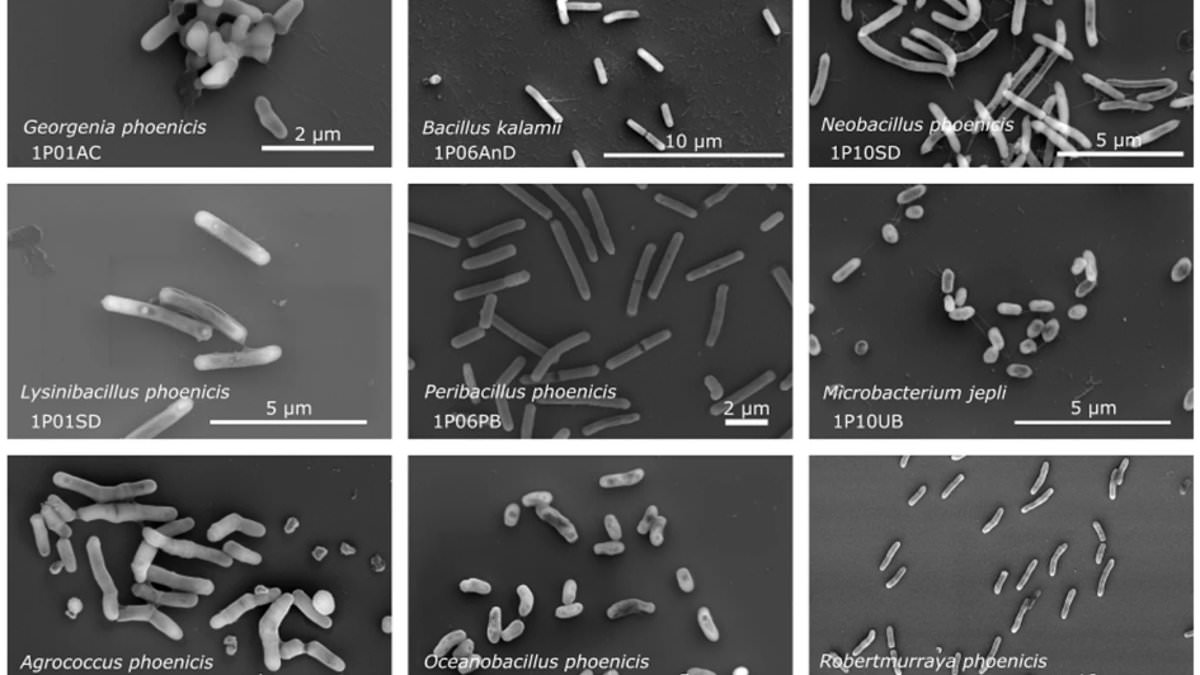

NASA’s cleanrooms, renowned for their sterility, have surprisingly become the birthplace of discovery, as scientists have identified numerous new bacterial species within them.
These cleanrooms are meticulously sanitized environments where spacecraft and delicate instruments are constructed and evaluated, ensuring an ultra-clean setting.
The primary function of these controlled areas is to eliminate any contamination risk and prevent microorganisms from being transported to other celestial bodies.
Therefore, researchers were astonished to uncover 26 previously unidentified bacterial species residing in the cleanrooms of the Kennedy Space Center in Florida.
Despite rigorous protocols such as air filtration, strict control of temperature and humidity, and the application of potent chemical cleaners, these resilient microbes have managed to endure.
“It was a genuine ‘stop and re-check everything’ moment,” Alexandre Rosado, a bioscience professor at King Abdullah University of Science and Technology (KAUST) in Saudi Arabia, shared with Live Science.
Recent analysis of these microbes has shed light on how they can live – and even thrive – in one of the harshest man-made environments on Earth.
And it turns out they have genes that help them resist the effects of radiation and even repair their own DNA.

A selection of the 26 new bacterial species discovered in the cleanroom, despite the facility being ultra-sanitised and highly controlled

The Phoenix Mars Lander in the cleanroom at the Kennedy Space Center. This photograph was taken in 2007, when bacterial samples were collected from the floor
The main goal of cleanrooms is to stop Earth’s organisms contaminating other planets that could potentially contain life.
They also play a crucial role in protecting Earth from potential alien hitchhikers in returned samples.
However, ‘cleanrooms don’t contain “no” life’, Professor Rosado said. ‘Our results show these new species are usually rare but can be found.’
The new species were identified lurking in cleanrooms where NASA assembled its Phoenix Mars Lander in 2007.
They were collected and preserved at the time, and recent advances in DNA technology has allowed scientists to properly analyse them.
The findings, published in the journal Microbiome, read: ‘Maintaining the biological cleanliness of NASA’s mission-associated cleanrooms, where spacecraft are assembled and tested, is critical for planetary protection.
‘Even with stringent controls such as regulated airflow, temperature management and rigorous cleaning, resilient microorganisms can persist in these environments, posing potential risks for space missions.’
The next step, experts said, is to figure out whether any of these tiny organisms could have potentially tolerated conditions during a journey to Mars’ northern polar cap, where Phoenix landed in 2008.

This image shows Phoenix hanging from its parachute as it descended to the Martian surface in 2008

Experts said the next step is to work out whether any of these microorganisms could have survived the trip to the Red Planet. Pictured: The Phoenix Lander on Mars
Professor Rosado said several species do carry genes that may help them adapt to the stresses of spaceflight.
But their survival would depend on how they handle the harsh conditions of the journey and on the Red Planet itself, including exposure to vacuum, deep cold and high levels of UV.
To explore this further, the team plan to test the microbes inside a ‘planetary simulation chamber’ that could reveal whether they could survive a trip through space.
One is currently being built at JAUST, with its first experiments expected to commence in early 2026.
The team said that beyond space exploration, these microbes hold ‘immense promise’ for biotechnology as their resistance to radiation and chemical stressors could drive innovations in medicine, pharmaceuticals and the food industry.