
Share this @internewscast.com
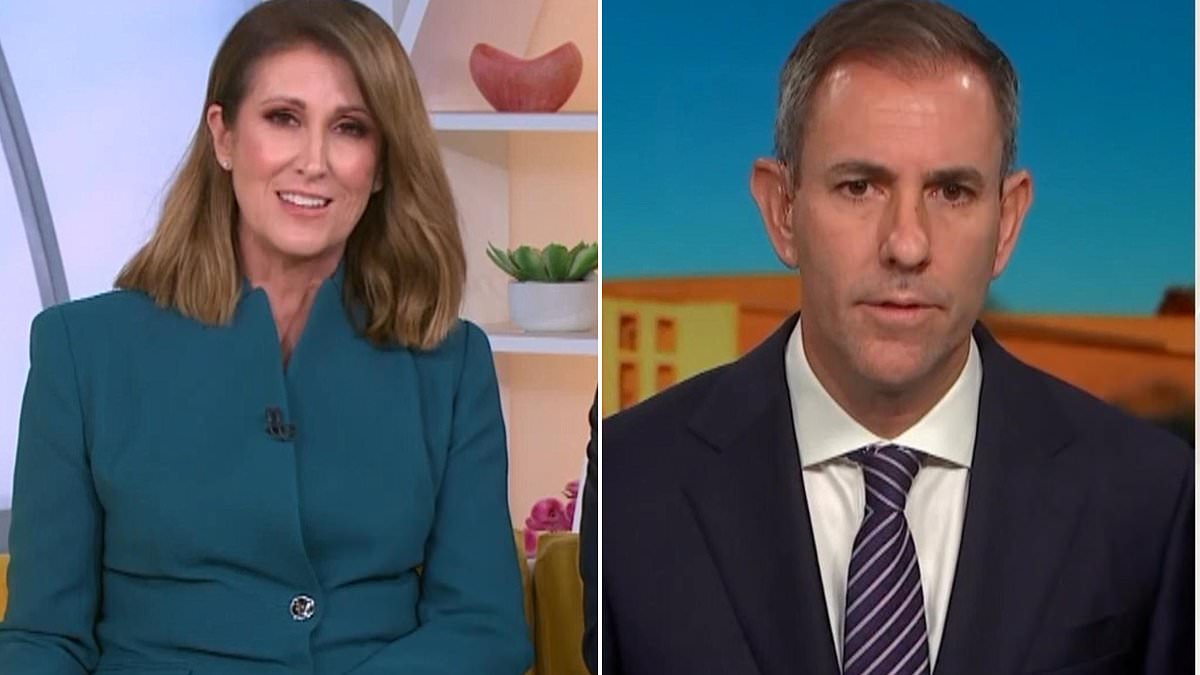
Sunrise host Natalie Barr took a firm stance against Treasurer Jim Chalmers in response to mounting opposition claims that government spending is fueling inflation and triggering interest rate hikes.
The Reserve Bank of Australia (RBA) has increased interest rates for the second consecutive month, cautioning that Australians could endure further financial strain if the conflict in the Middle East persists.
On Tuesday, the RBA’s monetary policy board opted to raise the cash rate by 25 basis points to 4.1 percent. This decision, passed by a narrow five-to-four margin — the closest vote since the Central Bank began releasing vote counts — follows a similar increase in February.
The latest 25 basis point hike translates to an additional $90 per month for a typical $600,000 mortgage on an owner-occupied home. Combined with February’s increase, homeowners with an average loan are now facing approximately $180 extra in monthly payments compared to December.
“Are you spending too much? Because every man and his dog is saying that,” Barr questioned Chalmers during their Wednesday morning exchange.
Chalmers countered, asserting that the current inflation issues stem from two primary factors, rather than excessive government expenditure.
‘We’ve got two parts to this inflation challenge. Before the escalation of hostilities in the Middle East, we had an inflation challenge, primarily towards the end of last year, because the private sector recovered quickly, quicker than people were anticipating, not because of an increase in public spending,’ he said.
‘And then obviously, in the last couple of weeks, that inflation challenge has gotten harder, particularly at the petrol bowser, because of the global oil price and for other reasons.’

Sunrise host Nat Barr has lashed out at the federal treasurer amid concerns the Albanese Government’s spending is to blame for rising interest rates

Jim Chalmers said the government is not anticipating Australia to experience a recession
Chalmers added: ‘So we more than acknowledge the pressures that people are under. This decision, which would have disappointed a lot of people yesterday from the independent Reserve Bank, more than acknowledges the pressure that adds to people’s household budgets.’
But Barr pushed back, arguing the latest rate rise was not linked to fuel prices.
‘But this interest rate rise had nothing to do with fuel. You acknowledge that, don’t you? The RBA Governor said that yesterday. So this is on you, isn’t it?’ she said.
Chalmers replied: ‘Well, what the Governor said yesterday is what I’ve said repeatedly for some time now, that we had an inflation challenge in our economy before the escalation of hostilities in the Middle East.’
Barr continued to press the Treasurer, claiming many Australians believed Labor had been ‘spending like crazy’.
‘But you’re not acknowledging that your government has been spending like crazy. Government spending is at a decades-high. Consumer confidence in this country is the lowest since 2020. Do you think you’re accepting your own responsibility for that?’ she said.
Chalmers pushed back, insisting the government had improved the budget position since coming to office.
‘I’m accepting my part in the fight against inflation and all aspects of my job, including the fact that we’ve got the budget in much better condition. When we came to office, spending as a share of the economy was up near a third of the economy. We’ve got it down closer to a quarter,’ he said.
Join the debate
Should government spending be scaled back to protect Australians from rising interest rates and inflation?

RBA Governor Michelle Bullock announced on Tuesday the bank would lift rates to 4.10 per cent
Barr raised concerns about recession risks and said the Reserve Bank Governor had been questioned about the prospect of an economic downturn.
‘The point the Governor made yesterday, and the point the Reserve Bank’s forecasts make, is that they are not anticipating a recession, nor is the government. But there is a lot of risk in the global economy right now, and we’ve got to get on top of this inflation challenge,’ he said.
It comes as experts have pointed to the RBA’s split vote as a sign of tensions within the board between inflation hawks and economic doves.
‘How events in the Middle East play out in terms of the severity and the duration of the energy price shock will be important with the Bank noting there’s “a wide range of possible scenarios”,’ he said.
‘Future decisions will hinge on these geopolitical developments just as much as domestic inflationary pressures.’
The RBA’s counterparts in the US, UK, European Union, Japan, Canada, Switzerland and Sweden are all expected to leave rates on hold this week when they meet. However all are on alert.
Matt Grudnoff, Senior Economist at The Australia Institute, said the Reserve Bank had made the wrong decision.
‘Inflation caused by a supply shock cannot be brought down by increasing interest rates. How can increasing Australian interest rates open the Strait of Hormuz?’ he said.
‘All this increase in interest rates will do is heap more misery on Australian mortgage holders who are already being hurt by higher fuel prices.
‘The RBA needs to be honest with the Australian people that nothing it can do will reduce inflation caused by a world oil price shock.’