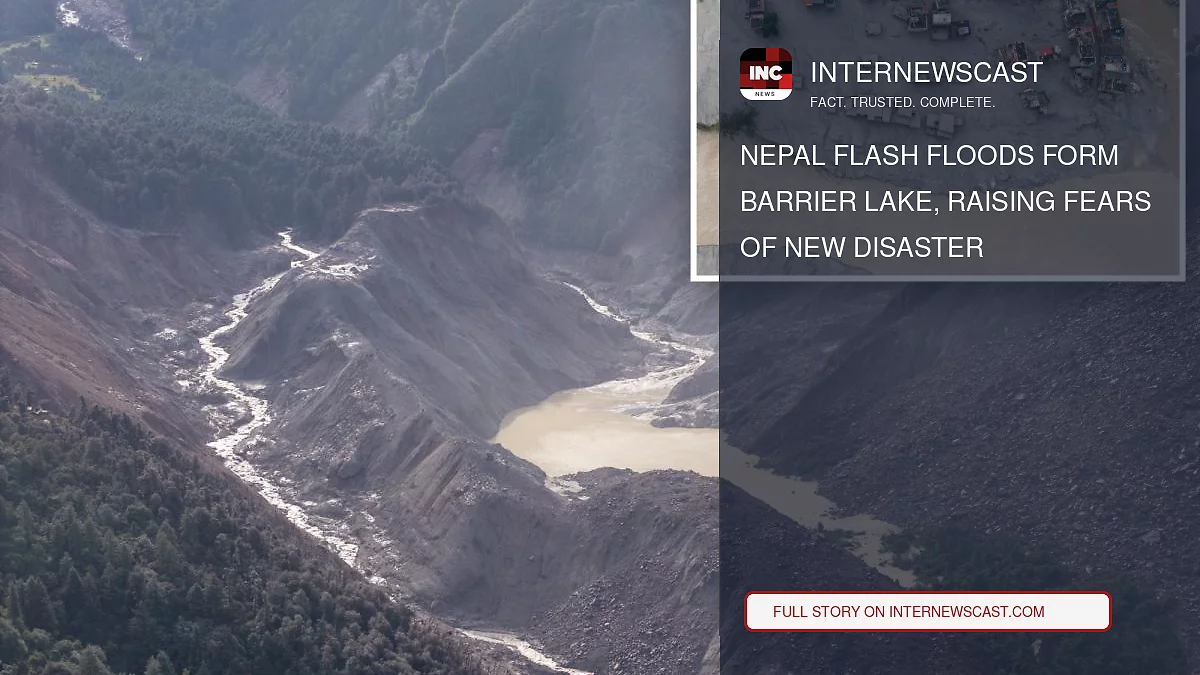

A deadly flash flood in Nepal has raised fresh concerns that more danger could be building upstream, after rock, mud and debris cascading from the mountains on Wednesday may have created a barrier lake where two rivers converge. Officials and scientists warn the natural dam could be overtopped, potentially unleashing a second wave of flooding.
China’s Ministry of Water Resources said Wednesday on CCTV News that a landslide dam posing a “high risk of breaching” is obstructing water flow near the confluence of the Tsogyal River and the Purupqiangzangbu River.
Specialists at the International Centre for Integrated Mountain Development cautioned that the newly formed blockage, along with other unstable obstructions across the region’s complex river networks, could set off another disaster if water continues to build behind them.
The barrier lake at the river junction is already spilling over, officials said. It is believed to be holding roughly 2 million cubic meters of water, with an additional 3 million cubic meters expected to flow into the lake over the next 72 hours.
The Chinese ministry said it is closely tracking conditions in the aftermath of Wednesday’s catastrophic flash flood, which Nepali officials described as “devastation beyond imagination.”
Scientists suspect the disaster was triggered by the collapse of an upstream glacier, sending what Bishal Nath Upreti, a geologist at Tribhuvan University in Kathmandu, called a 300- to 650-foot-high “tsunami from the sky.” Upreti described the event as “one of the largest disasters in Nepal.”
Nepali police said more than 350 people have been killed, while over 1,300 remain missing — 826 in Nepal and 558 in China-controlled Tibet. Among those unaccounted for are hundreds of tourists from countries around the world.
Nepal’s tourism board said 54 Americans have been confirmed dead in the flooding so far, and at least 65 others remain missing.