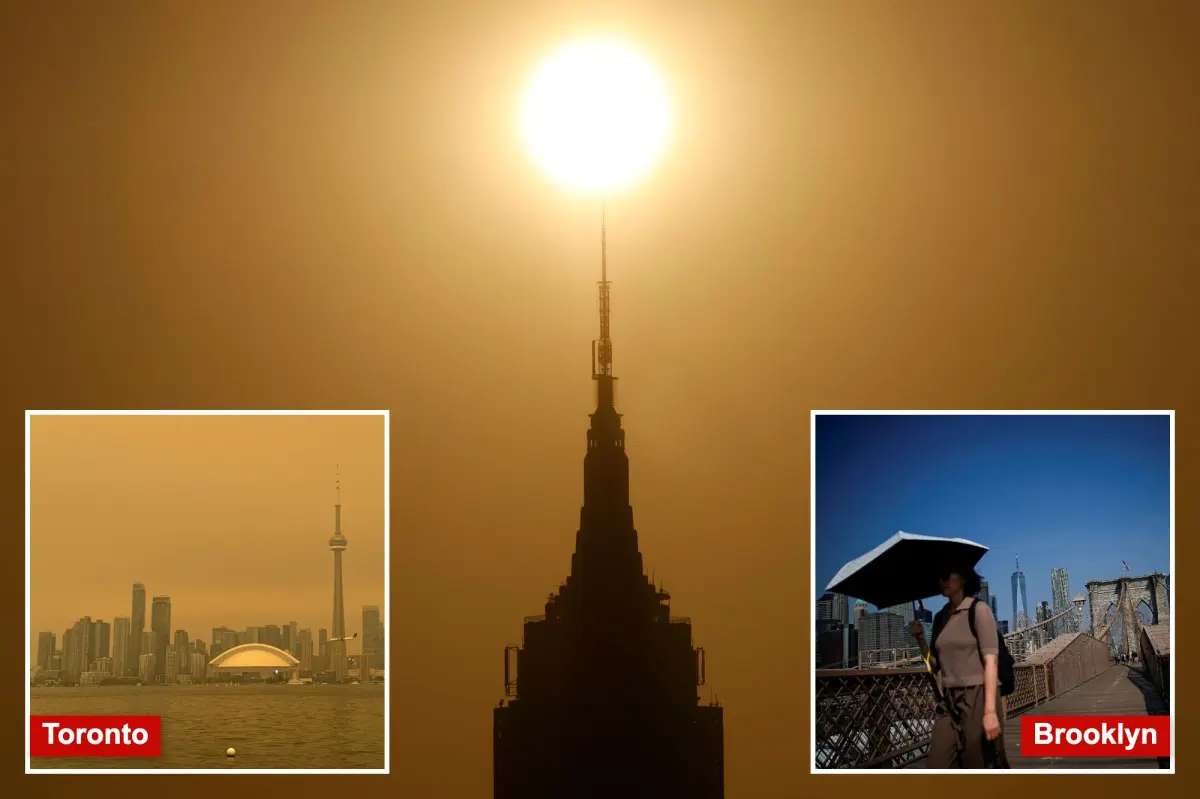

New York’s skies are expected to look worse before they begin to clear.
New York City is now under an Air Quality Health Advisory as wildfire smoke from Canada and the Great Lakes region drifts into the area, spreading a smoky veil over the Big Apple.
According to the city’s Office of Emergency Management, air pollution climbed to the “Unhealthy for Sensitive Groups” category around 11 a.m. and is forecast to linger at that level until roughly 11 p.m.
The smoke, visible as it moves across New York State, has softened the city’s normally bright summer sky into a washed-out haze.
Officials expect the Air Quality Index, or AQI, to remain between 101 and 150 on Wednesday — well below the alarming 465 “Hazardous” reading that blanketed the metro area in orange skies during the Canadian wildfire smoke crisis in June 2023.
Still, this latest wildfire smoke event is arriving at the same time as an ongoing heat wave, with temperatures across New York City expected to approach 100 degrees on Wednesday.
The city has also issued a heat advisory and put its heat emergency plan into effect. If the smoke thickens, however, it could slightly reduce temperatures by limiting some of the sun’s strongest rays.
NYC Emergency Management cautioned that the extent of ground-level smoke impacts remains uncertain, but warned that poor air quality may create health risks, particularly for people with respiratory conditions such as asthma or other lung diseases.
“Every New Yorker has a different risk profile, and this week you need to know yours,” NYC Emergency Management Commissioner Christina Farrell said Tuesday. “If you’re sensitive to air quality, don’t remain in a space without air conditioning or filtration.”
“And if you’re in a population vulnerable to heat, older adults, young children, people with chronic conditions, take the heat seriously too,” Farrell added. “In both cases, you should get to a cool indoor space, and if you don’t have one at home, a cooling center is open near you.”
So far, at least 17 wildfires have eaten thousands of acres across Minnesota –– the five largest of which have consumed at least 30,000 acres, officials said.
Canada is suffering its own swath of fires after two of the largest US flames — the Bear Trap and Thumb fires — jumped the border.