
Share this @internewscast.com
Australians may soon face petrol shortages if the ongoing conflict in Iran continues to disturb global energy supplies.
Across the nation, fuel prices have spiked, with unleaded petrol surpassing $2.20 per liter and diesel climbing beyond $2.60, as the turmoil affects worldwide supply chains.
A crucial shipping lane, the Strait of Hormuz, has been blocked due to the conflict. This passage is vital for transporting about one-fifth of the global crude oil supply.
The International Energy Agency reports that approximately 20 million barrels of crude oil and petroleum products navigate through the strait daily, representing around 25% of the world’s seaborne oil trade.
However, the conflict has significantly hindered oil transportation through this route, and there are few alternative paths to circumvent this critical passage.
In a bid to counteract the disruption, the International Energy Agency’s 32 member countries recently agreed on a temporary solution. They plan to release 400 million barrels from emergency reserves to stabilize global oil prices and ensure supply continuity.
Deakin Law School energy policy expert Professor Samantha Hepburn said fuel rationing would become likely if the latest Middle East conflict does not end quickly.
‘Our short-term buffer will obviously not survive a prolonged war and we’re going to have to immediately switch to rationing,’ Professor Hepburn told the ABC.

Deakin Law School energy policy expert Professor Samantha Hepburn said there will be fuel rationing
Professor Hepburn also warned diesel would be the first fuel to face purchasing restrictions, as the military, essential service vehicles, transport operators and farmers would need to be given priority.
‘A short-term buffer is not a realistic solution for these types of conflicts. Given the huge impact that this has on consumers and the prospect of inflation increasing, and the Reserve Bank increasing interest rates,’ she said.
‘This is a major concern moving forward, and it needs to be properly addressed.’
Retired Royal Australian Air Force vice-marshal John Blackburn also predicted Australians would have to ‘adjust fuel consumption’ and implement a ‘type of rationing’.
‘What we’ve got to do now is start to take measures to prepare if the war doesn’t solve itself,’ Mr Blackburn said.
Mr Blackburn said Australia’s political leaders had failed for years to plan for a situation like this.
He also pointed out Australia has only two oil refineries left in the country, which he said was ‘symptomatic of our failure to plan ahead’.

Retired Royal Australian Air Force vice-marshal John Blackburn predicted Australians will have to implement a ‘type of rationing’

Fuel prices have skyrocketed across Australia
‘I had people in the Department of Energy tell me 10 years ago they didn’t care if we didn’t have any refineries because it was cheaper to import refined fuel,’ he said.
‘I did somewhat sarcastically ask that individual, “were they an economist?” and I tried to explain the difference between ‘just in time’ and ‘just in case’, because there was no concept of fuel security. The assumptions were huge.’
Mr Blackburn implored politicians to explain the reality of the global market to the Australian public and highlight that the country imports 90 per cent of its fuel.
He also said recent panic buying ‘had only made things worse’ because ‘our fuel system wasn’t built for huge demand shocks like that’.
‘The reason we’re running into problems is that people seeing what’s happening in the Middle East are running around trying to buy extra stocks in case of interruption,’ Mr Blackburn said.
‘In some areas, [there’s been] about a 35 to 40 per cent increase in demand. Our system is not designed to do that.
‘It’s not a problem with the supply coming into the country at the moment or the processing. It’s our behaviour that’s causing the system itself to break down. We’ve got to stop panic buying.’
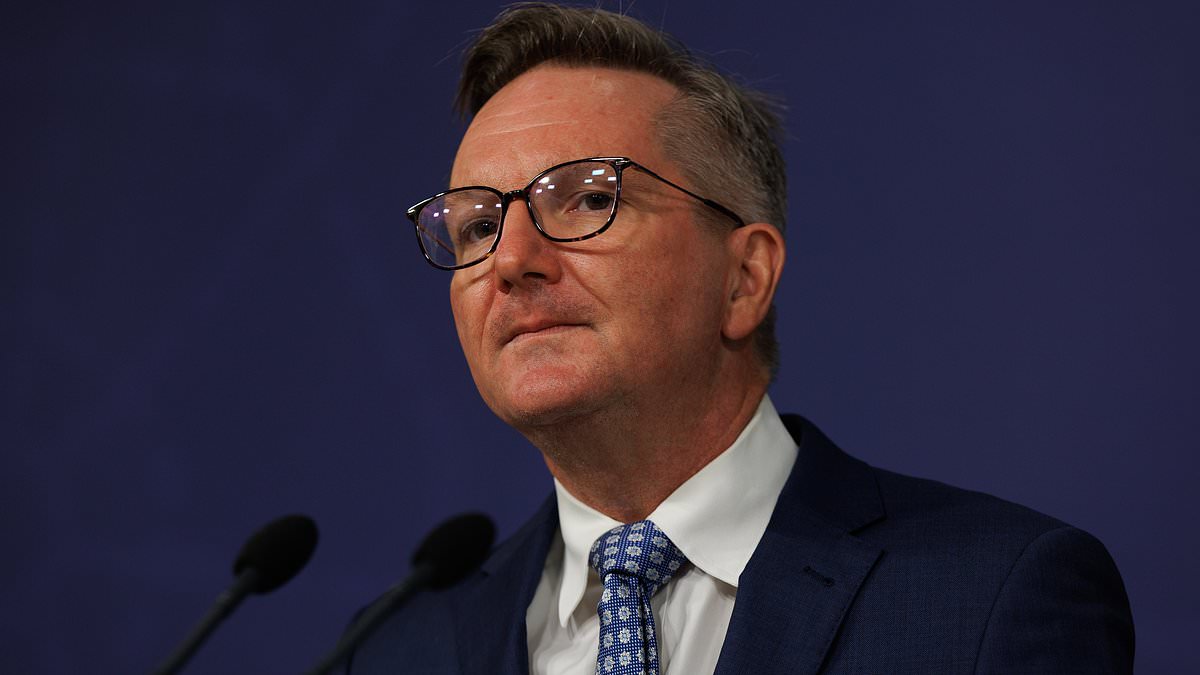
Energy Minister Chris Bowen said on Saturday that Australia has now stockpiled more than a month’s supply of fuel.

Iranian boats appear have struck fuel tankers in the Strait of Hormuz

NRMA head of media Peter Khoury has asked Australians to stop panic buying petrol
Bowen said the country is ‘as prepared as possible’, with 1.6 billion litres of petrol, or 37 days’ supply, available, 2.7 billion litres of diesel, or 30 days’ supply available, and 800 million litres, or 29 days’ supply, of jet fuel available.
However, NRMA head of media Peter Khoury told the ABC that when officials talk about Australia having roughly ’30 days of fuel’ left, that is only in an ‘extremely unlikely scenario’ in which no fuel arrives from overseas.
‘We cannot stress enough the reality that it’s never happened before,’ Mr Khoury said.
‘It is highly unlikely that tankers would ever stop crossing the Indian and Pacific oceans.
‘If you picture what it was like in the earlier years of World War II — Nazi Germany had marched through Europe, Japan was on our doorstep with Darwin — even then, we had access to fuel.’
Mr Khoury also said the panic buying was sparked by fuel prices in capital cities rising ‘a lot higher, and a lot quicker, than they should have’.
He is encouraging motorists to ‘return to their normal buying habits to reduce stress on the system’.
‘People started to see prices in the $2.30 and $2.40 range and went out and started stockpiling to the point where Bunnings ran out of jerry cans,’ he said.

Energy Minister Chris Bowen told reporters on Saturday that Australia has now stockpiled more than a month’s supply of fuel
‘What we want to ensure is that at the terminal, one way or another, we’re getting diesel out to regional service stations and to farming communities, because at the end of the day, we know there’s enough fuel -but for whatever reason, shortages have hit regional areas.’
Mr Khoury said there’s still enough fuel coming into Australia and ‘there’s nothing to suggest that we will need to ration fuel at this point’.
But he says the only way for the Strait of Hormuz to reopen is for the war to end.
‘Our hope, and again, NRMA are not, you know, geopolitical experts, but like everybody else, our hope is the announcement [by the IEA] to release 400 million barrels will enable all parties to buy time to end the conflict one way or another,’ he said.