A drop in Australia’s headline inflation has not eliminated the possibility of a February interest rate hike, according to some economists.
The annual consumer price index (CPI) dipped from 3.8 to 3.4 per cent in November, according to Australian Bureau of Statistics data released on Wednesday.
That was lower than headline figure of 3.6 per cent economists had forecast.
But the RBA places greater emphasis on the trimmed mean or underlying measure of inflation, after removing volatile items, which remains too high.
Trimmed mean inflation fell from 3.3 per cent to 3.2 per cent after rising 0.3 per cent month to month. The figure is above the RBA’s two to three per cent target band, but is consistent with their November forecast.

The Reserve Bank of Australia (RBA) is keeping a close eye on the upcoming December quarter inflation report, which is set to be released on January 28. This report is crucial as it arrives just days before the RBA’s board meeting scheduled for February 2-3.

AMP Chief Economist Shane Oliver says the RBA will be concerned by stickier items like the cost of building a new home, which is “accelerating”.
“New dwelling inflation was up 2.8 per cent on a year ago, compared to 1.7 per cent in October on a year ago,” he told SBS News.
“So that’s still a red flag there with new dwelling construction prices, which are continuing to pick up pace, so that will concern the RBA.”

Economic analyst Holden noted that while market services prices have not increased, they remain stubbornly high at around 3 percent. This persistent inflationary pressure may lead the RBA to consider an interest rate hike, which Holden suggests is still a possibility.

Holden believes that the inflation data from the December quarter will serve as a more accurate indicator for the RBA’s decisions during their February meeting.

Richard Holden, Scientia Professor of Economics at UNSW Business School, said the inflation data showed the cost of items still went up, but the growth had slowed slightly.
“I think it’s telling us that inflation is still too high,” he told SBS News.
“The RBA are going to have to do something to get it under control. And today’s figures don’t change that.”

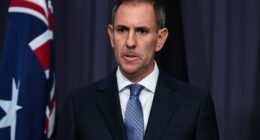
Australian Treasurer Jim Chalmers expressed his approval of the latest Consumer Price Index (CPI) data, which exceeded economists’ expectations. He acknowledged the ongoing financial challenges facing Australians, yet described the CPI results as “very welcome and very encouraging.”

“It certainly could, and a lot of economists are suggesting that rates will need to go up. So if you thought that they were going to go up before this number, I wouldn’t change my mind,” he said.
Oliver, relieved by the drop, predicts a hold but admits “they’re not great numbers”.
“They’re still too high. The Reserve Bank will still be nervous. It keeps alive the prospect of a rate hike in February,” Oliver said.

He said the December quarter CPI figures will be a better predictor for the RBA’s February meeting.

A man wearing a black suit

Treasurer Jim Chalmers welcomes the CPI data, which was better than economists predicted. Source: AAP / Lukas Coch

Treasurer Jim Chalmers said while he understood Australians were still feeling the pinch of competing costs, the CPI results were “very welcome and very encouraging”.

“We know that households are still under pressure and that’s why our responsible cost of living relief is so important,” he said in a statement.
“Inflation remains much lower than we inherited from the Coalition but still higher than we would like.”
Stephen Smith, partner at Deloitte Access Economics, highlighted that the new data comes with “wide margins of error”.
He said the RBA should be “careful and cautious, rather than impulsive”, arguing a cash rate increase would be “premature”.
“If the RBA feels it has no choice to hike rates, then it is a sad indictment on the failure of policymakers to address the root causes through reform.”
Following its decision, the central bank’s governor Michele Bullock said it was unlikely there would be further interest rate cuts “for the foreseeable future”.

— With additional reporting by the Australian Associated Press.
You May Also Like

Heightened Security as ISIS Brides Prepare for Imminent Return: Police on Alert

This morning on Today, a lively debate unfolded between Nationals Senator Bridget…

Family with IS ties communicates from aircraft ahead of imminent arrival in Australia

In Brief Some returning adults will face charges, the AFP commissioner has…

Government Unveils Gas Export Reservation Plan: Balancing Act Sparks Debate

In Brief The policy will begin in July 2027 and bar gas…

Ceasefire Between Russia and Ukraine Collapses Amidst Reports of Drone and Missile Strikes

In brief Ukrainian officials say Russia launched a drone attack just hours…

Noel Pearson Criticizes Neil Mitchell’s ‘Radio Cube’ Perspective, Warns of Grim Future if Voice Referendum Fails

Noel Pearson, a prominent advocate for the Yes campaign, has delivered a…

Shocking Revelations: Court Unveils Alleged Suicide Note by Jeffrey Epstein

In Brief The handwritten note was said to have been discovered by…

Australia’s Soaring Welfare Bill Predicted to Surpass New Zealand’s Entire Economy by 2027

Australia is on the brink of a welfare expenditure surge so significant…

WA Budget Introduces $100 Fuel Assistance for All Drivers

Every driver in Western Australia is set to receive a $100 fuel…

Trump Denounces Iranian Attacks as Leadership by ‘Lunatics

Donald Trump has commented on the recent tensions between the United States…

Australia Secures Energy Future: New Rule Mandates 20% Gas Supply Reservation for Domestic Use

In a strategic initiative aimed at enhancing domestic gas availability and curbing…

Climactic Confrontation Looms in Rebel Wilson’s Intense Dispute with Co-Star

The curtain is falling on a whirlwind courtroom drama involving Hollywood’s Rebel…

From Family Vacation to Unimaginable Fear: Fio’s Battle with Cancer and Life Beyond Recovery

A seemingly routine family vacation to New Zealand took a dramatic turn…