
Green Lanes in Palmers Green presents the quintessential image of a north London high street, lined with an array of cafés, takeaways, and estate agents. At first glance, it appears to be a typical suburban scene.
However, venture just five minutes further south, nearing the suburb of Wood Green, and the atmosphere shifts noticeably.
The change is first evident in the shopfronts. Bright, flashy signs adorn the buildings, contrasting sharply with their darkened windows. Groups of men congregate outside, from morning until late at night. Some sit sipping beer at plastic tables while others stand idly on the pavement for hours.
Within a half-mile radius, there are over five establishments open around the clock, posing as cafés, lounges, or bars. Yet, these spots seem to be shrouded in mystery, as they attract neither the typical local pub-goers nor significant online attention.
This air of secrecy has left residents understandably wary. Questions circulate about the true nature of these venues, their ownership, and the reasons behind such discretion.
Understanding the dynamics of these establishments holds intrigue not just for locals, but for anyone curious about the undercurrents in this part of London.
At a time when high streets across Britain have been taken over by a variety of ‘dodgy’ businesses, the reality behind this bizarre phenomenon could shine a light on the shady forces turning our town centres from community hubs to crime hot spots.
The curious transformation of this half-mile stretch of Green Lanes was clear to see when the Daily Mail visited one morning last week.
The atmosphere could hardly be described as family-friendly, with groups of men loitering outside the venues smoking, engaging in furtive conversations and casting suspicious glances at passers-by.
The picture documented in official records was even more concerning.
Our investigation discovered licensing, planning and food standards regulations being repeatedly ignored, as well as concerning links between some of the bars and serious crimes ranging from drug dealing to murder.
As the while, those unfortunate enough to live near the venues complain of being subjected to round-the-clock noise and antisocial behaviour that local officials are seemingly powerless to stop.
Two of the bars, Konak Lounge and Avenue Club 2, pictured one morning last week
A group of men on a table at Konak Lounge. The premises has previously been known by several other names
At 336 High Road, currently 2a Cafe and Pool, thirteen different companies have been linked to the same premises over a fourteen-year period
But first, some geography. Stretching for more than six miles through north London, Green Lanes is one of the capital’s longest roads.
The half-mile section covered by this article lies just north of the area associated with London’s Turkish community, which featured in Netflix drama Legends as the territory of a fictional heroin-smuggling gang called the ‘Green Lane Turks’.
Here, a concerning pattern has emerged.
Over recent years, a series of licensed venues have appeared and disappeared in rapid succession, with many sharing similar characteristics: darkened windows, extensive security, long opening hours and an ever-changing cast of directors – almost all of them hailing from Albania.
Residents say the businesses feel entirely disconnected from the wider local community.
‘No locals go to them – there are just the same men standing outside and we watch them cycle between different names every few months,’ one said.
‘Everyone locally can see what’s happening but nobody in authority seems to want to look.’
One of the most prominent venues is Avenue Club 2, which announces its presence with a mass of dazzling bright white neon and red strip lighting.
Social media images of its interior reveal a similarly over-the-top aesthetic, with spinning disco globes casting technicolour flashes over walls studded with stylised leopard heads.
The business, operated by Albanian businessman Denis Gjelaj, is licensed to open from 9am daily and close between 11pm and 2.30am depending on the day of the week.
Last year, Mr Gjelaj applied to extend those hours further to stay open until as late as 4am.
The application was rejected after councillors heard evidence the venue had already been operating outside its permitted hours. The Metropolitan Police strongly opposed the application, raising concerns about alcohol-related crime and reports of cannabis use among customers.
Residents also submitted numerous complaints describing regular disturbances, including shouting, fights and noise continuing into the early hours.
One objection quoted during the proceedings claimed revellers would ‘drink and urinate on the street’. It claimed they were ‘professional criminals’ and ‘dangerous people’.
Mr Gjelaj was accused of showing ‘no awareness’ that his bar was surrounded by 139 residential properties, many of them housing families with young children.
It might be tempting to ask why anyone in search of a quiet life would decide to live near a nightclub.
Well in this case, they didn’t. The venue had previously been a sit-down restaurant, but Mr Gjelaj renovated it into a nightclub without planning permission.
Enfield Council has started an enforcement case against the venue, but it continues to operate as normal – causing misery for neighbours.
Avenue Club 2’s owner, Denis Gjelaj, has been criticised for making his neighbours’ lives a misery
Avenue Club 2 has been converted into a nightclub without planning permission, complete with a gaudy, exterior featuring neon strip lighting
Social media images showing the inside of Avenue Club 2 reveal a similarly over-the-top aesthetic
A recurring feature across several venues we examined was the rapid turnover of companies connected to each location.
The premises next to Avenue Club 2, 6 Green Lanes, has been home to seven companies since 2017.
Currently named Konak Lounge, it previously operated as Kuq E Zi – a name that references the red and black of the Albanian flag – before a fatal stabbing outside the venue in July 2023 led to its licence being revoked.
The same trend is repeated elsewhere along the road.
At 336 High Road, currently 2a Cafe and Pool, thirteen different companies have been linked to the same premises over a fourteen-year period.
Campaigners say the repeated opening and dissolution of companies makes enforcement difficult and allows operators to distance themselves from previous complaints or regulatory action.
Police and council records reviewed by the Mail reveal repeated licensing breaches at several of the venues.
One business operating from 336 High Road was raided by police investigating drug-related issues in February 2025 and found to be hosting illegal casino-style gambling.
At a previous venue operating from the site now occupied by Konak Lounge, locals reported witnessing regular fights and disturbances, including one incident that allegedly left ‘blood everywhere’ on the pavement.
Residents’ objections to alcohol licence applications for the bars repeatedly referenced fears about crime, public disorder and harassment of female pedestrians by ‘leering’ men.
In several cases, applications were ultimately approved after the management agreed to reduced opening hours – only to allegedly stay open later than permitted.
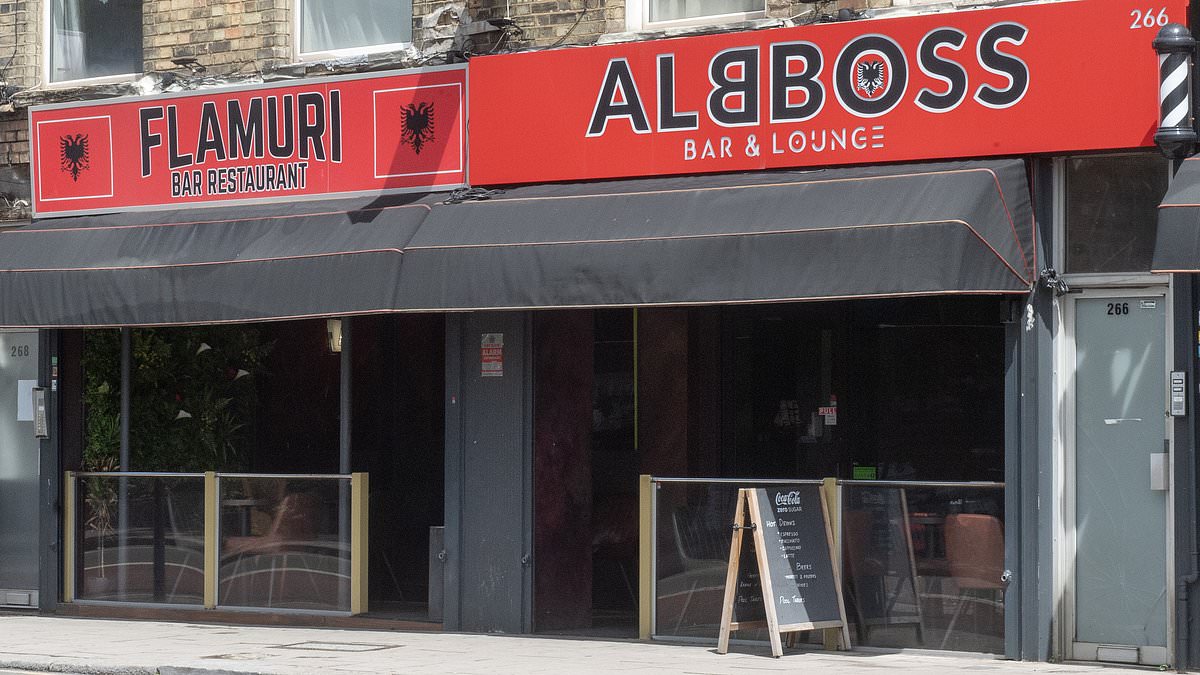
One venue, Albboss – a bar and lounge marked by a sign bearing an Albanian eagle – has been serving food without being registered as a food business.
Haringey Council is aware this is happening but is to do anything to stop them.
Of course, north Londoners are not the only ones looking on with concern at the transformation of their local high street, with a recent Trading Standards report finding that up to a half of outlets in some areas are linked to organised crime – including drug dealing and money laundering.
Bambos Charalambous, Labour MP for Southgate and Wood Green, said residents had repeatedly raised concerns about whether some local venues are being used for criminal activity.
‘There has been a proliferation of cafes and other shops on the high street and there is a suspicion among local residents that some of them are just fronts.
‘There are a lot of different agencies involved, while police need evidence and it can be frustrating when that isn’t available.’
One venue, Albboss – a bar and lounge marked by a sign bearing an Albanian eagle – has been serving food without being registered as a food business
Men outside Albboss when the Mail visited the area last week

Pictures of some of the dishes on offer at Albboss. These were advertised on the venue’s social media pages
Join the discussion
How should authorities deal with nightlife venues linked to crime and disrupting local communities?
Mr Charalambous said concerns had also been raised regarding the immigration status of some workers and the possibility of labour exploitation, adding that these were matters authorities should investigate.
Part of the difficulty facing authorities appears to be limited enforcement capacity, with only a handful of council Trading Standards and licensing officers handling thousands of businesses.
Mr Charalambous said he had presented a petition to Parliament calling for stronger powers and greater resources for Trading Standards officers and specialist financial investigators.
‘I would also like to see more specialist financial investigators and more communication between agencies,’ he added.
A single licensing consultant seems to have something of a monopoly on representing local Albanian-run bars in their licensing appeals. We contacted his business for comment but did not hear back.
Cllr Elisa Morreale, cabinet member for Enfield Council, said the authority ‘takes antisocial behaviour and breaches of licensing conditions extremely seriously’ and vowed to take ‘robust action’ against wrongdoers.
The Met said it ‘recognises the significant impact organised criminality has on communities’ and was ‘tackling it head-on in the Green Lanes area’, including by increasing the number of patrols and varying licensing conditions at venues.
Haringey Council was also contacted for comment.


