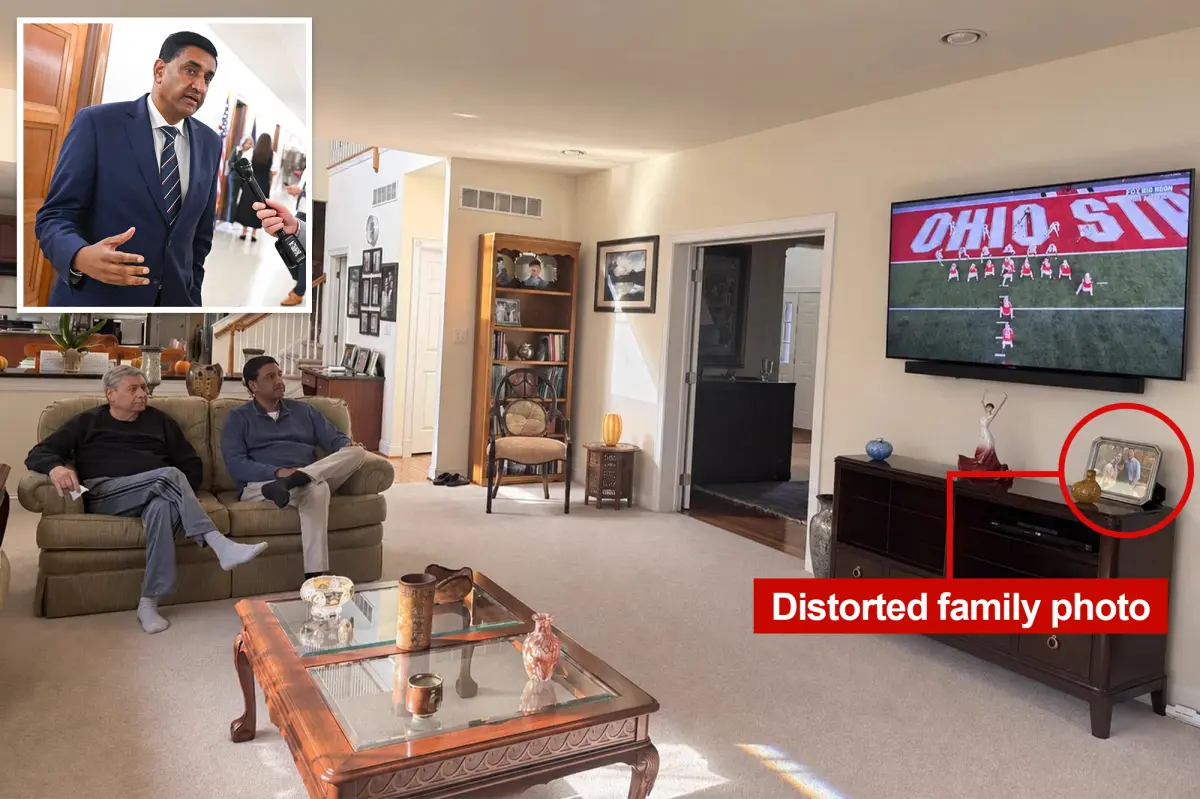

Rep. Ro Khanna (D-Calif.), who has repeatedly warned about the risks posed by artificial intelligence, acknowledged Sunday that AI was used on a photo showing him watching the Michigan-Ohio State game with his father—after users on X mocked the image.
“Yes, we used AI to blur out one of the family pictures for privacy! But my Dad and I did watch most of the blowout, even though he was tempted to turn off the TV at halftime,” the California Democrat posted Sunday morning.
The original image was shared Saturday afternoon. It showed Khanna and his father sitting together on a living room couch as the game played on a wall-mounted television.
“Watching the Michigan-Ohio State game with my Dad, a huge Wolverines fan. He never misses a game. Tough start,” Khanna wrote in the caption.
By Sunday morning, an X Community Note—part of the platform’s crowdsourced fact-checking system—identified the image as AI-generated, citing confirmation from OpenAI’s official verification tool.
YOU MAY ALSO READ: Kate Garraway Holds Back Tears Hearing Her Kids’ BBC Doc Messages
The controversy emerged just three days after Khanna, whose district includes part of Silicon Valley, wrote: “We should not surrender our autonomy to govern ourselves to AI systems or tech billionaires.”
Critics quickly seized on the apparent contradiction. “why would you ai generate a picture of yourself watching football with your dad,” Menlo Ventures investor Deedy Das wrote.
Jeremiah Johnson, co-founder of the Center for New Liberalism, described Khanna as “one of the weirdest, most pathetic, and most transparently fake politicians of this century.”
A review of the image by The Post also revealed several apparent distortions. On the television screen, Ohio State players appear lined up for a kick, while the Michigan players expected to face them are scattered across the back of the end zone, with some seemingly blending into the painted lettering.
The family photographs visible around the room also appear distorted rather than simply blurred. Faces in the frames look smeared and misshapen, suggesting AI manipulation instead of a conventional privacy filter.