
Serbia’s dominant political figure, Aleksandar Vucic, has acknowledged defeat to a student-backed coalition in a stunning election result that could reshape the Balkan country’s political landscape.
The fiercely contested parliamentary vote on Sunday drew strong participation as tensions mounted throughout the day.
Eighteen parties were competing for seats in Serbia’s 250-member Parliament, but the election effectively became a direct contest between Vucic’s right-wing Serbian Progressive Party and the Students’ List.
The Students’ List brings together 250 academics, professionals and public figures chosen by university students who have spearheaded protests against Vucic for nearly two years. Cardiologist Ilija Srdanovic leads the slate.
The youth-backed Students’ List won the support of Serbia’s 6.4 million voters as Vucic conceded defeat on Sunday.
Vucic, who had received an endorsement from Russian President Vladimir Putin, had portrayed the student movement as a foreign-backed effort to remove him from power. He had dominated Serbian politics for 14 years, governing with near-total authority.
“The Students’ List has won,” Vucic told supporters at his party’s election-night gathering. He nevertheless blamed Serbia’s independent media, alleged involvement by unnamed European governments and an “American deep state” for the result.
Vucic said his SNS party had secured approximately 1.7 million votes, compared with about 2.2 million for the Students’ List.

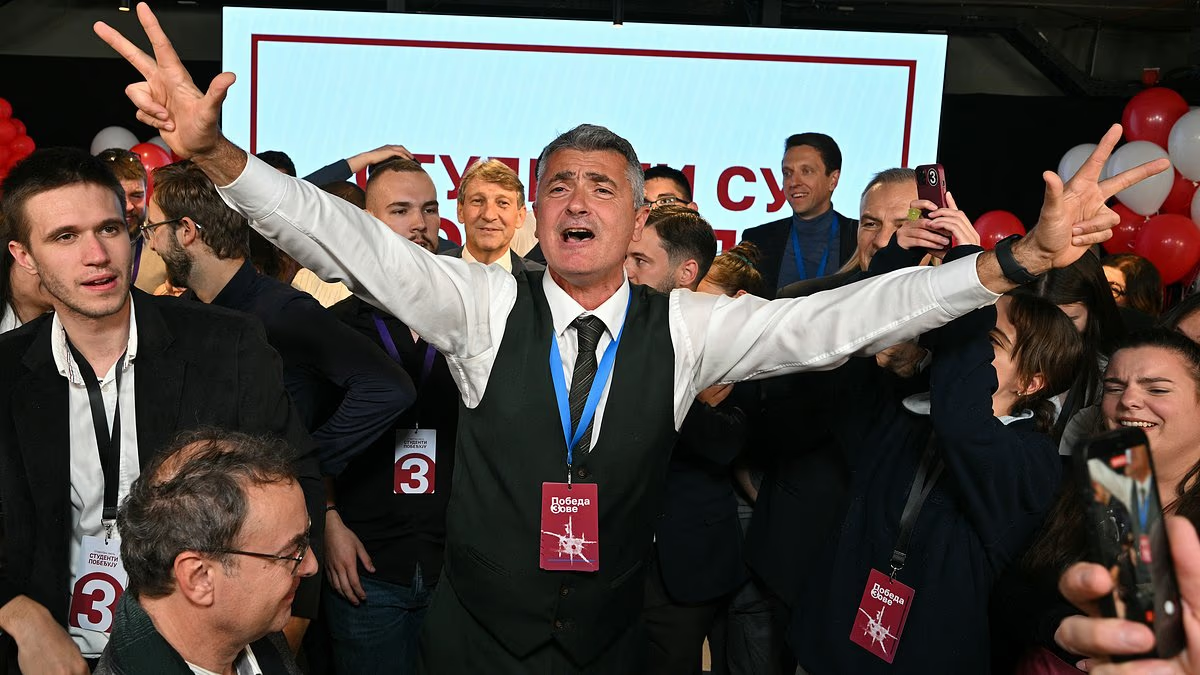
Ilija Srdanovic, centre, the leading candidate on the student-backed electoral list, celebrates the Students’ List victory in Serbia’s parliamentary election on October 25, 2026

Supporters of the Students’ List bloc celebrate early parliamentary election results in central Belgrade, Serbia, on October 25, 2026

Aleksandar Vucic, the Serbian Progressive Party’s prime ministerial candidate, concedes defeat during a news conference at the party headquarters in Belgrade on October 25, 2026
Celebrations began almost immediately, with Students’ List supporters pouring into the streets of Belgrade and other cities. They honked car horns, shouted and chanted, “Aleksandar is gone,” referring to Vucic.
Vucic announced the result roughly 90 minutes after polling stations closed, following a day marked by rising tension and uncertainty.
Riot police sealed off the area around the election commission’s headquarters in central Belgrade.
Special police vehicles were also spotted near a Belgrade park where Vucic loyalists have maintained a camp for more than a year. Large groups of men dressed in black gathered at several locations across the capital.
Vucic had sought to become prime minister after serving two nearly complete terms as president. He stepped down from the presidency last month to head the election campaign.
His popularity began to weaken after 16 people died in 2024 when a concrete canopy collapsed at a railway station in Novi Sad. The tragedy triggered a powerful youth protest movement, whose members blamed the disaster on senior-level corruption, political favoritism and widespread graft linked to the station’s renovation.
MUST READ: Woman Accused in NYC Rabbi Syringe Attack Allegedly Stabbed Another Jewish Man Hours Earlier: Report
Even amid the demonstrations, Vucic maintained a substantial base of support. His backers saw him as a steady leader capable of guiding Serbia through international instability—an image reinforced by the country’s mainstream media.
Vucic’s increasingly authoritarian style had enabled him to repeatedly overcome Serbia’s divided opposition. But the leaderless student movement proved an unusually formidable challenger, shaking his grip on power more seriously than any force since his party entered government 14 years ago.
Although university students created and organized the Students’ List, none of them stood as candidates. The slate instead featured relatively unknown experts, athletes, farmers and artists.
This approach was meant to counter Vucic’s one-man rule and restore a sense of community and solidarity. The students’ message during the campaign focused on a non-partisan effort to rebuild Serbia’s economy and restore its democracy.

Ilija Srdanović (pictured) blows kisses to supporters following the results of the parliamentary election. He tops the Student List’s 250 candidates but will not necessarily become prime minister after their victory

People celebrate in the Serbian capital Belgrade after Aleksandar Vucic, leader of the Serbian Progressive Party (SNS, conceded defeat in the parliamentary election on October 25, 2026

Aleksandar Vucic (far left), leader of the right-wing Serbian Progressive Party (SNS), concedes defeat in the parliamentary election in Serbia on October 25, 2026

Supporters of the Student List wave Serbian flags and set off coloured flares in celebration after victory in Sunday’s parliamentary election

Supporters of the electoral list ‘Student List – Students Win’ celebrate following the results of the parliamentary election in Belgrade, Serbia on October 25, 2026
The students have used youthful energy to attract voters who are disillusioned with local politicians. Vilified by pro-government media, they cycled and walked through the country to reach voters in rural areas — Vucic’s traditional strongholds.
The student victory echoed the recent electoral defeat of a Vucic ally in Hungary, where youth participation helped oust the autocratic Viktor Orbán after 16 years and bring in a new pro-European government. It was likely to resonate beyond Serbia as countries across Europe have faced angry youth and student protests.
Monitors predicted that total turnout in the election could reach around 70%, unseen in Serbia since 2000. During the day, long queues formed at polling stations in Serbia and in cities around the world. Some in the Serbian diaspora were made to vote in the middle of the night after authorities tied voting hours to local Serbian time.
Recent Serbian elections had been marred by irregularities and the EU was closely watching the conduct of Sunday’s vote in a candidate nation for the bloc’s membership.
Independent election monitors reported dozens of cases of irregularities on Sunday such as photographing of ballots that suggested pressure on voters and attempted vote buying.
Both international and local election monitors had expressed concern about the safety and fairness of an election campaign marked by detentions, near-total government control over the media and reports of surveillance and cyberattacks against activists.
Local elections earlier this year in 10 municipalities in Serbia saw violent attacks on journalists and activists. The previous parliamentary vote in 2023 was followed by opposition protests alleging fraud.
This is a breaking story, more to follow


