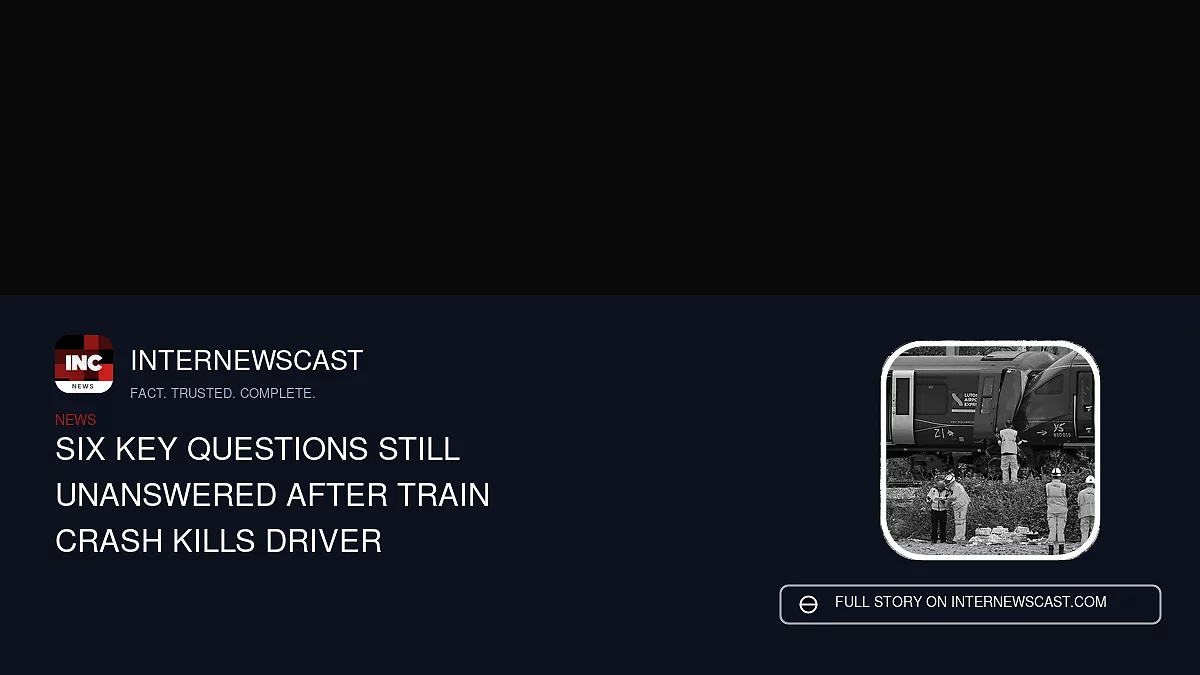

Serious questions are emerging in the aftermath of a devastating train collision that killed one driver and left nine people critically ill in hospital, marking Britain’s worst rail disaster in two decades.
In all, 100 people were injured — 32 of them seriously — when a Luton Airport Express service travelling from Corby to St Pancras crashed into the rear of a Nottingham to St Pancras train at about 5.15pm on Friday.
The scale of the incident makes it the most severe railway crash in Britain since 2007, when a train derailed at Grayrigg in Cumbria, killing one person and injuring 100 others.
Passengers were left with broken bones and described “spitting out blood” after the two East Midlands Railway services collided, with the Nottingham train having come to a stop on the line because of a technical problem.
Several travellers said they were “flung” out of their seats and thrown into tables and chairs ahead of them, before smoke began spreading through the carriages — though fire crews later confirmed it had not been caused by a fire.
A major incident was declared, and more than 80 people were treated in hospital overnight. By Saturday morning, 28 remained in hospital, according to British Transport Police Chief Constable Lucy D’Orsi.
Brett Byatt, a teacher travelling on the Corby service that struck the stationary Nottingham train, recalled: “I knew something was up because the train never slows down from Bedford to Luton — and I felt it brake.”
As reports focus on a possible technical fault involving the first train’s automatic warning system (AWS), passengers have criticised the condition of the UK’s ageing rail infrastructure.
The AWS system is designed to automatically apply the brakes if a driver fails to acknowledge an approaching red signal.
It is understood the Luton Airport Express train collided with the other stationary EMR service while its driver was reporting the issue to maintenance staff by phone.
Investigators and police remained at the scene, near Bedford, throughout Saturday as they began probing the possible cause of the crash.

Investigators begin their work in the aftermath of the train crash near Bedford on Friday evening

British Transport Police officers, Rail Accident Investigation Branch officers and Network Rail work at the site of the crash

Passengers filmed the aftermath of the incident, which showed panicked travellers lying on the floor and crying out for help

Members of an investigations team inspect the line and train at the scene of the crash
What was the fault with the automated warning system on the stopped train?
Although it has been reported that there was a fault with the AWS on the stopped train, it is not known what this was or why it brought the train to a halt.
Simon Calder, transport expert and former travel correspondent, said the Nottingham train had come to a halt ‘because of a problem with the automatic warning system which warns train drivers if there is a red signal ahead’.
The driver of this train is understood to have been on the phone with maintenance staff to relay information of the fault when the Luton Airport Express rammed into the back of it.
It is not known if the second driver, who is the one believed to have died in the collision, had been informed there was a stationary train ahead or that there was a fault with the AWS.
Due to confusion over the fault, after the crash staff on both trains leapt into action to activate a second warning system which ensured all signals in the area turned red, to avoid a further collision.
Rail expert Tony Miles told the BBC that staff acted ‘very quickly to protect the railway’ by ‘laying wires across the adjacent tracks’ to trigger a secondary signalling system in case the first one had failed.
Was there a red signal, and if so why did the driver cross it?

Investigators are examining whether a fault with the stationary train’s safety systems may have played a role in the crash

A crime scene manager from the British Transport Police photographs the inside of an electrical box at the side of a train track near where the crash occurred
In his interview, Mr Miles, from Modern Railways magazine, said authorities must establish whether the signals in the area were on red and the Luton Airport Express train from Corby had passed them anyway.
‘Were the signals showing red and the train went past them, or were the signals showing that the line was clear and, if so, how were they able to know when the train in front was stopped?’ he said.
He continued: ‘As long as the track is occupied, it shouldn’t be possible to clear the signals.’
Mr Miles said that while a driver could theoretically make a decision to cross a red signal, ‘they would normally only do that because they had been given permission by a signal box because there was a fault’.
Investigators will be looking at whether the stopped train and AWS fault had led to a red signal in the path of the second train.
If there was, attention will no doubt turn to whether the driver saw and crossed the signal anyway, and if he was assured he had permission to do so before taking that decision.


Did the driver make a mistake, or could he have been taken ill?
As the circumstances of the collision are unknown, investigators will be sure to consider whether a mistake was made, or if the second driver was taken ill in some way.
Images from the scene appear to show that the collision was not at high speed, which would corroborate passengers’ reports on the Corby train that they felt the service brake before the collision.
This could indicate they had seen the train and attempted to avert disaster, or that something else had gone wrong. Even if the driver did brake, experts have pointed out that the weight of passenger trains mean they take a long time to slow down, and can still pose a significant danger on impact even if only travelling very slowly.
Mr Miles told Sky News: ‘The question has to be how has that train that’s in the rear got into contact with the train that it was following.
‘Obviously it’s either gone past the signal that was telling it it should stop, or the signal was faulty, or the driver’s made a mistake in some way, or didn’t read the signal, or something.’
Although a mistake is possible, experts have pointed to advanced signalling and warning systems which should have prevented the second train ever crashing into the stationary one – assuming the message it had stopped had been passed along correctly.
The driver of the Luton Airport Express could have been trying to slow the train and prevent the crash in the moments before the tragedy – or they could have had a medical incident such as a heart attack or stroke.
There is no evidence at this stage that the driver of the moving train was taken ill, and investigations are still in their early stages..
Will the trains’ ‘black boxes’ reveal what happened?

It appears that the East Midlands Railway train was stationary when it was hit by the Luton Airport Express

Investigations into the crash are ongoing and there has been no official finding as to the cause of the collision

An aerial image taken yesterday shows police and rail engineers at the scene in the aftermath of the crash
A railway expert said today that investigators would ‘already know’ what happened in the Bedford rail crash from ‘second by second’ airline-style black box recorders in the trains.
Mr Miles said they recorded ‘every switch that was pressed and every control that was activated’ in both trains.
The UK’s train network is generally considered to be one of the safest in the world, and each is fitted with a ‘black box’ that tracks its location, movements and controls.
Some details, such as the locations from and times the trains set off, are already known.
The first train left Nottingham for London St Pancras at 3.50pm, while the second – the Luton Airport Express – left Corby for St Pancras at 4.40pm.
Both were heading in the same direction and to the same destination.
‘They will know every switch that was pressed,’ Mr Miles said.
‘They will know every control that was activated in both of the trains and they will have second by second data from the trains as to what was going on.
‘So I suspect there are probably people who have got a reasonable insight into what happened already but it doesn’t mean they will release it.’
Did the moving train have permission to cross points to get to the other line?
Investigators looking at how the two trains could physically have collided will finally be examining whether the second train had been given permission to cross points to get onto the same line as the stationary Nottingham service.
Mr Miles said that the route of the trains, which collided near Elstow, close to Bedford, meant the Luton service would have had to cross multiple sets of points to get onto the same line as the first train.
It would have been ‘going quite slowly as it was crossing a lot of points to get to the other line’, he said, so the question would be: ‘was it cleared to do that?’.
‘The drivers would stop at a red signal regardless and talk on their radio,’ he added.
‘So the two questions will be “were the signals showing red and the train went past them?” or “has something catastrophically gone wrong with the electronics system that interlocks itself so it can’t allow a dangerous situation to happen?”, and this then allowed the train to go past.

Did the driver see the train in time – and did he have time to stop?
Analysis of satellite imagery shows the railway tracks cut through a mixed industrial and rural setting.
It could be possible the driver did not see the stationary train which was well ahead on the track.
The rail line changes from straight and goes into a curve where the other train had stopped after the bend.
It’s understood that the collision did not occur at high speed and passengers reported that they felt the driver brake.
But the question remains as to whether this was done too late as experts have said the length and weight of trains mean they need a long time to slow down – which could explain the crash if the diver acted too late because he didn’t see the other train.
Speaking at a press conference near the scene on Saturday, British Transport Police Chief Constable Lucy D’Orsi said: ‘Tragically, the driver of one of the trains died in the collision.
‘His family have been informed and our deepest condolences are with them, his friends, and his colleagues at East Midlands Railway.
‘The driver’s family, as you would expect, are being supported by specially trained officers at this difficult time.’
She thanked emergency service teams and railway staff for their response to the incident.