
My first brush with Harry Potter came around the turn of the millennium, somewhere above the Atlantic. I remember watching, slightly baffled, as the adult woman seated next to me opened what looked unmistakably like a children’s book — then remained utterly absorbed in it for the rest of the flight.
Before long, that scene was being repeated everywhere. Every new instalment brought overnight queues outside bookshops, packed with readers young and old, while supermarkets stacked enormous pallets of the brightly covered books as if they were household essentials.
Now, roughly three decades on — after 600 million copies sold, eight smash-hit films, seven flagship stores, four theme parks and the creation of a multi-billion-dollar entertainment empire — the boy wizard from Little Whinging has become woven into my own family story, largely through my children.
My eldest daughter seemed to spend as much of her childhood in the Potterverse as she did in the real one. She read the full series, all 4,000 or so pages of it, seven times over, carefully holding off on each film until she had finished the corresponding book. Naturally, there was a cloak, a hat, a wand and even a spell book.
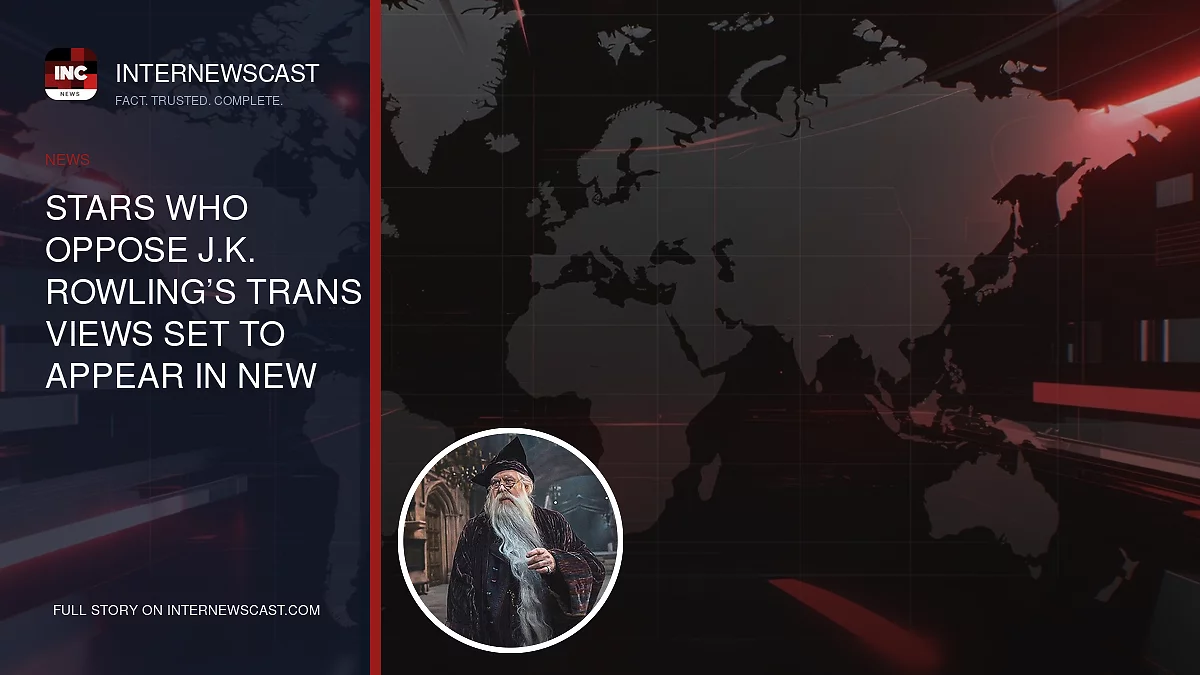
Her brothers and sisters were hardly immune to the spell either. In ordinary times, then, we would probably be joining much of Britain in excitement over HBO’s new Harry Potter television adaptation, scheduled for release on Christmas Day, with the plan to remake the entire saga over several years using a fresh cast.
But we cannot quite bring ourselves to watch. For a sense of how the enchantment has curdled, consider Nicholas Hoult’s departure from the role of the flamboyantly fraudulent Gilderoy Lockhart, officially because of a scheduling conflict. He has since been replaced, happily enough, by Kit Harington, best known to millions as Jon Snow in Game Of Thrones.

John Lithgow, cast as Hogwarts headmaster Albus Dumbledore in the series, has spoken publicly about wrestling with the decision to accept the role

Nick Frost, who is playing Hagrid, has said his views and those of the author “don’t align in any way”
Hoult’s departure came after a major online backlash from the actor’s fans over his decision to take the role. Typical was a comment by a fan account named Hoult-Daily, which said on X: ‘Nicholas Hoult do better, so many of your fans are hurt.’ Another declared that his decision to join the production was ‘disappointing’ and ‘anti-LGBT’.
The furore is over JK Rowling’s controversial views, which include – shock horror – that the only humans with penises are men, and that those born male who say they are female should be prevented from sharing single- sex bathrooms, prisons and refuges with biological women.
That’s right: what used to be called common sense – and a view still held by most Britons – is now so toxic to the luvvie class that they are trashing a much-loved literary creation with their own cultural politics.
Did the gender row drive Hoult’s decision to withdraw? He would hardly be the first industry figure to distance themselves from the series for which JK Rowling is an executive producer. When Black Mirror director Ally Pankiw was asked if she’d be interested in working on the series, she responded: ‘Absolutely f*****g not!’ She added later that ‘it simply is this easy to say no to funding transphobia’.
Director Kate Herron bragged that she’d been approached ‘twice’ and ‘had to explain my answer is never going to change from a “no” ‘. The two shared these messages in public and engaged in a sort of love-in online.
Clearly, they feel that getting involved with Harry Potter comes with a personal and professional cost, while trumpeting your opposition to the fantasy franchise in public wins huge adulation among the denizens of la-la land.
Indeed, the pro-trans mob – which can muster eye-popping levels of intolerance in the name of tolerance – is orchestrating a campaign against the upcoming series. In January, radical group Defund Transphobes protested outside a performance of Harry Potter and the Cursed Child at London’s Palace Theatre, while pro-trans Reddit message boards are saturated with activists pledging to boycott the new series.
What I find extraordinary is that actors and actresses who have taken leading roles have still chosen to speak out against the woman who created Harry Potter.
John Lithgow, who is Hogwarts headmaster Albus Dumbledore in the series, has agonised publicly over taking the part. ‘I find it ironic and somewhat inexplicable that Rowling has expressed such views,’ he declared loftily, adding that the backlash to his decision to join the series ‘upsets me’.
Other actors, including Bel Powley (due to play the Muggle Petunia Dursley), Nick Frost (half-giant Hagrid) and Paapa Essiedu (complex baddie Snape), have assumed the bizarre position of publicly distancing themselves from JK Rowling’s stance on gender while continuing to bring her fictional world alive.
‘I think that the trans community deserve safety and dignity and respect,’ preened Powley this month. Frost declared that ‘she [JK Rowling] is allowed her opinion, and I’m allowed mine. They just don’t align in any way’. Essiedu signed an open letter declaring he stood ‘in solidarity with the trans, non-binary and intersex communities…’

Paapa Essiedu who plays Snape signed an open letter declaring he stood ‘in solidarity with the trans, non-binary and intersex communities
The author has responded with generosity. ‘I don’t have the power to sack an actor from the series, and I wouldn’t exercise it if I did,’ she has said of Essiedu. ‘I don’t believe in taking away people’s jobs or livelihoods because they hold legally protected beliefs that differ from mine.’ But then, Rowling has become accustomed to her own actors biting the hand that feeds them.
The stars of the original films, Daniel Radcliffe (Harry Potter), Emma Watson (Hermione Granger) and Rupert Grint (Ron Weasley), who were gifted global fame and fortune through the power of Rowling’s imagination, repaid her with a venomous campaign against her good sense.
In 2022, Watson made a dig at Rowling during a Bafta ceremony – ‘I’m here for all the witches’, she famously declared, a remark universally interpreted as a statement of support for the trans community – while the author was, by her own account, receiving death and rape threats.
Radcliffe responded to JK’s stance on transgender by saying: ‘Transgender women are women. Any statement to the contrary erases transgender people and goes against all advice given by professional healthcare associations who have far more expertise on this subject matter than either Jo [Rowling] or I.’
Grint, set to reprise his role as Ron Weasley on stage in New York next year, also made clear his position in a statement that he ‘firmly stands with the transgender community’. He later wrote supportively of JK Rowling: ‘I don’t necessarily agree with everything my “auntie” says but she’s still my “auntie”.’
At least the original trio had signed up for the roles before the controversy erupted, I suppose. For the new crop, there can be no such excuse. But such is the bubble in which these people exist that they are unlikely ever to see their own posturing for what it is.
What is most remarkable about the arts these days is its drab uniformity of opinion. Almost everybody seems to support the latest trendy causes, from Gaza to trans rights. Do none of them think for themselves? If they do, they seem to keep quiet.
Small wonder, perhaps: last month, when Boy George released We Will Dance Again, a song supportive of the Middle East’s only democracy in its war against jihadism, he was roundly condemned and forced to withdraw from his role in Jesus Christ Superstar at The London Palladium. How many performers have the courage to face such a backlash?
With so much online bile poured on to JK Rowling, how many would even dare pull out a Harry Potter book on an aeroplane today for fear of social opprobrium?
As for the new TV series, populated by stars who felt they just had to tell us their views on transgender rights, well, I think my family will stick to the books.