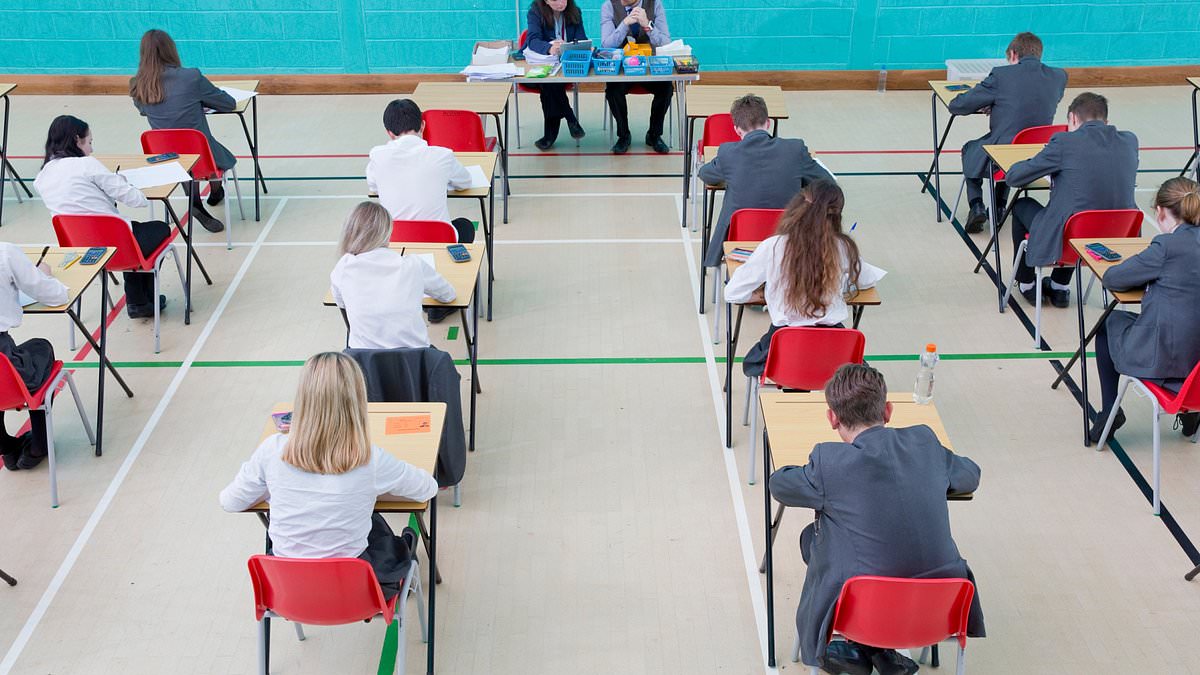

Disheartened students have compared an A-level mathematics exam to a ‘war crime,’ prompting over 19,000 individuals to sign a petition calling for a reevaluation due to its challenging nature.
The Maths 1 exam, administered by Pearson Edexcel on Wednesday, faced backlash after examinees reported it was much tougher than previous tests, leaving them feeling ‘overwhelmed’ and ‘uncertain’ about their performance.
In response, a petition has been launched, amassing more than 19,000 signatures, urging a reconsideration of the grade boundaries to ensure fair assessment.
Addressed to the examination authority, the petition highlights ‘widespread concern among students, educators, and institutions’ that the test surpassed the expected level of difficulty based on the official syllabus and prior exams.
The petition states: ‘Although exams are meant to be challenging, the extent and uniformity of these worries are noteworthy.’
It continues: ‘Feedback from examinees indicates that the difficulty wasn’t limited to a few hard questions at the end but was prevalent across much of the exam.’
The petition emphasised it was not created to ‘avoid accountability for performance,’ nor was it an assertion that ‘examinations should be made easier’.
Rather, it said: ‘It is a request that Pearson Edexcel examine whether the level of challenge presented by this paper was proportionate and whether grade boundaries should be adjusted accordingly to ensure fairness for all candidates.’
Pupils have likened a Pearson Edexcel A-level maths paper to a ‘war crime’
It added that according to pupils, the test ‘required multiple layers of reasoning, extended algebraic manipulation, and unfamiliar approaches’ that were beyond expectations based on previous exams.
According to reports, questions included trigonometric identities, solving a circular segment using the Newton-Raphson method, harmonic form and complex integrals.
In comments on the petition, pupils expressed their indignation at the intense difficulty of the paper.
One commenter described the exam as ‘not accessible’ while another labelled it ‘atrocious.’
Another said: ‘Walking out that exam hall, I couldn’t feel any of my senses, couldn’t see properly because of the tears rolling down my face, couldn’t hear properly because of the trauma warping my hearing.
‘All I could feel was sadness and rage.’
One woman, named Karen, said: ‘My son has studied so hard for this exam and came home so deflated by the content and difficulty in the exam. This will have an impact on Uni offers.’
Ofqual – who oversee regulating examinations in England – said it was made aware of the concerns and that it will ‘closely’ monitor Pearson’s approach to marking the exam.

A petition demanding grade boundaries be adjusted accordingly to ensure fairness when marking has been signed by over 19,000 people
Join the discussion
Should exam boards be held accountable when tough papers risk students missing out on university places?
A spokesperson said: ‘Our priority is students and ensuring their grades are a reliable indication of what they know, understand and can do.’
A spokeswoman for Pearson, said pupils will ‘receive results that fairly reflect their performance’.
She said: ‘Every paper is developed with input from experienced senior examiners and rigorously checked to ensure it reflects the course and meets required standards,’ she said.
‘If a paper is found to be more difficult than previous years, grade boundaries will be set to reflect that. When setting grade boundaries, we review a range of evidence, including statistical data and expert judgment.
‘This process ensures students receive results that fairly reflect their performance and are comparable across exam series.’


