
Britons are being encouraged to prepare emergency food supplies as the Super El Niño weather event gathers strength.
Dame Angela Eagle, Secretary of State for Environment, Food and Rural Affairs (Defra), told The Guardian that having basic provisions at home could make a crucial difference during a disruption. ‘If you’ve got a store of a bit of food that can keep you going for a while before the emergency services can get to you, you’re going to be a lot better off than if you haven’t,’ she said.
But what should households actually be putting aside?
Professor Elizabeth Robinson, an environmental economist at the London School of Economics, says families should aim to keep enough non-perishable food and water at home to last for two weeks.
Speaking to Our News Outlet, she said useful supplies include staples such as pasta and rice, along with tinned foods — particularly options that can be eaten without heating if a power cut occurs.
‘Definitely items that you can combine to make a tasty and nutritious meal, so maybe tins of beans or pulses, fish or meat, vegetables, some tinned fruits, and UHT or powdered milk. And of course water,’ Professor Robinson advised.

Experts say the ‘unprecedented’ Super El Niño could bring wetter, stormier conditions to the UK through autumn and winter

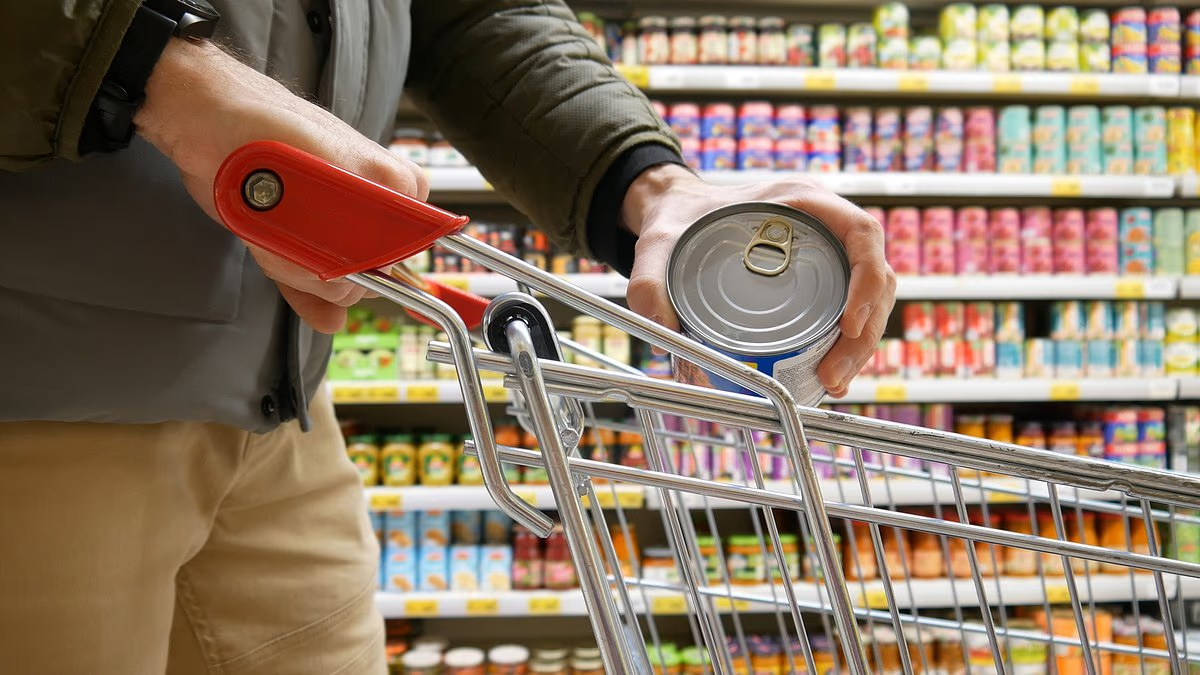
Britons have been advised to keep emergency food supplies at home as the Super El Niño weather event intensifies (stock image)
The El Niño Southern Oscillation is a naturally occurring climate cycle that shifts between hot El Niño years and cool La Niña years once every two to seven years.
As we enter an El Niño phase, the powerful trade winds that normally blow hot water across the Pacific towards Australia weaken, or even reverse.
That prevents cool waters welling up from the deep ocean below and causes hot water to collect near the surface off the west coast of South America.
Eventually, that warm water starts to spread out, raising the average global temperature and causing major disruptions to weather patterns around the globe.
While the UK just experienced its hottest summer on record, scientists predict devastating storms will batter Britain from October, before temperatures plummet this winter.
To prepare for this extreme weather, Defra is urging Brits to stockpile food.
On the government website, a ‘household emergency plan‘ reveals a list of nine ’emergency supplies’.
According to the government, you’ll need a battery or wind-up torch, a portable power bank, a battery or wind-up radio, and spare batteries.
In addition, your emergency kit should include a first aid kit, wet wipes and hand sanitiser, bottled water, non-perishable food that does not require cooking, and a tin opener.

Scientists warned El Niño is ‘firmly established’ and ‘being supersized before our eyes’ as temperatures continue to rise
Finally, if you have a baby, your kit should include supplies like nappies and formula.
Speaking to Our News Outlet, Professor Robinson agreed that it ‘definitely makes sense’ for Brits to stock up amid the Super El Niño.
‘In general, it definitely makes sense for those households that can afford it to have a week or two of non-perishable foods and water stored at home, in case of any food emergency, whether due to a pandemic, conflict, or weather shock such as could be caused by the growing El Niño,’ she said.
‘But the government cannot abdicate responsibility for ensuring that the country as a whole is resilient to shocks that affect access to food.
‘This might include diversified sourcing, buffer stocks for critical staples, robust monitoring and early warning systems, and safety nets for the most vulnerable households.’
Professor Robinson added that El Niño could send the cost of your weekly shop soaring.
She explained: ‘In the UK we are highly dependent on imported fruits and vegetables, and we have already seen how weather extremes in places like Spain and north Africa can lead to shortages and higher prices.
‘More broadly, rice, coffee, cocoa, tea, could all be more costly; animal feed prices are likely to increase considerably, affecting the affordability of meat and dairy; and domestic production could be affected, again pushing up food prices.’


