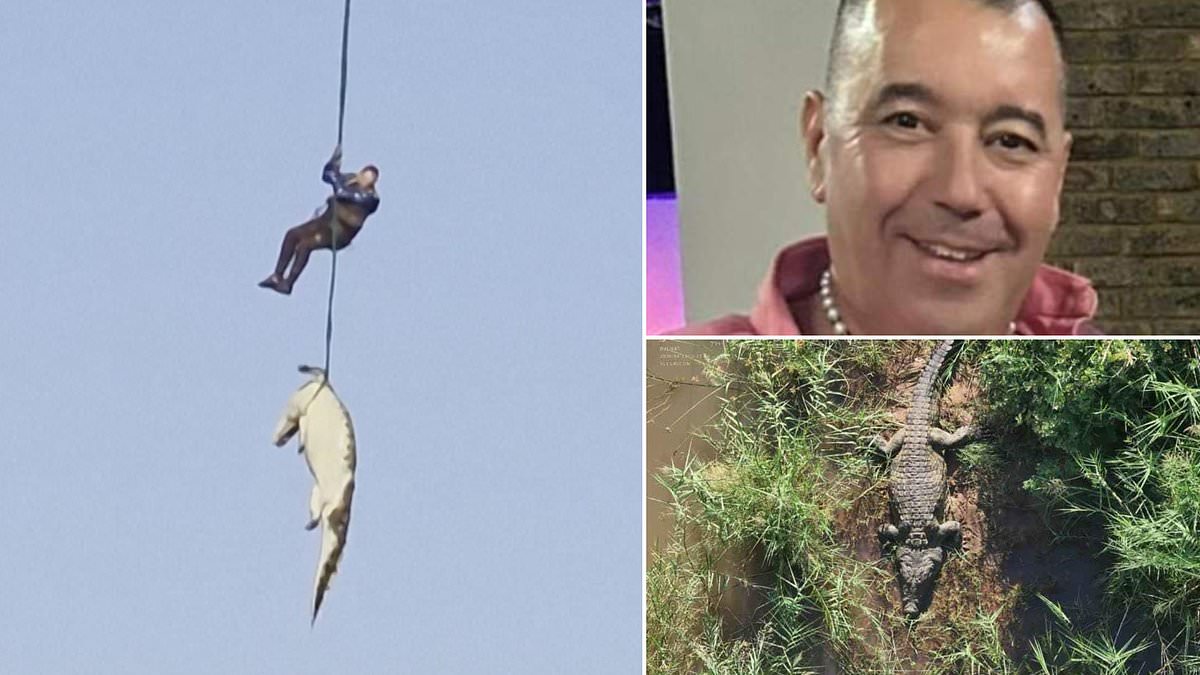
A hotel manager tragically consumed by a crocodile in South Africa has been identified. The shocking incident unfolded when authorities discovered the animal with his remains inside, leading to a dramatic airlift operation by a police dive team from a river island.
The victim, 59-year-old Gabriel Batista, was found within the massive reptile after it was brought to the ground at Kruger National Park. A field necropsy revealed the gruesome contents of the creature’s stomach, including Batista’s remains.
During their investigation in Komatipoort, located in Mpumalanga Province, police also uncovered six pairs of shoes in the crocodile’s belly.
South African Police Captain Joey Potgieter led the procedure that uncovered two severed arms, complete with hands, along with parts of a rib cage and chest tissue.
DNA tests confirmed the remains belonged to Batista, who was swept away by powerful floodwaters before the tragic encounter.
Interestingly, none of the shoes found were linked to Batista, sparking concerns that the crocodile may have been a rogue predator responsible for multiple attacks or had fed on other drowning victims in recent years.
Crocodiles cannot digest plastic according to wildlife experts hence the discovery of shoes including flip flops, sandals, Nike trainers and high heels.
A full investigation is now underway to try to link the shoes to missing locals or villagers who use the often flooded bridge either on foot or by car and had been swept away.
The remains of Gabriel Batista (pictured), 59, were found inside the half-ton carnivore
Police investigating the incident at the town of Komatipoort in Mpumalanga Province found six pairs of shoes inside the crocodile’s stomach
The drama began last Monday when Batista tried to drive over the flooded low level bridge by the town golf course to get to his hotel and bar on the other side as the river levels rose.
But the vicious currents pushed his 4×4 Ford Ranger over the side and onto rocks and the businessman is believed to have climbed out of the vehicle to try and wade to safety.
But they believe the strength of the water washed him off his feet and down the Komati River towards the nearby border with Mozambique and the hungry crocodiles.
Police and wildlife rangers said dozens of the fearsome carnivores use the muddy islands in the river and the sandy banks to lie and wait for prey swept downstream.
It is not known if Batista drowned before being eaten by the crocodile that was shot dead and it is possible his remains may also be inside several other crocs.
The victim owned the Border Country Inn and sports bar just a short drive from the regularly flooded bridge and 3 miles from the world-famous Kruger National Park.
A spokesman said: ‘Gabriel was a lovely guy and a family man who was married with lots of kids and he spent a lot of time up here and customers loved him.
‘He lived in Johannesburg but owned this guest house and bar and spent a lot of time here and was on his way to work on Monday when he was just swept away.
The bravery of the police dive team commander Captain Johan ‘Pottie’ Potgieter has been hailed after he volunteered to be airlifted in to retrieve the shot-dead croc.
His team suspected that Batista had been eaten and sent up a drone on Tuesday and monitored the activity of the resident crocodiles on the mudbank islands.
Capt Potgieter said: ‘My dive team have been recovering bodies from local rivers in this part of South Africa for a long time so we know the behaviour or crocodiles.
‘From a drone we studied a number of crocodiles on an island 60m from the bridge and we identified one particular croc we were 100 per cent certain had eaten the man.
‘This very large one was not moving in the sun and showed typical signs of recent feeding as it has a massively full tummy and stayed out of the nearby water.
‘He made no effort to move despite the noise of the drones or our chopper overhead or any inclination to seek out food so we were sure it was this crocodile’ he said.
Permission had to be sought to euthanise the crocodile which was given on Saturday and he was killed with a single shot from a marksman on the police helicopter.

The bravery of the police dive team commander Captain Johan ‘Pottie’ Potgieter has been hailed after he volunteered to be airlifted in to retrieve the shot-dead croc
The next task was to recover the predator from the crocodile infested island.
Captain Potgieter said: ‘I got the job and was put into a harness and the noise of the gunshot and the helicopter that lowered me down scattered the other crocodiles.
‘There was so many things that could go wrong and the rope basically lowered me onto the snout of the crocodile so I was kind of hoping it really was properly dead!
‘There were two crocs nearby watching as I slipped the harness around the waist of the dead crocodile and secured it under the front legs and tightened the strap.
‘Then I signalled to the chopper and it just took me straight up leaving a lot of big crocodiles behind and then we flew to a landing zone to open the croc up’ he said.
His police service wife Captain Joey Potgieter opened up the dead crocodile.
Lieut General Puleng Dimpane, acting National Police Commissioner, commended the extraordinary bravery and selflessness displayed by Captain Potgieter.
She said: ‘His willingness to place his own life in danger is going far beyond the call of duty to try and bring some form of closure to the family and shows great bravery.
‘It reflects the unwavering commitment of South African Police members to do the right thing even in the face of a danger that could have cost him his very life’.
The Nile crocodile is amongst Africa’s most feared predators and has one of the strongest bites in the animal kingdom which has 8 times of the force of the Great White Shark.
They kill 1000 people a year in Africa, grow up to 20ft long, weigh up to 1500lbs and can run at 22mph and are no match for a human. Few are lucky to escape their attack.
They feed mainly on fish but can easily take down buffalo, antelope, young hippo and young elephants and have 64 to 68 teeth up to five inches long to grip and hold onto their prey.