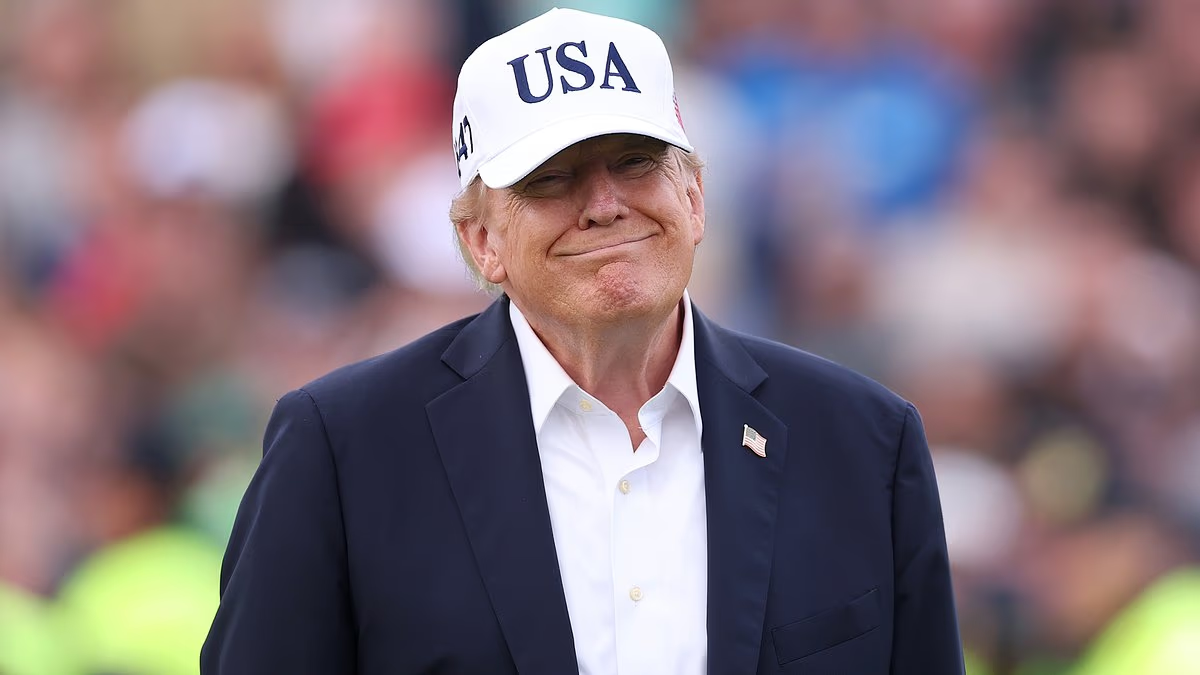

President Donald Trump has suggested that the United States could maintain a presence in Iran even after the war ends, saying he may draw on his administration’s approach to Venezuela.
In remarks to reporters over the weekend, Trump said he was considering staying in the oil-rich Islamic Republic after the conflict to gain access to its crude reserves—effectively treating the oil as a form of compensation.
After again predicting that the war could continue until after the US midterm elections in November, Trump said Washington might ultimately remain in Iran and “keep the oil.”
“We’ll ultimately get out unless we decide to stay and keep the oil, like Venezuela,” Trump said.
The Trump administration recently reached an agreement through the Pentagon’s Office of Strategic Capital with North American Blue Energy Partners, a private company described as Venezuela’s second-largest producer. Under the deal, the company would sell the United States up to 20 percent of Venezuela’s oil at the cost of production.
‘We have the oil now,’ Trump said Sunday, referring to the Venezuelan agreement. ‘We’re bringing millions and millions in.’ The arrangement could help replenish the United States’ depleted strategic petroleum reserve while easing pressure on gasoline prices, which have climbed during the war.
Iran’s distance from the United States, combined with the hostility of its leadership, raises major questions about how Washington could manage a large-scale oil transfer from the other side of the world, whether through military resources or civilian operations.

President Trump said the United States could remain in Iran after the war to extract oil from the Islamic Republic

Global oil prices have surged during the Iran war as restrictions disrupt traffic through the Strait of Hormuz. Prices have climbed even higher after Houthi fighters began threatening the Bab al-Mandeb Strait off Yemen

The national average price for diesel has reached a record $6.23 per gallon
If Trump were to pursue such a strategy, US troops could be required on the ground in Iran to oversee oil production and transportation operations.
Venezuela’s interim President Delcy Rodriguez has said the agreement with Washington could support production of as many as 1.5 million barrels of oil per day. Analysts caution, however, that Rodriguez was willing to cooperate with Trump—an option Iranian leaders may be far less likely to accept.
‘The Venezuela deal worked because the people left running Caracas after Maduro were pragmatists who valued survival over ideology, and the President read that correctly,’ César Dager, a partner at Tower Strategy advising on energy and Venezuela, told Our News Outlet. ‘The state apparatus stayed in place and the oil sector was ready to transact within weeks. Iran is a different negotiating partner.’
‘Any arrangement in Iran that looks like the Venezuela model would require a sustained U.S. security presence to protect the fields, the infrastructure, and the companies operating there, and that carries a cost and a timeline the Venezuela deal never faced.’
Details aside, the president has grasped for solutions to abate ballooning US gas prices before the November elections.
The nationwide average cost for a gallon of regular-grade gasoline reached $4.32, according to the American Automobile Association (AAA). The highest-ever gas price for a gallon of regular topped out at $5 in 2022 following inflation from the COVID-19 pandemic.
Meanwhile, diesel fuel prices hit a record high on Monday, reaching $6.23 a gallon, per AAA.

Fishermen motor past a commercial vessel anchored off Yemen’s coast at Bab al-Mandeb, in the straits connecting the Red Sea with the Gulf of Aden and the Indian Ocean on September 12, 2026

A satellite image shows a closer view of the damage at the Saudi Arabia East-West pipeline, located across the Arabian Peninsula, after a strike that hit it on September 11, 2026,
US gas prices have shot up well over $1 per gallon compared to prices before the war began.
The president has claimed on numerous occasions that gas prices ‘will drop like a rock’ after the elections, but he has done far less explaining about how or why they would.
Inflation and prices were ranked as the top concerns of both Republican and Democratic respondents in a poll from The Economist published last week.
The second-largest concern among voters in the survey were the economy and jobs.
Those concerns are not likely to dissipate quickly given the Iran war’s protracted timeline. Trump initially estimated the war would be wrapped up within six weeks, but now the conflict has raged for over six months.
Global oil prices have jumped dramatically during the Iran war because of the restrictions placed on the Strait of Hormuz, through which some 20 percent of the world’s oil supply flows.
The US is currently blockading all Iranian vessels from transiting the critical waterway.
Furthering the oil price woes are the recent advances Houthi forces have made within Yemen and an Iranian-backed attack on Saudi Arabia’s critical East-West oil pipeline.
An attack launched out of Iraq severely damaged the important pipeline, through which some four percent of the world’s oil supply flows.
With Houthi fighters’ recent advances within Yemen, gaining new territories, they now have more control over the Bab al-Mandeb Strait, forcing oil prices even higher.
Brent crude oil has shot up roughly 20 percent over the past month, with the renewed regional instability threatening supplies. As of Monday morning, Brent hovered around $109 per barrel.


