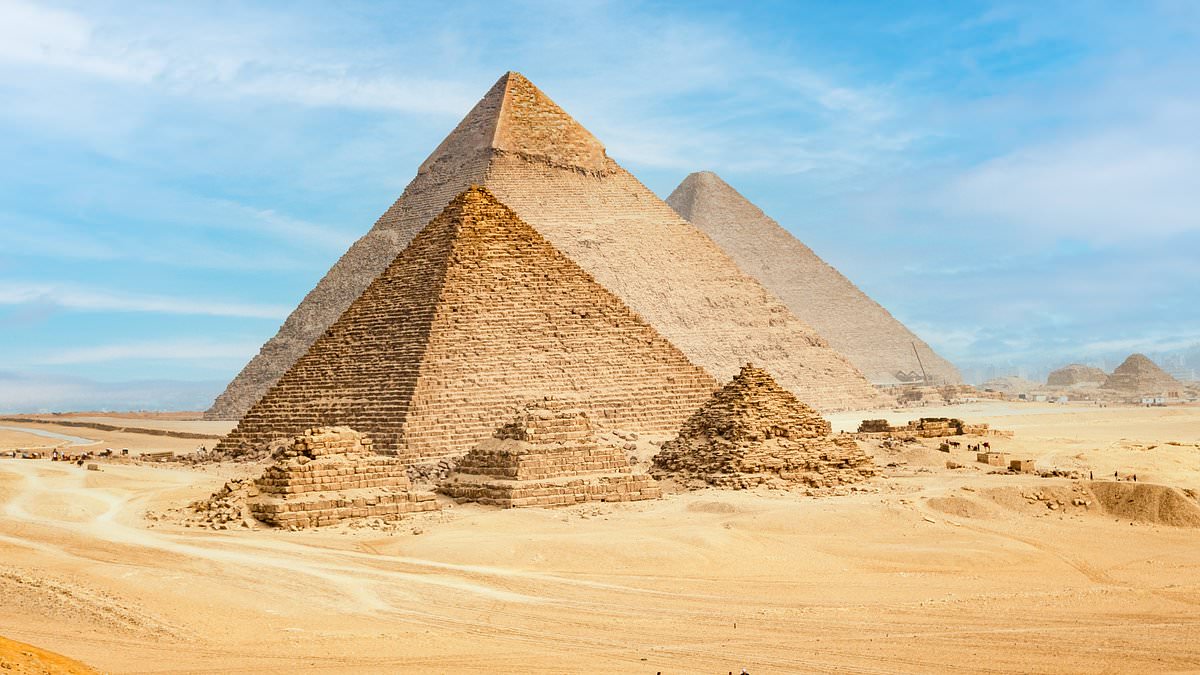

The age-old enigma surrounding the construction of Egypt’s Great Pyramid might finally be unraveling. For many years, historians and archaeologists have puzzled over how ancient builders managed to transport and place the enormous stone blocks that make up the pyramid, some of which weigh as much as 15 tons, all without the aid of modern machinery. The absence of written records documenting the techniques used has only deepened the mystery.
However, a recent study introduces a fascinating theory that could illuminate these ancient engineering feats. It proposes that the Pyramid of Khufu was constructed utilizing a concealed spiral ramp that wound its way inside the structure. This innovative hypothesis offers a fresh perspective on the construction methods employed by the ancient Egyptians.
Vicente Luis Rosell Roig, a computer scientist, has put forward the idea that an ‘edge ramp’ was employed by the workers—a sloping path that followed the outer edges of the pyramid. As each new layer of the pyramid was completed, this ramp would have been gradually enveloped by the subsequent layers. This approach would have enabled the laborers to incrementally maneuver the stones upwards, layer by layer, eliminating the need for enormous external ramps.
The sheer magnitude of this architectural marvel is awe-inspiring. The base of the pyramid spans approximately 755 feet on each side, and it towers to a height of around 481 feet. Understanding the techniques behind its construction not only sheds light on the ingenuity of ancient civilizations but also deepens our appreciation for their remarkable achievements.
Instead of relying on massive external ramps, this would have allowed workers to move stones steadily upward, one level at a time.
The scale of the project is staggering. The pyramid stretches around 755 feet along each side of its base and rises to about 481 feet.
Historians estimate it was built from roughly 2.3 million stone blocks – a feat that required extraordinary planning and coordination during Pharaoh Khufu’s reign.
The new model also sheds light on how long the construction may have taken.

The construction of Egypt’s Great Pyramid has long baffled archaeologists, with no surviving ancient texts explaining how its massive stone blocks were lifted and assembled so quickly
Simulations suggest blocks could have been placed every four to six minutes – a fast, consistent pace.
At that rate, the pyramid could have been completed in just 14 to 21 years.
When quarrying, transport, and breaks for workers are factored in, the total timeline rises to around 20 to 27 years, in line with existing estimates.
Crucially, the theory could also explain why mysterious empty spaces have been detected inside the pyramid. It suggests parts of the hidden ramp could still be inside.
‘Old Kingdom technology precluded iron tools, wheeled heavy transport, and compound pulleys, but allowed copper chisels, water-lubricated sledges, ropes, levers, earthen works, and Nile barges,’ Rosell Roig said in a study in NPJ Heritage Science, published in March 2026.
‘Accordingly, we bound ramp slope, lane width/clearance, and friction, and evaluate the dispatch headway (time between placing successive blocks) required to satisfy the 20–27-year window, encoding these constraints as model parameters.’
For centuries, experts have debated how ancient builders managed to raise such massive materials with limited technology while maintaining the pyramid’s precise geometry.
Many earlier ramp theories struggled to explain how construction could continue efficiently without creating obstacles or requiring vast amounts of additional material.

Now, a new study proposes that the Pyramid of Khufu may have been built using a sophisticated hidden ramp system capable of moving stone blocks every few minutes
Rosell Roig’s research aimed to address these challenges by combining multiple forms of analysis into a single system.
According to the study, he built a computer model that simulated how stones were moved and how the structure stayed stable as it rose layer by layer.
At the center of the system is the IER ramp itself, a gradual path built into the pyramid’s outer structure rather than relying on massive external ramps.
Sections of the outer stone layers were temporarily left open to form the upward path, then filled in as work progressed, removing visible evidence of the ramp once construction was complete.
Rosell Roig described this method as ‘a helical path formed by omitting and backfilling perimeter courses,’ allowing the ramp to rise alongside the structure.
Timing proved to be one of the most important elements of the study. The model calculated that maintaining steady block placement intervals would allow construction to proceed within realistic historical timeframes.
When expanded to include additional logistical steps such as quarrying stone and transporting materials along the Nile, the overall construction window increased but remained consistent with accepted estimates.
Structural stability was another major focus, with staged finite-element analysis used to simulate the pressure created as each new layer of stone was added to the growing monument.
The results showed that ‘stresses and settlements remain within plausible limits for Old Kingdom limestone under self-weight,’ indicating the structure could support its own immense mass throughout construction.
The model was also tested against physical observations already detected inside the pyramid. Imaging technology has revealed unexplained internal spaces, and the study found that the proposed ramp geometry corresponds with those features.

This design would have allowed workers to move stone blocks steadily upward without constructing massive external ramps that would have required enormous amounts of additional material
That alignment suggests the voids may not be accidental gaps, but structural elements created as part of the building process.
A key strength of the model is its ability to be tested. Rather than offering an unprovable idea, the research outlines measurable physical markers that archaeologists could investigate.
These include ‘falsifiable predictions (edge-fill signatures, corner wear),’ referring to specific patterns expected where ramps were filled in or where heavy traffic would have caused repeated wear.
According to Rosell Roig, the IER model helps solve several long-standing questions about how the pyramid was constructed efficiently without leaving visible traces.
He wrote that the system ‘helps reconcile throughput, survey access, and zero-footprint closure,’ meaning it allows construction to remain efficient while preserving the pyramid’s final appearance.
By combining logistics, geometry and structural modeling into a single framework, the study presents what it describes as a workable construction pathway grounded in measurable constraints.
If future archaeological investigations confirm the predicted physical evidence, the findings could reshape modern understanding of how one of the world’s most famous monuments was built, not through brute force alone, but through careful planning, engineering precision and a construction method designed to disappear into the finished structure itself.