Share this @internewscast.com
Reports suggest that when Israel gave a confidential briefing at the White House to persuade President Trump to initiate Operation Epic Fury against Iran, most of Trump’s closest advisors were skeptical about the plan.
According to the New York Times, Israeli Prime Minister Benjamin Netanyahu was granted a rare opportunity to pitch his case in the Situation Room, an unusual setting for direct discussions with foreign dignitaries.
On February 11, Netanyahu sat across from Trump and delivered a comprehensive, hour-long presentation. His argument was straightforward: Iran was susceptible to attack, and the moment was ideal for instigating regime change.
The Israeli officials painted a scenario of rapid and decisive victory, asserting that Iran’s missile infrastructure could be neutralized in a matter of weeks.
They assured that the Strait of Hormuz would remain accessible and that any retaliatory actions against American interests would be limited.
In conjunction, Israel’s intelligence agency, Mossad, reportedly had plans to incite an internal rebellion to bring the mission to fruition.
At one point, Netanyahu played a video montage highlighting potential future leaders of Iran should the regime collapse – including Reza Pahlavi, the exiled son of the country’s last shah.
Trump’s reaction was positive, and he appeared to be on board.

President Donald Trump (R) meets with the Israeli Prime Minister Benjamin Netanyahu (L) at the White House on February 11

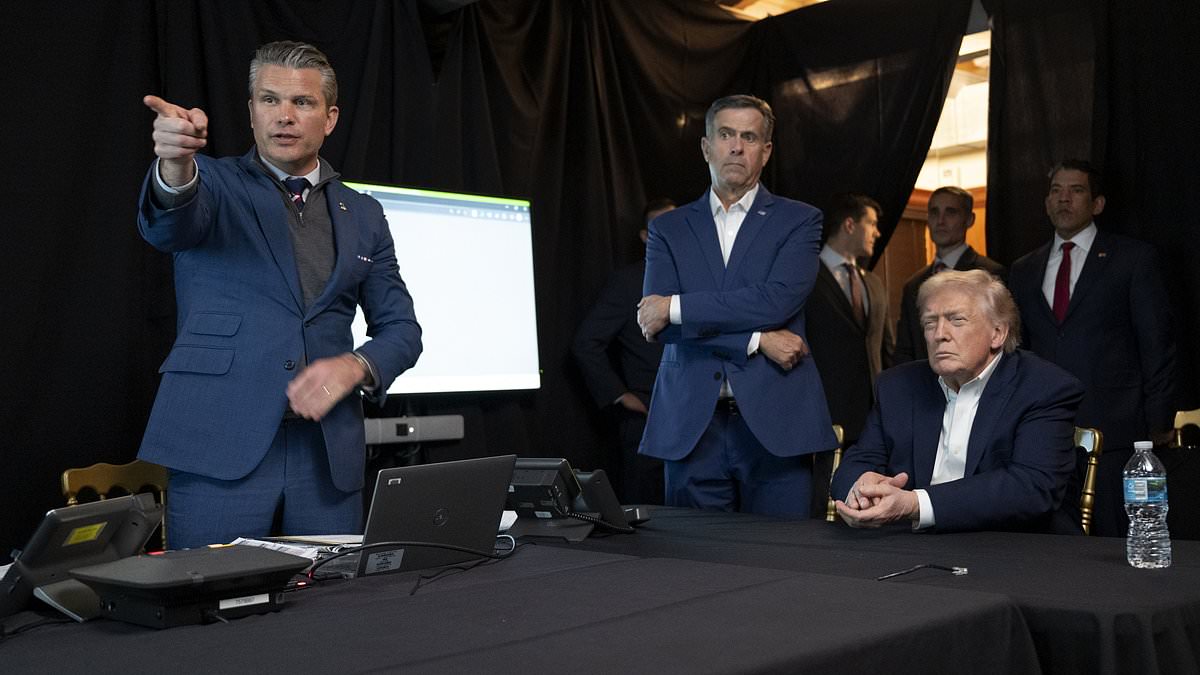
President Donald Trump, Secretary of War Pete Hegseth (L), and CIA Director John Ratcliffe monitor US military operations in Venezuela, from Trump’s Mar-a-Lago Club on January 3, 2026 in Palm Beach, Florida

Iranians burn US and Israeli flags during a demonstration following the announcement of a two-week ceasefire at Enghelab Square in Tehran, Iran, 08 April 2026
Within hours of Netanyahu’s presentation, US intelligence agencies began urgently assessing the claims.
By the following day, their verdict was delivered in another Situation Room session, and it was stark.
While analysts agreed that certain military objectives, such as targeting Iran’s leadership and degrading its regional threat capabilities, were achievable, they dismissed the broader vision of regime change.
The idea of a popular uprising replacing the Islamic government with a secular alternative was deemed unrealistic.
CIA director John Ratcliffe summed it up in a single word: ‘Farcial’.
Trump listened – but did not dwell on it. Regime change, he said, would be ‘their problem’.
His focus remained firmly on military action against Iran’s leadership and infrastructure.
Among Trump’s inner circle, only Vice President JD Vance consistently and forcefully opposed the push toward conflict.
Having built his political identity on resisting foreign military interventions, Vance warned colleagues that a war with Iran could spiral into catastrophe.
He cautioned that it risked destabilising the entire region, causing massive casualties and fracturing Trump’s political base – particularly among voters who backed a promise to avoid new wars.
Vance also highlighted practical concerns, including dwindling US munitions, the unpredictability of Iran’s response, and the possibility that Tehran could choke off the Strait of Hormuz, sending global energy prices soaring.
While he initially argued against any strikes, Vance later shifted to advocating more limited options – and, failing that, overwhelming force to bring a rapid end to hostilities.
At the final meeting on February 26, he made his position unmistakably clear, expressing to Trump that he thought starting a conflict was a bad idea, but that he would support his decision.
Elsewhere in the room, doubts existed but rarely translated into direct opposition.

President Donald Trump (2L), US Secretary of State Marco Rubio (3R) and White House Chief of Staff Susie Wiles (2R) monitoring activity related to ‘Operation Epic Fury’ against Iran from an unnamed location on February 28, 2026

Pro-government demonstrators chant slogans as they hold Iranian flags and a poster of the Supreme Leader Ayatollah Mojtaba Khamenei in a gathering after announcement of a two-week ceasefire, at the Enqelab-e-Eslami, in Tehran, Iran, April 8, 2026
Defence Secretary Pete Hegseth emerged as one of the most hawkish voices. We’re going to have to take care of the Iranians eventually, so we might as well do it now, he told colleagues on the eve of Trump’s final decision.
Rubio took a more cautious stance, favouring continued economic pressure over war, but stopped short of challenging the President outright.
White House Chief of Staff Susie Wiles harboured concerns about the political risks – particularly with midterm elections looming – yet chose not to voice them in a group setting.
Meanwhile, Chairman of the Joint Chiefs of Staff General Dan Caine repeatedly flagged the dangers, such as depleted weapons stockpiles, the risk of Hormuz being shut, and the unpredictability of Iran’s retaliation.
However, his careful insistence that it was not his role to advise the President on what decision to make meant his warnings often lacked force.
To some, it appeared he was presenting every side without taking a clear position – leaving Trump free to interpret the advice as he saw fit.
Central to Trump’s thinking was a firm conviction that any conflict would be swift.
He drew confidence from recent events – including Iran’s limited response to earlier US strikes on its nuclear facilities, and a dramatic commando raid that captured Venezuelan leader Nicolas Maduro without any American casualties.
Warnings that Iran could lose the Strait of Hormuz, which is a vital artery for global oil supplies, were brushed aside.
Trump assumed Tehran would back down before taking such drastic steps.
Similarly, concerns over dwindling US weapons reserves were weighed against what the President saw as a key advantage – a vast supply of inexpensive, precision-guided bombs.
When commentator Tucker Carlson privately questioned his certainty, Trump’s reply was characteristically blunt: ‘Because it always is’.
Ultimately, the reporting suggests that the decision to go to war was not the product of a unified strategic consensus.
Instead, it stemmed from Trump’s instinct – bolstered by a team far more aligned with him than during his first term.
Unlike earlier advisers who often sought to restrain or redirect him, his second-term circle largely viewed him as a transformative historical figure.
His political comeback in 2024, survival through legal battles and assassination attempts, and previous high-profile successes had only reinforced that belief.
In that environment, scepticism struggled to gain traction.
After over a month of war, Iran and the US have agreed to a conditional two-week ceasefire, during which shipping traffic will be allowed through the Strait of Hormuz.
But it remains to be seen whether the break in hostilities is binding, or simply a brief pause before diplomacy shatters and the conflict explodes again.
Despite the ceasefire, strikes appear to be continuing, with Kuwait on Wednesday morning reporting Iranian attacks which damaged power and desalination plants as well as oil facilities.
And there is fundamental disagreement about what the ceasefire even entails, with Netanyahu insisting it doesn’t include Lebanon, where Israel has been fighting the Iranian-backed armed group Hezbollah.
According to Pakistan’s Prime Minister Shehbaz Sharif, Lebanon is included.
Since the coordinated attacks on Iran were launched on February 28, several predictions of the Israeli Prime Minister haven’t come to fruition.
While he assured his American counterpart Tehran’s missile arsenal could be dismantled in a matter of weeks, the Islamic Republic clearly has been able to maintain its bombardment of Gulf neighbours.
The regime also defied expectations by enforcing the de facto shutdown of the Stait of Hormuz, the passageway between the Persian and Oman gulfs which handles around 20 per cent of the world’s oil and gas
Its closure has triggered the biggest disruption to global energy supplies in history.
The situation is ‘more serious than the ones in 1973, 1979 and 2022 together’, Fatih Birol, the executive director of the International Energy Agency (IEA), told newspaper Le Figaro.
‘The world has never experienced a disruption to energy supply of such magnitude,’ he said in an interview with the French outlet.
He added that European countries, as well Japan, Australia and others will suffer, but those most at risk were developing nations which will be hit by higher oil and gas prices, increased food prices and a general acceleration of inflation.
Netanyahu’s assurance that attacks against American targets would be minimal has also been proven wrong.
Iranian strikes on military bases used by the US in the Middle East caused about $800m (£600m) in damage in the first two weeks of the war, according to the Center for Strategic & International Studies (CSIS).
The constant bombardment of US bases in the Gulf has meant thousands of troops and personnel have evacuated the region, forcing Washington to prosecute its war remotely.
And despite the fact that Gulf states assured Tehran that none of their bases would be used for attacks, this has not stopped the regime from launching thousands of drones and missiles targeting airports, oil refineries, ports, hotels and office buildings.