
Share this @internewscast.com

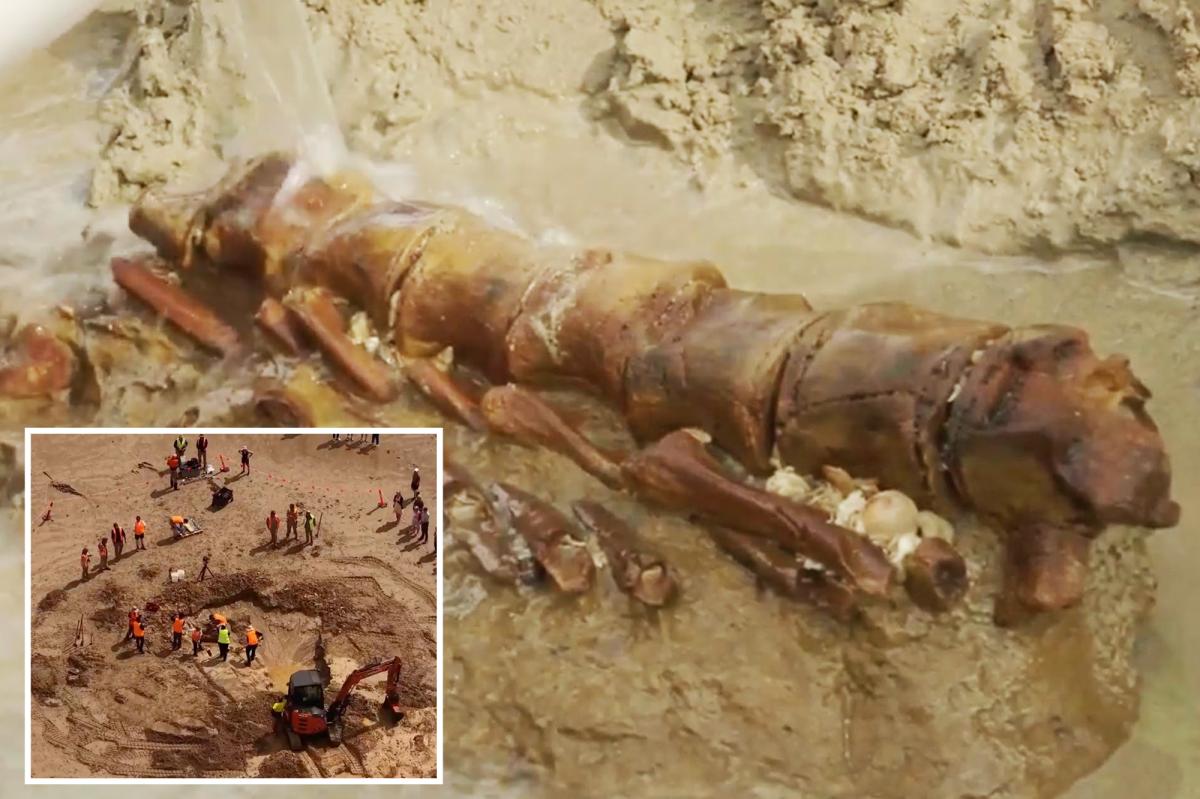
In an extraordinary discovery on an Australian beach, a family vacationing stumbled upon a 20-million-year-old whale fossil. This rare find, described as “mind-blowing,” has captured the attention of paleontologists due to its significance and size, potentially marking it as one of the largest whale fossils ever unearthed in Australia.
The ancient vertebrae were hidden beneath approximately 1.5 feet of sand at Ocean Grove Beach in Victoria. The fossil was initially spotted in December by a family of five, who quickly recognized they had found something extraordinary.
Kristina Davidson, one of the family members, recounted the moment to Nine News, saying, “I pretty much stumbled over it. We spent some time trying to dig it up and look at it, and took some photos.” She described the fossil’s impressive display, noting, “There’s the spine, there’s rib bones, it’s just kind of all there.”
On Thursday, a team of paleontologists descended on the site to carefully excavate the enormous fossil, which was encased in a substantial one-ton sandstone block. Their efforts mark the beginning of a significant recovery operation aimed at preserving the relic for further study.
“There’s the spine, there’s rib bones, it’s just kind of all there.”
Dozens of experts arrived at the site on Thursday to start digging up the giant fossil, which was encased in a one-ton sandstone block.
“We got out in the field, the weather was great and the fossil was monumental,” Dr Eric Fitzgerald, a senior paleontologist at Museums Victoria Research Institute, told ABC News.
“It’s very rare to find fossils where you still have the bones of the skeleton connected together.”
Fitzgerald said it took some time to locate the full fossil under that much sand before his team had to scramble to extract the remains as the tide rose.
“There were some real hairy moments,” he said.
“I was looking at my clock, I was looking at the worried faces of the excavator operators, I thought it’s now or never.”
“They look pretty solid but it’s essentially bone turned to stone,” Fitzgerald added of the fossil remnants. “They can be quite brittle so we had to use as much care as possible.”
He praised the excavator operator who ultimately retrieved the fossil as “an absolute legend.”
“He shifted it as though it was a newborn child, the delicacy with which he operated that heavy machinery and a 1-tonne block of sandstone… was one of the most marvelous things I’ve ever seen in my life,” he said.
The fossil was subsequently loaded onto a truck and then transported to Melbourne so it can be fully examined and studied.