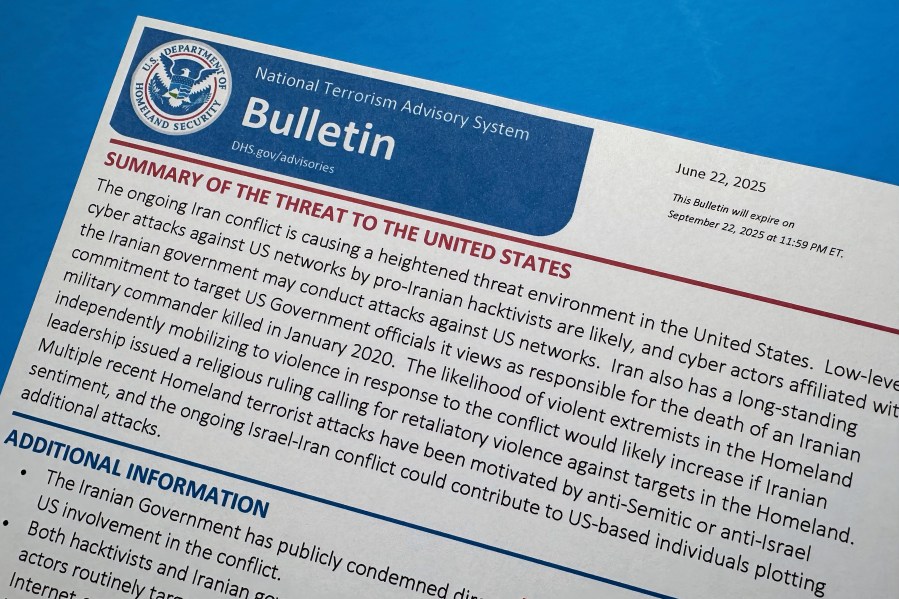


The Department of Homeland Security has issued a warning about an increased threat level following U.S. military actions against Iranian nuclear facilities. According to the deputy director of the FBI, the agency’s resources are fully committed to preventing any retaliatory violence. In response, local law enforcement in major cities like New York are remaining highly vigilant.
So far, there haven’t been any verified threats to the U.S. following the covert American operation. It’s also yet to be determined how a potential ceasefire announced on Monday between the U.S., Israel, and Iran will impact any threats, or how enduring such an agreement might be.
However, the risk of retaliation remains a real concern. This is especially true given Iran’s alleged actions in the past to target political figures within the U.S. and the history of cyberattacks on American targets by hackers backed by Iran.
The U.S. has alleged that Iran’s most common tactic over the past decade, rather than planning mass violence, has been murder-for-hire plots in which government officials recruit operatives — including reputed Russian mobsters and other non-Iranians — to kill public officials and dissidents. The plots, which Tehran has repeatedly denied engineering, have been consistently stymied and exposed by the FBI and Justice Department.
“You run into this problem that it’s not like there’s this one sleeper cell that’s connected directly to command central in Iran. There’s a lot of cut-outs and middlemen,” said Ilan Berman, a senior vice president of the Washington-based American Foreign Policy Council. “The competence erodes three layers down.”
Whether Iran intends to resort to that familiar method or has the capacity or ambition to successfully carry off a large-scale attack is unclear, but the government may feel a need to demonstrate to its people that it has not surrendered, said Jon Alterman, a Middle East expert at the Center for Strategic and International Studies.
“The capability to execute successfully is different from the capability to try,” he said. “Showing you’re not afraid to do this may be 90% part of the goal.”
Hours after the attack on Saturday evening U.S. time, FBI and DHS officials convened a call with local law enforcement to update them on the threat landscape, said Michael Masters, who participated in it as founding director of Secure Community Network, a Jewish security organization that tracks Iranian threats.
The DHS bulletin released over the weekend warned that several foreign terror organizations have called for violence against U.S. assets and personnel in the Middle East. It also warned of an increased likelihood that a “supporter of the Iranian regime is inspired to commit an act of violence in the Homeland.”
“The amount of material that we’re tracking online is at such a fever pitch at the moment,” Masters said.
A plot against President Donald Trump
The Justice Department in November disclosed that it had disrupted a plot to kill Donald Trump before the 2024 election, a reflection of the regime’s long-running outrage over a 2020 strike that killed Iranian Gen. Qassim Soleimani.
The scheme was revealed to law enforcement by an accused Iranian government asset who spent time in American prisons for robbery and who is alleged to maintain a network of criminal associates enlisted by Tehran for surveillance and murder-for-hire plots.
The man, Farhad Shakeri, told the FBI that a contact in Iran’s paramilitary Revolutionary Guard instructed him last September to set aside other work he was doing and assemble a plan within seven days to surveil and ultimately kill Trump, authorities have said.
He said the official told him if he could not put together a plan within that timeframe, then the plot would be paused until after the election because the official assumed Trump would lose and that it would be easier to kill him then, according to a criminal complaint.
Shakeri disclosed some of the details of the alleged plots in a series of recorded telephone interviews with FBI agents while in Iran, the complaint said. The stated reason for his cooperation, he told investigators, was to try to get a reduced prison sentence for an associate behind bars in the U.S. Shakeri is at large and has not been apprehended.
A plot against John Bolton
John Bolton was ousted from his position as Trump’s national security adviser months before the Soleimani strike, but he nonetheless found himself targeted in a plot that U.S. officials say was orchestrated by a member of the Revolutionary Guard and involved a $300,000 offer for an assassination.
Unbeknownst to the operative behind the plot, the man he thought he was hiring to carry out the killing was actually a confidential informant who was secretly working with the FBI.
The Justice Department filed criminal charges in August 2022 even as the operative, Shahram Poursafi, remained at large.
A plot against Masih Alinejad
Sometimes the intended target is not a U.S. government official but rather a dissident or critic of the Iranian government.
That was the case with Masih Alinejad, a prominent Iranian American journalist and activist in New York who was targeted by Iran for her online campaigns encouraging women there to record videos of themselves exposing their hair in violation of edicts requiring they cover it in public.
Two purported crime bosses in the Russian mob were convicted in March of plotting to assassinate her at her home in New York City in a murder-for-hire scheme that prosecutors said was financed by Iran’s government.
Prosecutors said Iranian intelligence officials first plotted in 2020 and 2021 to kidnap her in the U.S. and move her to Iran to silence her criticism.
When that failed, Iran offered $500,000 for Alinejad to be killed in July 2022 after efforts to harass, smear and intimidate her failed, prosecutors said.
A plot against a Saudi ambassador
Underscoring the longstanding nature of the threat, federal prosecutors in 2011 accused two suspected Iranian agents of trying to murder the Saudi ambassador to the United States.
The planned bomb attack was to be carried out while envoy Adel Al-Jubeir dined at his favorite restaurant in Washington.
And as is common in such plots, the person approached for the job was not an Iranian but rather someone who was thought to be an associate of a Mexican drug trafficking cartel who was actually an informant for the Drug Enforcement Administration.