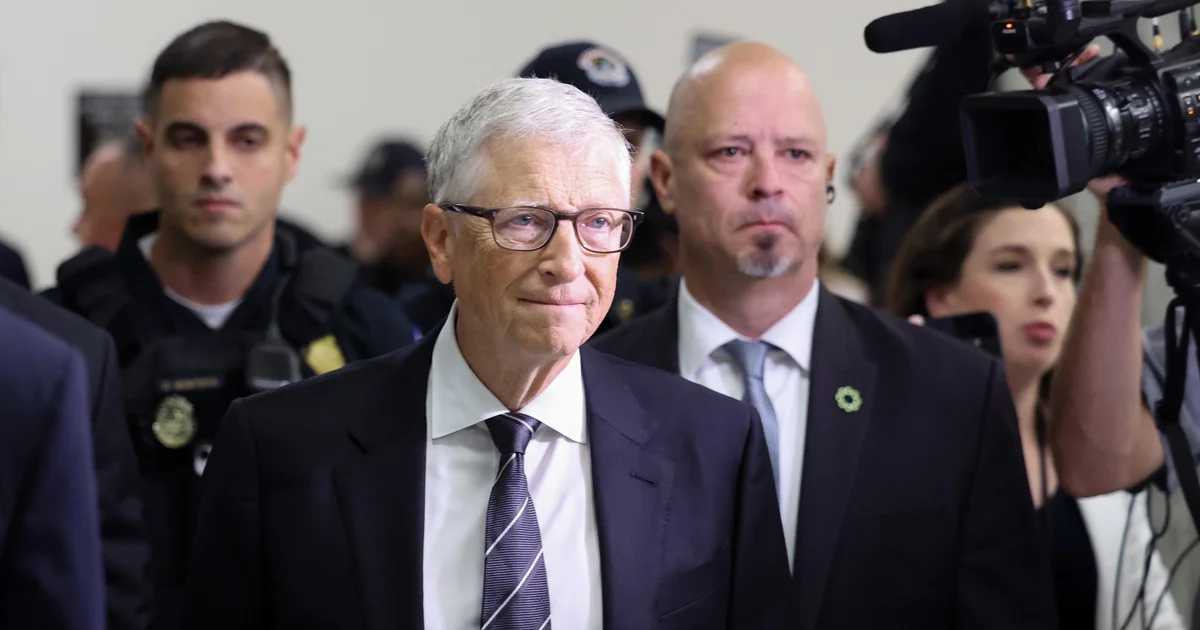
Microsoft co-founder Bill Gates told congressional investigators he believed Jeffrey Epstein may have tried to use knowledge of Gates’ extramarital relationships as a way to gain leverage over him.
Gates appeared before the House Oversight Committee on June 10, testifying for nearly six hours as lawmakers probe the government’s handling of the Epstein case and the people connected to him. According to a transcript released Tuesday, Gates said he first met Epstein in 2011 through adviser Boris Nikolic — three years after Epstein pleaded guilty in Florida state court to charges that included soliciting a minor for prostitution. Gates said his final contact with Epstein came in 2015, four years before Epstein’s arrest on federal sex trafficking charges and his subsequent death in jail.
Gates said he had no knowledge of Epstein’s alleged ongoing criminal activity, though he conceded he was aware of Epstein’s earlier legal troubles. He also told lawmakers he was startled that Epstein appeared to know about two of his affairs involving young Russian women — one a bridge player and the other a nuclear scientist — and acknowledged that Epstein once sought several thousand dollars in reimbursements tied to one of the women.
“These affairs had nothing to do with my interactions with Epstein, but they were painful for my family,” Gates said. In February, Gates apologized to employees at the Gates Foundation for his association with Epstein.
While Gates said he was not blackmailed, he told the committee that certain emails suggested Epstein may have been trying to move in that direction. Gates also acknowledged a third affair and, when questioned by congressional staff, said he did not know Epstein and Nikolic may initially have been linked through that woman.
Epstein also played a role in discussions over an exit package for Nikolic, with emails indicating he appeared to serve as an intermediary between the two sides during severance negotiations.
In his opening remarks, Gates said he and Epstein had talked about “potential giving structures” connected to Gates’ philanthropic work, but said those conversations “were a dead end.” He described the relationship as a “grave error in judgment.”
Gates denied ever making payments to Epstein, saying their discussions were largely focused on finding wealthy donors who might support global health initiatives.
“As the public can now see based on what has been released in the files, Epstein was working to use information about my infidelities, in addition to many lies that he layered on top, to pressure me to reengage with him,” Gates said. “He was unsuccessful in this effort.”
He said they met in person roughly a dozen times, meetings that included visits to Epstein’s New York and Paris homes, and a flight on Epstein’s plane from New York to Florida. Gates said they also had several video calls.
In a statement released following his testimony, Gates said that he “appreciated the opportunity to meet with the House Oversight Committee today and to answer all of their questions. I support the release of all the files and hope my participation contributes to getting justice for the victims.”
Gates was one of several billionaires to testify before the committee, which also interviewed Commerce Secretary Howard Lutnick and businessmen Les Wexner. It is expected to interview investor and Epstein confidant Leon Black later this week.
Others who are expected to be interviewed in the next month include former Goldman Sachs executive and Obama White House lawyer Kathy Ruemmler, and Harvard law professor Alan Dershowitz and former JPMorgan Chase executive Jes Staley.