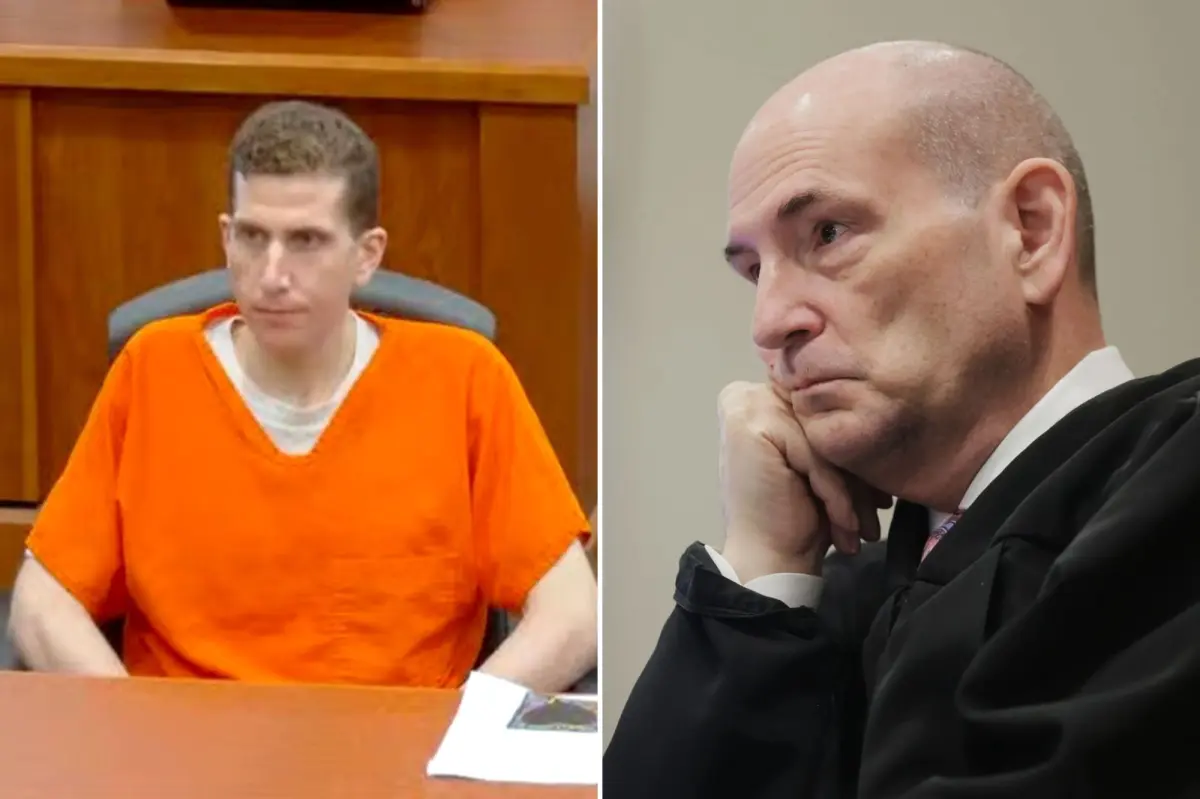

Bryan Kohberger, who was convicted in the deadly stabbing of four University of Idaho students, is now seeking to remove the judge overseeing his case and move the proceedings to a different venue as he tries to withdraw his guilty plea.
The requests were submitted Thursday by Kohberger’s newly appointed attorney, Gregory Rauch, in a pair of motions filed after Kohberger’s first-degree murder conviction.
Kohberger has since maintained that he is innocent, arguing that his previous defense team pressured or guided him into making what he now describes as a false confession.
The filings ask that Fourth Judicial District Judge Steven Hippler be removed from Kohberger’s post-conviction proceedings and that future hearings be transferred out of Ada County. In seeking Hippler’s disqualification, the defense raises concerns about the judge’s ability to remain impartial.
“This motion does not rest upon one adverse ruling, one harsh statement, or the mere fact that the judge who presided over Bryan Kohberger’s criminal case has been assigned to his post-conviction proceeding,” the motion states. “It rests upon the extraordinary convergence of all of them.”
Kohberger’s original criminal trial was moved to Ada County in 2024 to help secure an unbiased jury and ensure the court had sufficient resources. His attorneys now contend that those reasons no longer apply because the current matter is a bench proceeding to be decided by a judge, not a jury.
Kohberger, 31, pleaded guilty last year to four counts of first-degree murder and one felony burglary charge in connection with the 2022 stabbing deaths of University of Idaho students Madison Mogen, 21, Kaylee Goncalves, 21, Xana Kernodle, 20, and Ethan Chapin, 20.
Despite that plea, Kohberger is now asking the court to allow him to stand trial, a move that could again expose him to the possibility of the death penalty.
Here’s the latest coverage on Bryan Kohberger:
The central pillar of the motion to remove the judge rests on the “constitutional adequacy” of the trial counsel’s preparation. Defense lawyers argued the capital trial schedule made it impossible to review the massive amount of evidence in the case.
The defense cautioned the court that forcing it to proceed to trial under those conditions threatened Kohberger’s constitutional right to effective representation.
Hippler rejected the defense’s claims that it was unprepared for trial, accusing it of using the massive volume of discovery as a tactic for delay rather than a genuine concern.
The motion also refers to Hippler’s statement during sentencing in which he made pronouncements regarding Kohberger’s ability to tell the truth.
“Do we really believe, after all of this, he is capable of speaking the truth?” he said, according to the document.
The judge also called Kohberger a “faceless coward” and the “the worst of the worst.”
“Those statements are fundamentally different from believing Kohberger committed terrible crimes or deserved severe punishment,” the motion states. “They are forward-looking judgments about his credibility. And credibility may now be at the center of this proceeding.”
The move to change the venue asks the court to relocate the proceeding from Ada County, where Kohberger pleaded guilty and was sentenced, to Latah County, where the murders occurred.
“Transfer is warranted in a case like this where ‘the convenience of witnesses and the ends of justice would be promoted by the change,’” that motion states.