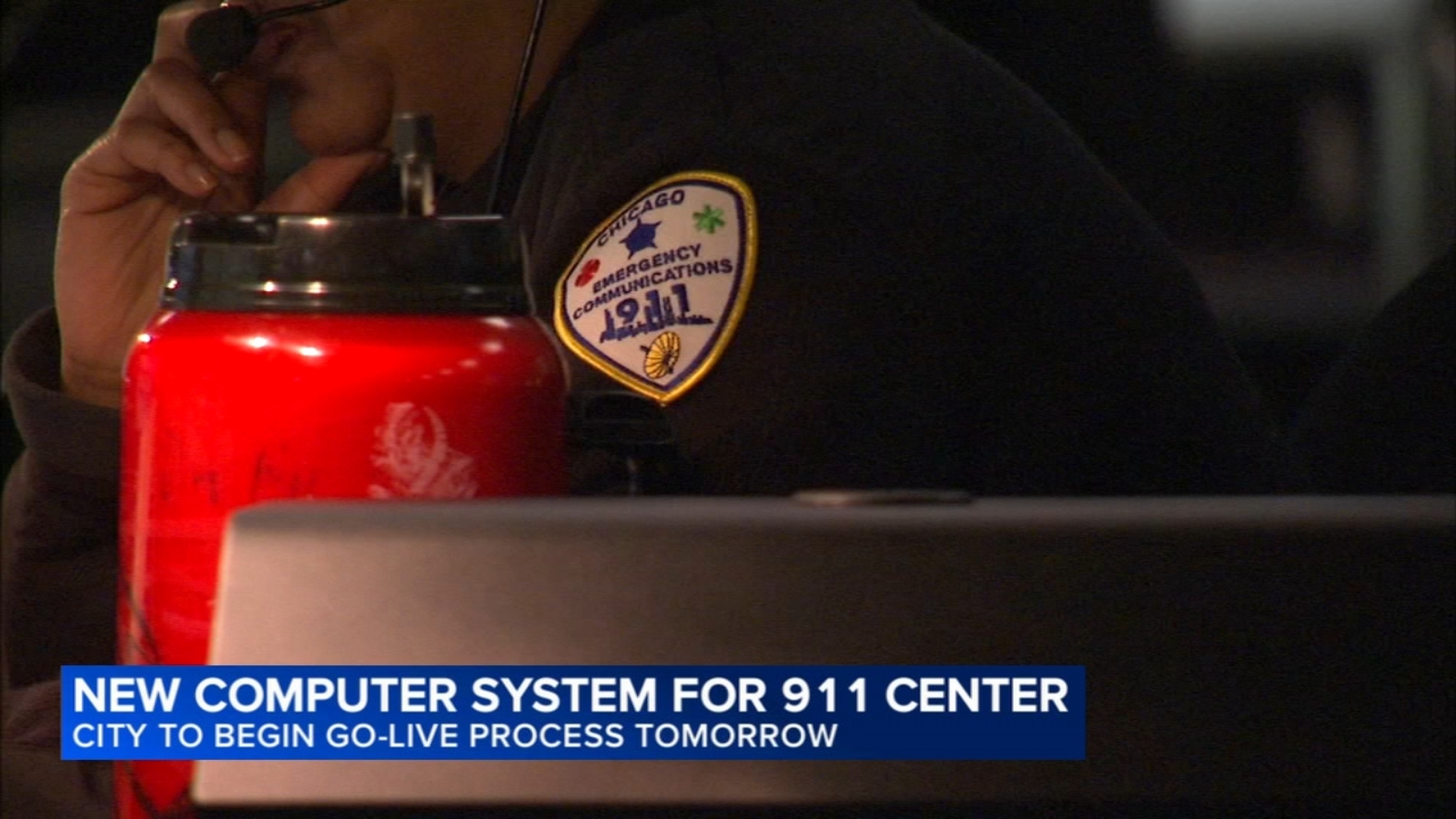

CHICAGO () — Chicago’s Office of Emergency Management and Communications will begin a phased launch of a new 911 center system Tuesday, starting the city’s shift away from dispatch technology that has been in use for roughly three decades.
Chicago signed a six-year-old contract with CentralSquare Technologies and began training employees to use the new computer-aided dispatch system, or CAD. The project represents the city’s first major dispatch technology upgrade in more than 30 years.
City officials say the updated platform should simplify the 911 workflow and contribute to faster emergency responses.
“The old system was one that predated Windows ’95, so if you can think about that from a technology perspective,” Deputy Mayor of Community Safety Emmanuel Andre said.
Andre said initial tests indicate the new system could make dispatch operations more efficient.
“The preliminary examples we have seen in seconds. It seems like that’s not a lot, when you talk about 15-30 seconds, but for that person responding to that call, it is absolutely critical time,” Andre said.
The rollout follows warnings from dispatchers and alderpersons, who fear technical issues with the new platform could interfere with emergency services.
“They are dropping calls. They are not calling back. Some are delayed responses. My concern is it will trickle down to services out here in City of Chicago,” said Ald. Chris Taliaferro, chair of the City Council’s Police and Fire Committee.
The mayor’s office said the software will first operate during a live data simulation and then be activated in stages. The current dispatch platform will remain available as a fallback throughout the transition.
Following concerns from dispatchers, 14 alderpersons wrote to Mayor Brandon Johnson with questions about the new software and its planned implementation.
Ald. Ray Lopez said officials should not proceed until they are satisfied the system can operate reliably.
“Unless we are 100% certain that it’s going to work properly, then we should be figuring out what we need to do in terms of next steps, so that there isn’t a single life lost or injury that could have been avoided if the system fails,” Lopez said.
In its response, the mayor’s office said, “This key milestone aligns directly with industry best practices for major system transitions. As part of the readiness process, the system underwent rigorous testing and was required to successfully handle call volumes far exceeding those anticipated under real-world conditions.”
CentralSquare Technologies said it has installed the same technology in municipalities nationwide and expects that experience to help guide Chicago’s launch.
“Of course, there’s always going to be little hiccups as you go live on a system like this or any system, a lot of the work we’ve been doing over the last several months is extensive testing to make sure we are ready,” said Sarah Grilliot, president of CentralSquare Technologies.
The mayor’s office said city employees have completed more than 4,600 hours of classroom training since October 2025. Officials said the six-year implementation effort was delayed by the COVID-19 pandemic.
Andre said alderpersons had numerous opportunities to voice concerns during the project. He described the new platform as a simpler way to manage 911 calls, noting that many major cities already use comparable technology while Chicago has fallen behind on modernizing its dispatch operations.
“What people need to keep in mind is we are in no way, shape, or form compromising public safety when it comes to this system,” Andre said.
City officials said they believe the CAD system is ready for its first deployment. Still, the changeover will be gradual, and the existing system will remain accessible during the transition.
The new CAD system is set to go live Tuesday, with the city’s 30-year-old dispatch platform serving as a backup. Alderpersons have said they will request hearings if issues arise after the launch, including allegations of dropped calls.