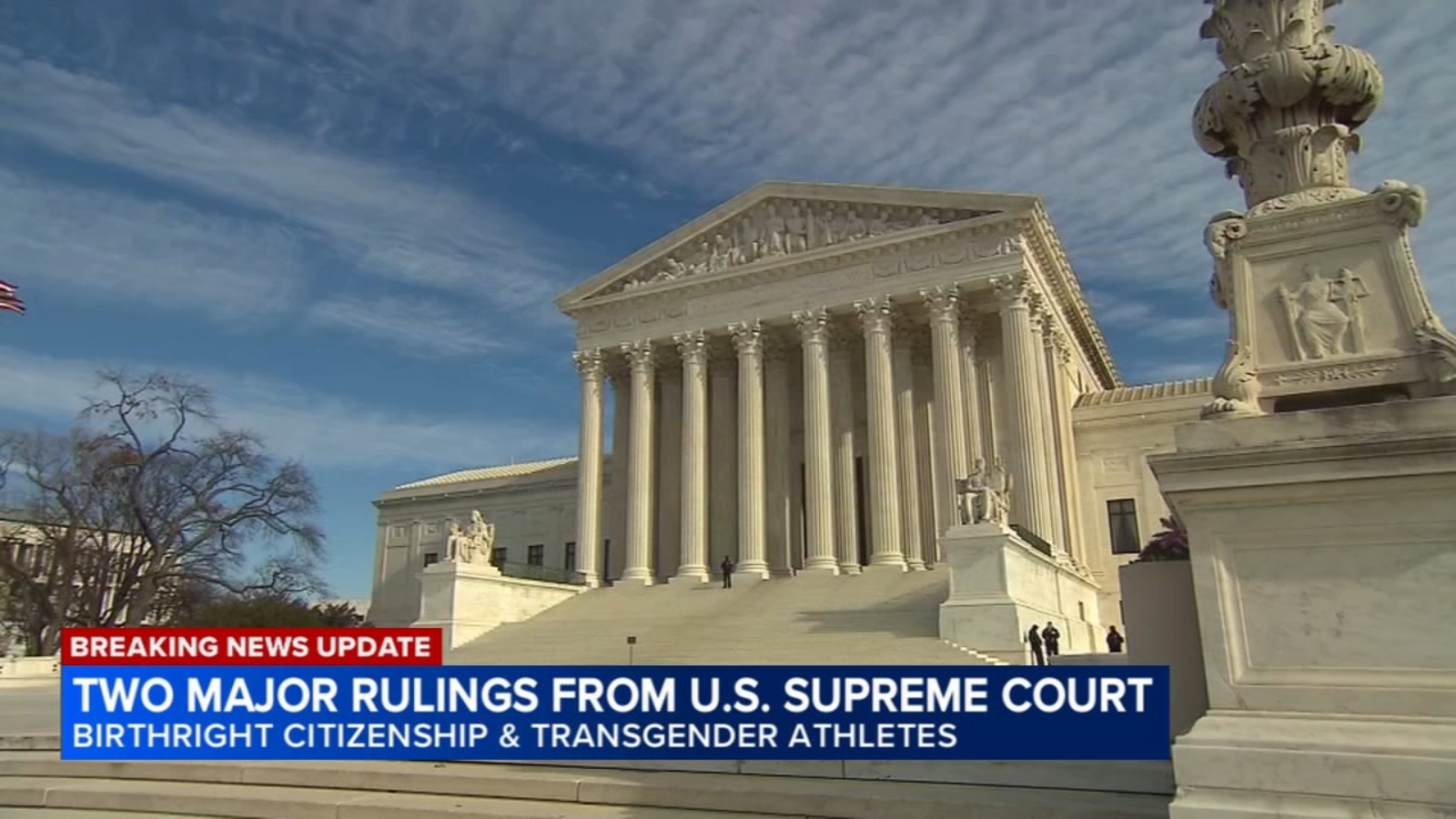

CHICAGO (WLS) — Two significant U.S. Supreme Court decisions prompted strong and divided responses across Chicago, as the rulings delivered both a win and a loss for President Donald Trump.
In one 6-3 decision, the court preserved birthright citizenship, turning back a Trump executive order that aimed to withhold citizenship from children born in the United States to undocumented parents. In another 6-3 ruling, the justices allowed states to prohibit transgender female athletes from competing on girls’ and women’s sports teams.
24/7. Click here to watch
For Jocelyn Aranda Ortiz, a U.S.-born daughter of an undocumented mother, the decision on citizenship was deeply meaningful and brought a sense of relief.
“She always says you have these opportunities where you don’t have to find the door that’s going to let you in, like your doors are open,” Aranda Ortiz said.
Aranda Ortiz said she has made the most of those opportunities, earning both a bachelor’s degree and a master’s degree. She now works with the Resurrection Project, where she helps support immigrant communities.
Immigration and civil rights attorneys said the ruling reaffirmed a constitutional protection long tied to the 14th Amendment.
“The court’s ruling today said that the Constitution not the President decides who’s a citizen of the United States,” said Colleen Connell, executive director of the ACLU of Illinois.
Connell said birthright citizenship has roots that extend even beyond the 14th Amendment, though the amendment later enshrined the principle in the Constitution. She and other legal observers said they were surprised that three justices dissented.
Despite the decision, Aranda Ortiz said concerns about future challenges remain.
“It’s absolutely scary that we have to live in a world where we have to keep watching our back,” she said.
On CNN Illinois Illinois Gov. JB Pritzker said it should never have gotten this far.
MORE STORY: Unmasking the Church: Hugh Jackman's Faith and Emily Watson's Chilling Accusations
“We have seen a lot of this from Donald Trump, as you know, issuing executive orders or making pronouncements that he thinks he can change the law on is own and do things that are illegal because he just says them… So, this is just another example,” Pritzker said.
Trump criticized the ruling on birthright citizenship, calling it “too bad,” but praised the court’s decision allowing states to restrict transgender athletes’ participation in girls’ and women’s sports.
That ruling disappointed Patti Flynn, a Chicago-area transgender athlete who competes in track, cycling and triathlons.
“Believe it or not, merely being trans doesn’t make one good at sport I can attest to that. I am a mediocre athlete,” Flynn said.
The decision does not affect Illinois, which has protections in place for transgender students and athletes. However, Flynn said the ruling could still have consequences in club sports and adult leagues, where she said exclusion has already occurred.
“You know, it happened a couple weeks right before my season started, and I just, I lost touch with my community at a time when I really needed it the most,” Flynn said.
Flynn said participation in sports is about more than competition, emphasizing discipline and the relationships built through athletics.
Meanwhile, the path for ending birthright citizenship would require a constitutional amendment, a process widely considered unlikely.
Copyright © 2026 WLS-TV. All Rights Reserved.