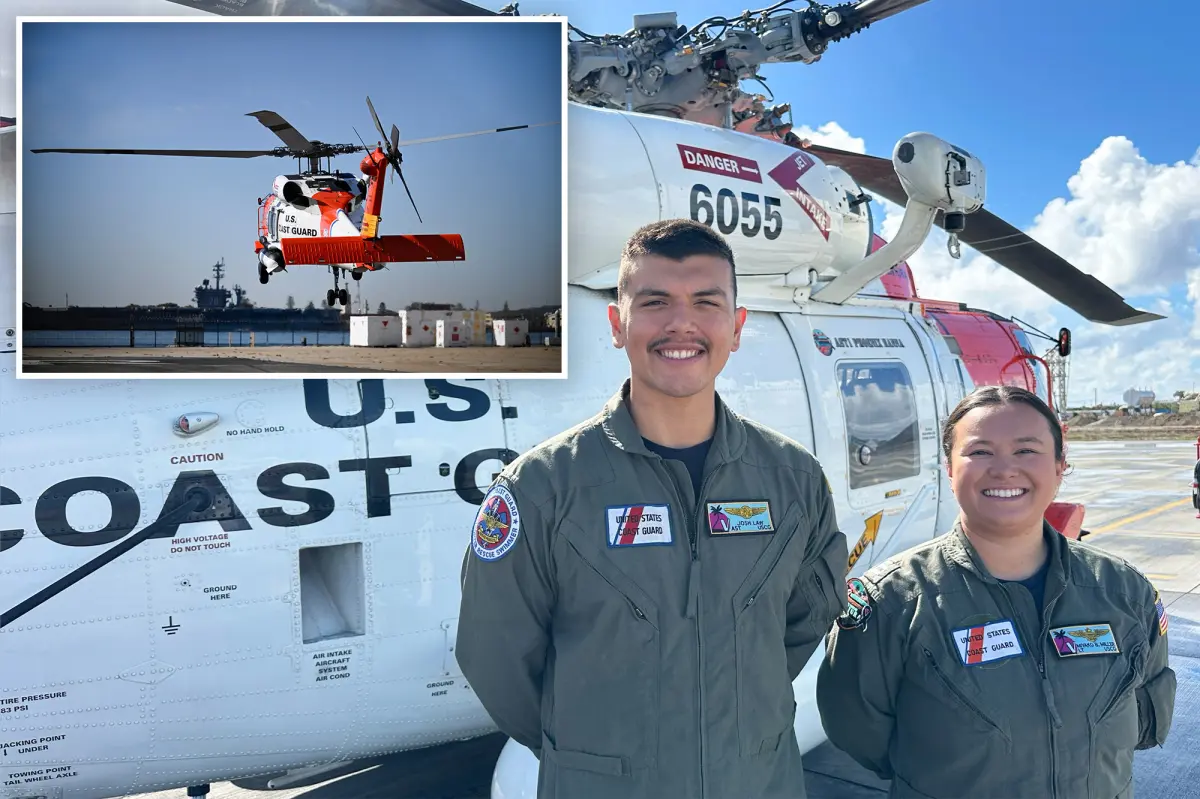

Strapped into a harness, US Coast Guard rescue swimmer Josh Law was lowered from a helicopter into the rough Pacific Ocean, deep in the darkness and roughly 140 miles off Mexico’s coast.
The helicopter’s rotors battered the water, sending spray and turbulence around him. Law could neither see through the darkness nor hear over the aircraft’s roar as waves 6 to 8 feet high slammed into him.
His only guide was the helicopter’s searchlight, which he followed in hopes of reaching the more than two dozen people thrown into the cold sea off Mexico’s Baja peninsula.
Law would personally bring 16 of them to safety.
“I was experiencing exhaustion at that point,” Law, 24, told The Associated Press in his first interview since the rescue.
“We had very little sleep. But what I was experiencing was nothing compared to what they were at that point … I just had to keep that in mind.”
For the next two hours before dawn on Oct. 16, Law remained the only person in the water, reaching survivors from the capsized boat and guiding them to safety.
Eleven other people were never found.
The Coast Guard ended its search late Sunday.
Law recounted the dramatic rescue along a remote stretch of ocean often used by migrant-smuggling boats.
Federal investigators are still working to determine where the vessel came from and what it was doing so far offshore.
It remains unclear whether the boat became lost, suffered engine failure, was carried out to sea or was intended to travel that far. Investigators recovered only pieces of the vessel.
The Mexican consulate said everyone rescued was Mexican.
The Coast Guard said US Customs and Border Protection was investigating and interviewing survivors. The agency did not respond to multiple inquiries about whether the vessel was being used for migrant smuggling.
The alarm sounded, awakening the Coast Guard crew
The mayday call came in at about 1 a.m.
The caller reported that a boat was sinking in the Pacific Ocean off Ensenada, Mexico.
Minutes later, an alarm roused Law and his colleagues from their sleep at the US Coast Guard Air Station in Ventura, northwest of Los Angeles.
Helicopter pilot Lt. Miyako Miller assessed the flying conditions and mapped a route over the vast ocean south of the US border for the four-person crew.
Law gathered his dry suit, fins and medical supplies before securing himself in a harness attached to a cable that would lower him into the sea.
By 2 a.m., the crew had taken off from the Coast Guard station in Ventura.
YOU MIGHT ALSO LIKE: Prince Philip’s Alleged Love-Child Reaches Breaking Point After Uneasy Meeting with the Royals, Christopher Wilson Reports
Pilot says she was guided by the stars
Miller wore night vision goggles to help her fly in the dark. She said she relied on the stars, with no moonlight that night.
As the crew approached the reported location of the sinking, Miller spotted a tiny flicker of light in the distance.
Then she spotted what looked like debris floating in the water, but it was difficult to distinguish what it was. Miller carefully navigated the helicopter over the area, lowering the aircraft until it was hovering about 40 feet above the water.
“I’m doing my best to maintain my references externally by looking outside through the night vision goggles,” Miller said, adding that meanwhile “the flight mechanic is telling me where to position the helicopter.”
Some 250 miles southwest of Ensenada, Mexico, is Guadalupe Island, a biosphere reserve that is well known as a place brimming with great white sharks.
Law said he didn’t think about what was in the water as he hooked himself to a cable and zipped into the ocean, strapped in a harness.
There was no time to waste. While Law’s dry suit provided some warmth, he knew the others had already spent hours in hypothermic temperature waters.
Law said he was guided by a searchlight from the crew, which allowed him to catch a glimpse of the people in the water.
They were scattered across a wide area. Some were wearing life vests that had tiny lights that produced the flicker first spotted by Miller. Others clung onto one another, buoys and pieces of wreckage, shivering and treading water to stay afloat.
Law said he swam to them, flipped them on their backs, put his arm over them and pulled them up using the “buddy tow” technique. Kicking his legs to swim, he carried them to the spot where he could signal the flight mechanic to lower a basket for them to be picked up.
“With one hand, I’m holding the survivor. With the other, I am signaling to the helicopter and working with the device,” he said.
He placed them into the basket, one by one. Then it was hoisted up repeatedly to the helicopter where the crew got each person into the aircraft before lowering the basket again.
Law’s dry suit slowly filled up to his knees with water, feeling like weights pulling on him as he battled heavy waves while swimming back and forth.
With little fuel, the crew flew to San Diego where ambulances waited
With a packed helicopter and dwindling fuel, the crew decided to head to the Coast Guard station in San Diego where ambulances were waiting.
On the flight, Law treated three people with what he described as “bad” wounds, staunching the bleeding. Several of the injuries were “consistent with shark bites” and the Coast Guard provided life-saving first aid, the agency said in a statement Saturday.
Customs and Border Protection officers went to a hospital and said they would process the survivors according to immigration laws after they were medically cleared. Nearly half of those rescued have since been returned to Mexico, US officials said.
Law and his crew returned to Ventura that morning — it was by far the longest rescue operation he had ever done, he said.
The search for the 11 others continued for another two days to no avail. The Coast Guard, alongside Mexico and the US Navy, searched more than 2,441 square miles for a combined 89 hours.
Migrants are increasingly turning to the risky alternative offered by smugglers to travel by sea to avoid heavily guarded land borders. Small boats called pangas leave Baja at night and sometimes travel hundreds of miles north.