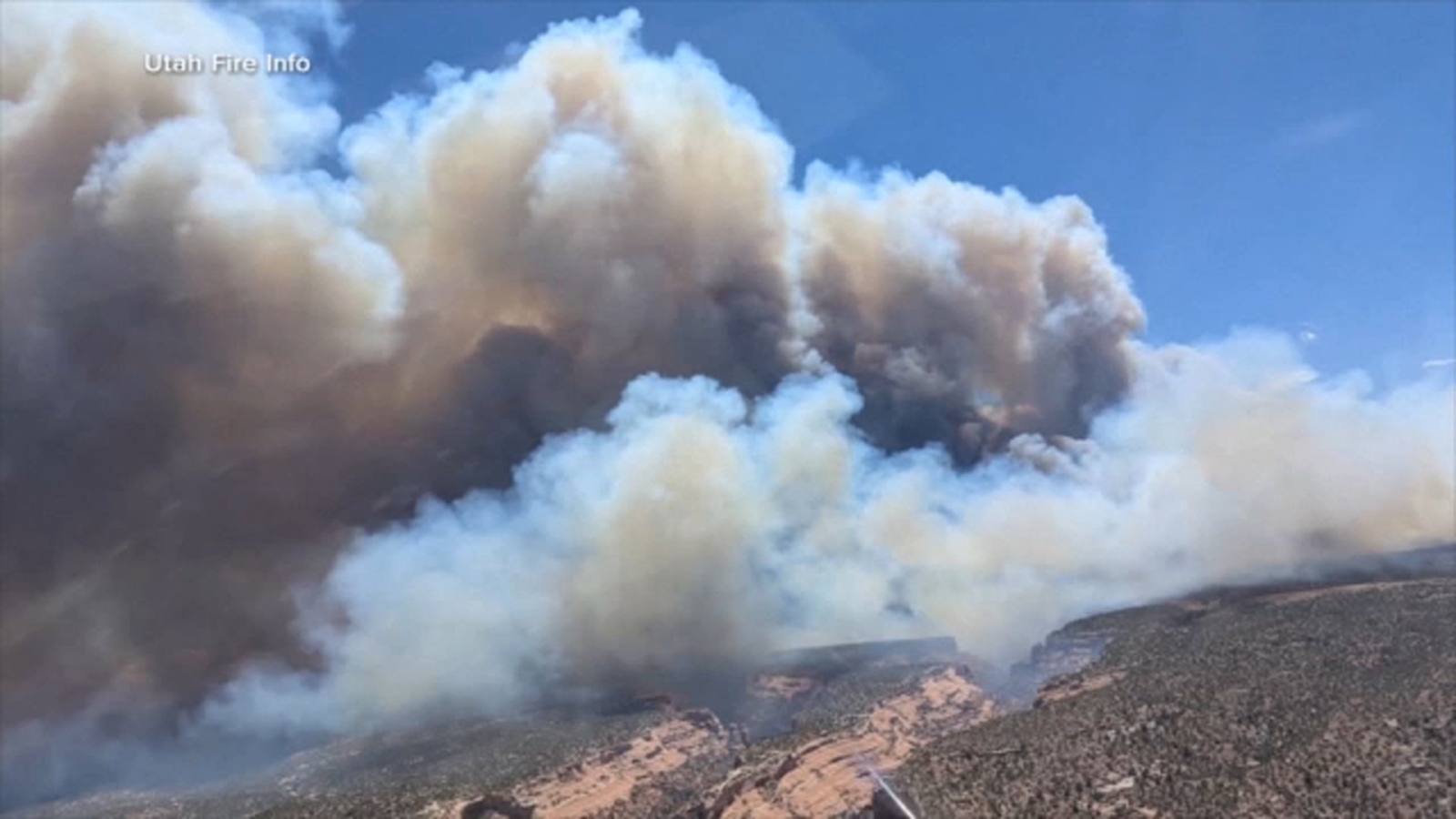

BEAVER, Utah — Three firefighters who died over the weekend while battling a wildfire near the Colorado-Utah border were attempting to protect themselves from the flames by using tent-like emergency shelters when they were overtaken, officials said.
Federal authorities said Monday the firefighters were members of a crew assigned to reach remote areas and respond quickly to newly sparked or fast-growing wildfires.
Their deaths Saturday occurred nearly 13 years after 19 members of an elite wildland firefighting crew were killed after becoming trapped in a steep canyon in Yarnell, Arizona.
In that 2013 tragedy, the Arizona firefighters also tried to deploy emergency fire shelters, equipment considered a last resort when crews have no escape route. Investigators did not assign blame in the deaths, though they pointed to radio communication failures that played a role in trapping the Granite Mountain Hotshots. Arizona’s workplace safety agency later fined the state forestry division for failing to remove the crew from danger.
The fatal incident comes as wildfires have broken out across the West in recent days, driven by months of dry conditions and, in some areas, record-low snowfall over the winter. Fire experts have warned for months that the region could face especially dangerous wildfire conditions this summer.
More than two dozen large fires are currently burning, prompting the deployment of nearly 8,000 wildland firefighters and dozens of firefighting helicopters. Roughly half of the largest fires are in Alaska, with most of the others burning across Western states.
Evacuation orders or warnings were in effect near seven fires, including blazes in Arizona, Washington, New Mexico, Colorado and Utah.
Firefighters were part of a specialized crew
The U.S. Forest Service identified the firefighters who died as Emily Barker, 38, of Clinton Township, Michigan; Nick Hutcherson, 27, of Glendale, Arizona; and Sydney Watson, 26, of Warrior, Alabama.
Two others who were with them sustained burn injuries, authorities said.
The thee victims were assigned to a Helitack crew that can be dropped into remote areas by helicopters and whose mission is to prevent new fires from growing into out-of-control blazes. But it can be extremely dangerous, often taking place in areas where fires are rapidly expanding.
EXCLUSIVE: Parenting Influencer’s 2-Year-Old Daughter Dies in Tragic Accident at Home
One of the crew members worked for the U.S. Wildland Fire Service while two were assigned to the U.S. Forest Service and all were part of an interagency response to fires just west of Grand Junction, Colorado.
The Snyder Fire in the area has burned about 44 square miles (114 square kilometers), authorities said.
The Wildland Fire Service, created earlier this year to streamline firefighting on public lands, said in a statement that it “stands united” with the Forest Service in grief and “in our unwavering support for the loved ones left behind.”
High wildfire threat for much of this week
More hot, dry and windy weather across the Southwest will elevate the threat of fires at least until the weekend, according to the national Storm Prediction Center.
Among the concerns were high winds in the mountains of Colorado and Wyoming, in the Black Hills of South Dakota and across portions of the High Plains.
Utah already has restricted firework usage going into the July Fourth holiday.
Officials on Monday increased the national “preparedness level” for wildfires to a 4, on a scale of 1 to 5. That’s a sign resources are beginning to be strained, and officials warned of a high potential for new, large fires in multiple parts of the country in coming days.
So far this year, the fires have burned more than 4,800 square miles (12,400 square kilometers) – the most by this point in the year since 2022 and significantly above the 10-year average.
Brown reported from Billings, Montana and Seewer from Toledo, Ohio.
Copyright © 2026 by The Associated Press. All Rights Reserved.