
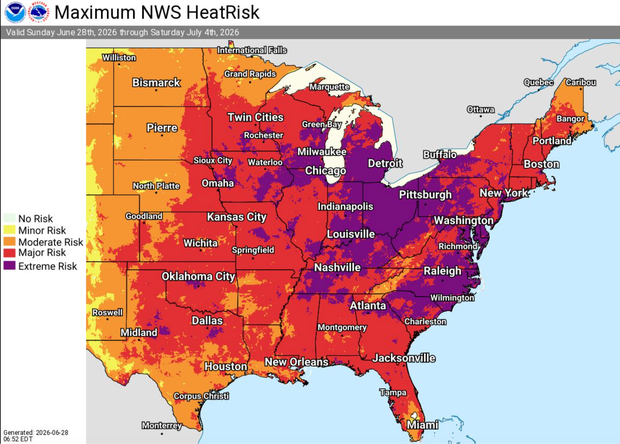
A prolonged and potentially dangerous heat wave is expected to grip a broad stretch of the United States this week, the National Weather Service warned, with temperatures climbing ahead of the Fourth of July holiday and oppressive humidity making conditions feel even hotter.
Forecasters said multiple days of intense heat are likely across the lower Great Lakes, the mid-Atlantic, and the Mississippi and Ohio River valleys.
Several major metropolitan areas could record their hottest readings of the year so far while also hosting World Cup matches.
Among the cities bracing for the heat are New York, Philadelphia, Washington and Baltimore on the East Coast, along with Chicago, St. Louis and Detroit in the Midwest and Great Lakes region. Farther south, Dallas, Little Rock, Arkansas, and Memphis, Tennessee, are also expected to face soaring temperatures.
The National Weather Service said the extreme heat is forecast to persist into next weekend across the Great Plains, the Southeast and the mid-Atlantic.
Forecasters described it as the summer’s first widespread heat wave, affecting more than half the country. While the central and eastern U.S. see the heat expand, the Four Corners region remains under hazardous fire weather conditions. Meanwhile, severe thunderstorms are continuing over the northern Plains and Upper Midwest, with flood risks extending from the Rockies to the Mid-Atlantic.
Temperatures are expected to push deep into the 90s and reach the low 100s Fahrenheit, or the mid- to upper 30s Celsius, the weather service said. With humidity factored in, heat index values could range from 100 to 110 degrees F (40 C to 43 C), with some areas approaching 115 F (46 C). Overnight lows in the 70s F (21 to 26 C) are not expected to offer much relief.
National Weather Service
EXCLUSIVE: Andy Burnham's Policies Poised to Benefit His Wife Financially
The heat index, commonly included in forecasts, accounts for humidity to show how hot it actually feels — and helps indicate when conditions become dangerous during extended exposure or strenuous activity.
Parts of the U.S., especially Phoenix, Las Vegas, central Texas, and much of the southwest, were already experiencing temperatures around 100 F.
During extreme temperatures, limit outdoor activity, stay hydrated and ensure access to air-conditioning and other cooling areas, the weather service said. The Centers for Disease Control and Prevention says heat can impact anyone. Signs of overheating include muscle cramping, dizziness, unusually heavy sweating, shortness of breath, headaches, weakness and nausea.
While large portions of the U.S. confront high temperatures, much of the West remains unusually cool, with high temperatures running 20-35 degrees below average across portions of the Northwest and northern Rockies, according to weather reports.
Europe has been sizzling for days, with the temperature hitting a record 106 degrees Fahrenheit in Germany on Saturday, the AFP reported. Switzerland, the Czech Republic, Denmark and France have also been facing high temperatures. In France, dozens of drowning deaths were recorded this month as swimmers turned to the water for relief from the heat.