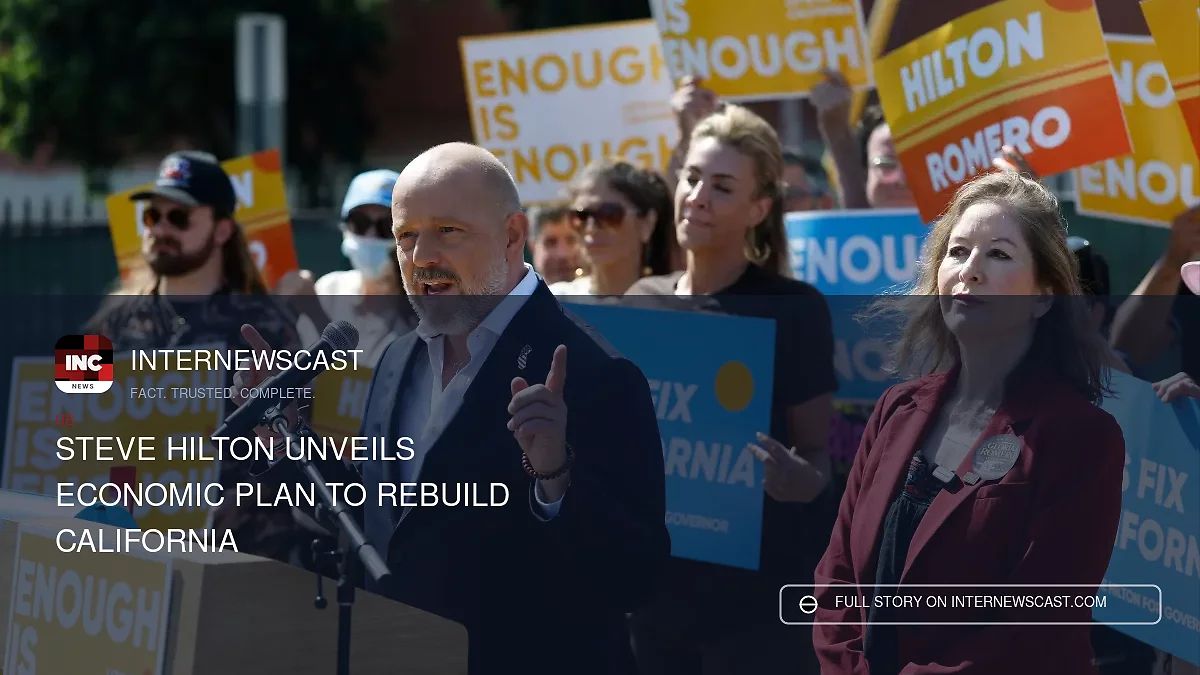

Republican candidate for California governor Steve Hilton unveiled an ambitious economic agenda Monday, proposing a decade-long pause on some of the state’s toughest regulations in an effort to ignite a major construction and development surge.
“For 10 years, California will have one overriding priority: build again,” Hilton said in prepared remarks for an address at the Commonwealth Club in San Francisco.
Pointing to recent election outcomes in heavily Democratic states such as Michigan and New York, Hilton warned that California, in his view, must resist “the further rise of socialism” and the potential consequences he said it could have for the state’s economy.
Hilton framed California’s economic challenges as the result of a deeply rooted, left-leaning government system rather than the influence of the wealthy, arguing that progressive policies have weakened job growth, reduced incomes and diminished residents’ overall quality of life.
He singled out younger residents as a key example, saying California has the nation’s second-highest youth unemployment rate despite adopting many policies that tend to appeal to young, college-educated voters in other states.
Under Hilton’s plan, he would call a special legislative session during his first week in office to pursue a 10-year suspension of regulations, fees, mandates and bureaucratic requirements that he says are pushing businesses and builders away from California.
The ambitious plan would target CEQA, the state’s landmark environmental law, as well as PAGA lawsuits, Vehicle Miles Traveled rules and taxes on investment — along with regulations Hilton says add costs without a clear public benefit.
Getting such sweeping changes through the Democratic-controlled Legislature could be a tall order, but Hilton suggested some of the changes could be enacted through executive powers.
“If they reject this offer, I am well prepared to use executive authority and the governor’s control of state agencies to achieve as much of it as possible incrementally,” Hilton said.
“But that would obviously be slower, harder, and sub-optimal.”
Hilton, who is facing off against Democrat Xavier Becerra in the November runoff, said clean air and water standards would remain in place while permitting and legal challenges would be dramatically streamlined.
“California will have clear deadlines. One decision. One appeal. Then build,” he said. “For 10 years, California should become the easiest, not the hardest place in America to build something that matters.”
The plan calls for an enormous expansion of housing, manufacturing and infrastructure, including semiconductor factories, AI infrastructure, aerospace and defense facilities, nuclear power plants, reservoirs, desalination facilities, roads, bridges, ports and entirely new communities.
Hilton argued that California could develop another 1% of its land — about 1 million acres — and create enough room for 5 million people in single-family homes while at least doubling the state’s manufacturing capacity.
One of the forces holding California’s economy back is “climate posturing,” Hilton said, arguing that it, along with high taxes, burdensome regulation, litigation and powerful union interests, has driven residents and businesses to competing states like Texas.
“This is not left versus right,” Hilton said. “It is builders versus blockers. Creativity versus bureaucracy. Growth versus decline.”













1 comment
Hilton should look at the rebuilding LA County issues and figure out a direction if he hasn’t . But GET THE INFO OUT INTO THE PUBLIC.