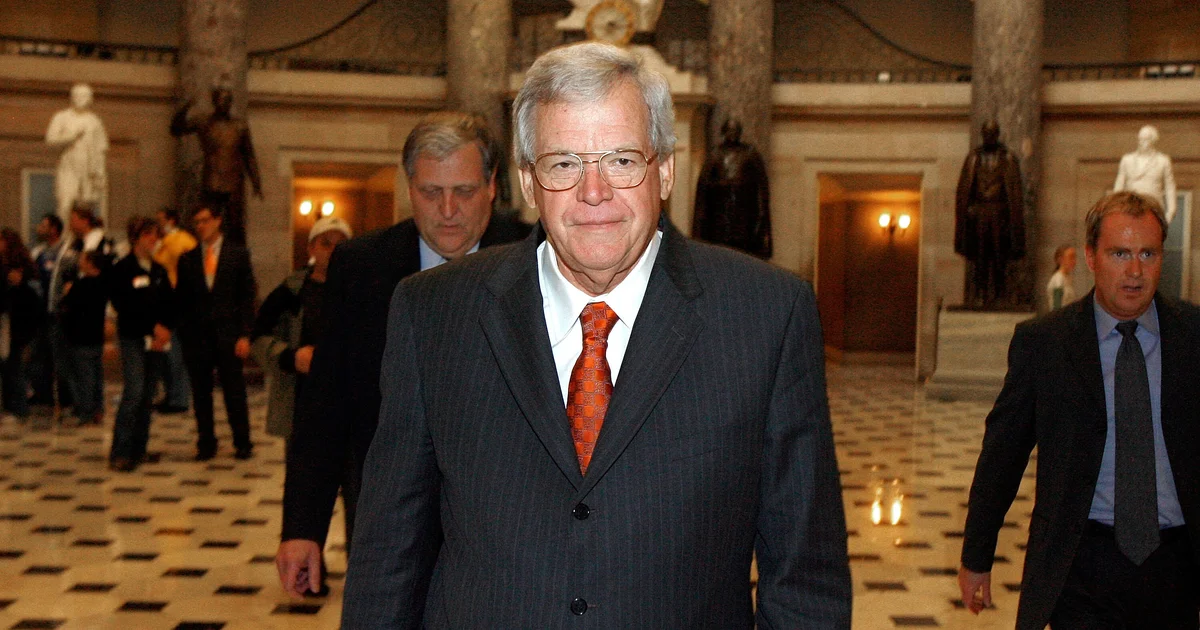

Washington — Dennis Hastert, the former Illinois congressman and longtime Speaker of the House whose political career ended in disgrace after a banking-related conviction, has died at 84, an Illinois coroner confirmed.
Hastert was the longest-serving Republican speaker in House history and the highest-ranking elected U.S. official ever to serve time in prison. His dramatic downfall came in 2016, when he was sentenced to 15 months in prison for violating banking laws while concealing hush-money payments tied to his sexual abuse of teenage boys when he was a high school wrestling coach.
Kendall County Coroner Jacquie Purcell said Monday that Hastert died at his home over the weekend from natural causes. She did not provide additional information.
Born in Aurora, Illinois, in 1942, Hastert was raised in a farming community. He earned an economics degree from Wheaton College and later received a teaching degree from Northern Illinois University. He married Jean Kahl in 1973, and they had two sons.
For 16 years, Hastert taught in Illinois and coached wrestling. His work on the mat earned him the title of Illinois Coach of the Year in 1976. Decades later, he acknowledged that he had sexually abused boys during his coaching career.
Hastert entered politics through the Illinois legislature before winning election to the U.S. House in 1986, representing Illinois’ 14th Congressional District.
He served in Congress from 1987 through 2007. With the guidance of House Minority Leader Robert H. Michel, Hastert steadily rose within the Republican Party and became chief deputy whip in 1995. After Speaker Newt Gingrich resigned in 1998, Hastert emerged as the party’s second choice to succeed him, following Rep. Bob Livingston’s withdrawal amid revelations of extramarital affairs.
Often described as the “accidental speaker,” Hastert ultimately held the position longer than any other Republican. A vocal critic of the Clinton administration, he later worked closely with President George W. Bush to advance the White House’s legislative agenda.
One of Hastert’s most lasting marks on the House is the policy informally known as the “Hastert Rule.” It calls for the chamber to consider legislation only when it has the support of a majority of the majority party. Critics have argued that the practice has intensified partisanship and, in recent years, complicated efforts by Republican leaders to move legislation.
When Republicans lost control of the House in the 2006 midterm elections, Hastert stepped away from leadership and resigned from Congress the following year.
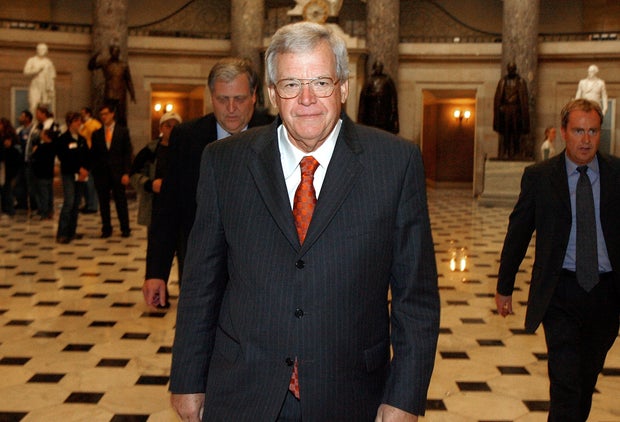
Chip Somodevilla / Getty Images
After leaving public office, Hastert worked as a lobbyist and consultant. The FBI and IRS began examining his financial activity in 2013 amid allegations that he had illegally structured bank transactions. In 2015, Hastert was indicted on charges of withdrawing money in a way designed to avoid federal reporting requirements and lying to investigators.
Hastert pleaded guilty later that year to violating banking laws through a series of large cash withdrawals. The money was ultimately found to have been paid to one of his victims. During court proceedings, Hastert admitted sexually abusing boys while serving as their wrestling coach. U.S. District Judge Thomas M. Durkin described him at sentencing as a “serial child molester” and imposed a 15-month prison term, a $250,000 fine and mandatory participation in a sex offender treatment program. Because the statutes of limitations had expired, Hastert was not charged with the sexual abuse. He served 13 months in federal prison and was released in 2017.
After Hastert was sentenced, Zachary Farden, then the U.S. attorney for the Northern District of Illinois, said there were “no winners in any of this.”
“Mr. Hastert’s legend and legacy are gone, and in its place are a broken, humiliated man,” Farden said. “That is how it should be.”


