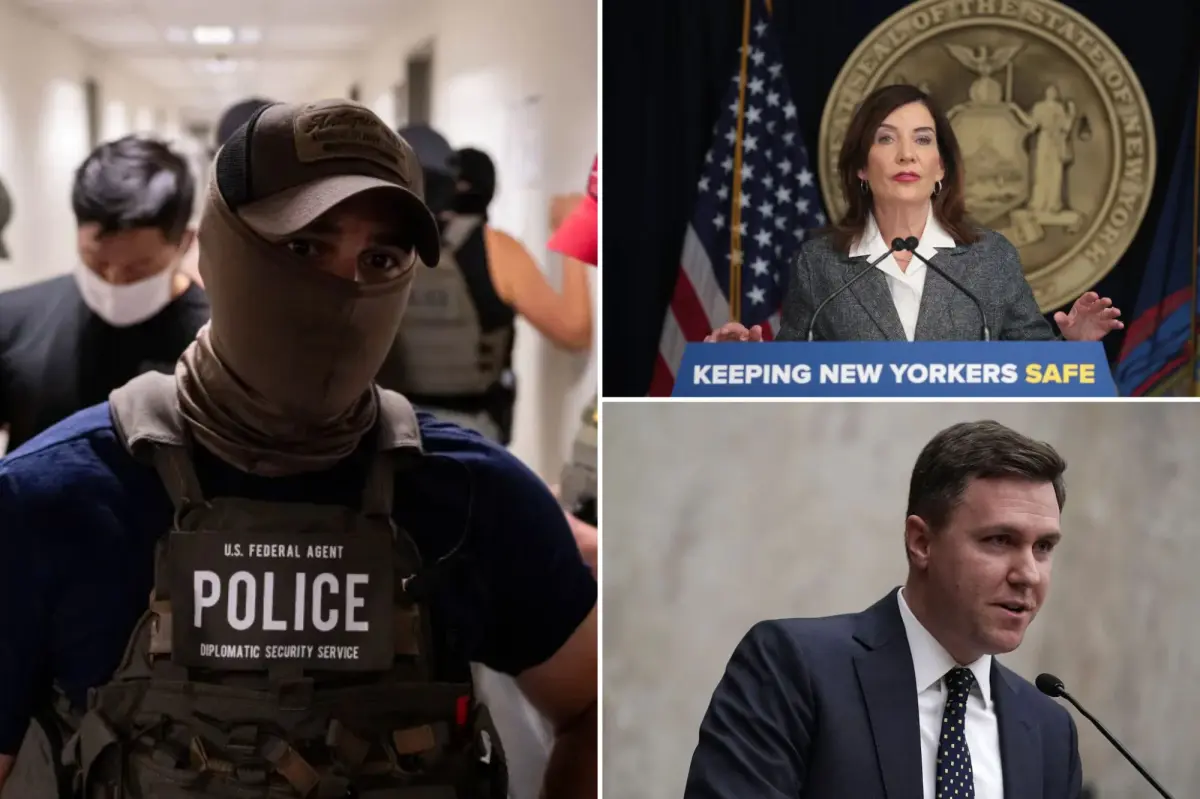

WASHINGTON — The Justice Department has filed a lawsuit against New York over a new state law scheduled to take effect this week that would prohibit federal agents from wearing masks during operations, a measure federal officials say could expose them to “harassment, tracking, intimidation, and assaults.”
The complaint was filed Monday in federal court in Buffalo by Associate Attorney General Stanley Woodward, Assistant Attorney General Brett Shumate and other attorneys in the DOJ’s Civil Division. The lawsuit alleges that New York Gov. Kathy Hochul included the challenged provisions in the state’s annual budget despite constitutional concerns.
“Governor Hochul cannot tell Federal officers how to do their job,” Woodward said. “And she certainly cannot prohibit them from ensuring their own safety in conducting Federal law enforcement operations.”
The 40-page lawsuit, which also names New York Attorney General Letitia James, argues that the state’s Face Covering and Identification Acts violate both the principle of intergovernmental immunity and the Supremacy Clause of the U.S. Constitution. The filing says the law is due to take effect June 26.
Under the law, Immigration and Customs Enforcement personnel, Drug Enforcement Administration agents and other federal officers could face “criminal penalties” for wearing masks while carrying out their duties, according to the complaint.
The Justice Department also challenges other provisions in New York’s budget, arguing they conflict with federal law by requiring local governments to end certain enforcement agreements with federal agencies.
“The need to protect Special Agents’ identities and association with DEA is not confined to activities which would compromise that particular investigation; rather, the exposure of Special Agents’ identities and association with DEA even in an overt DEA operation could enable suspects to identify those agents who become involved in future undercover operations, which would obstruct those future actions,” the lawsuit states.
The filing also points to what federal officials describe as a growing threat from online exposure, saying members of the public increasingly photograph, record and post federal enforcement actions online while identifying officers “for the sole purpose of intimidation and harassment.”
READ MORE: World Cup Fans Say Henry and Zlatan Appear Frustrated With Lalas
That information can be used by “rioters, illegal aliens and “highly sophisticated gangs like Tren de Aragua and MS-13,” among others, according to the DOJ officials.
“The Department of Justice will steadfastly protect the privacy and safety of law enforcement from unconstitutional state laws like New York’s,” said Shumate.
The DOJ has already filed suits in California, Virginia, and New Jersey — as well as the city of Philadelphia — against laws forcing agents to go maskless. All of the jurisdictions impose “sanctuary” policies that limit their cooperation with federal immigration enforcement.
“If California and New York can impose these requirements, there’s nothing that prevents them from, you know, in the next session saying, ‘Federal agents can’t even use marked cars,’” a DOJ official told The Post
“This is a troubling new trend that started in California and other sanctuary jurisdictions are trying to follow the same lead of passing bills that target federal law enforcement officers directly and attempt to directly regulate how they do their jobs by banning masks and requiring federal agents to wear identification,” the official also said.
“That puts agents’ lives at risk, and so we’re prioritizing these cases and filing lawsuits as quickly as we can,” the official added.
New Jersey Gov. Mikie Sherrill signed her state’s version of the law in March, saying in a statement: “We’re not going to tolerate masked roving militias pretending, pretending to be well-trained law enforcement agents.”
In April, the Ninth US Circuit Court of Appeals blocked California from implementing its version of the law, but the official indicated that if another circuit court rules against the administration, it could prompt an appeal to the Supreme Court to resolve the dispute.
Reps for Hochul and James’ offices did not immediately respond to a request for comment.