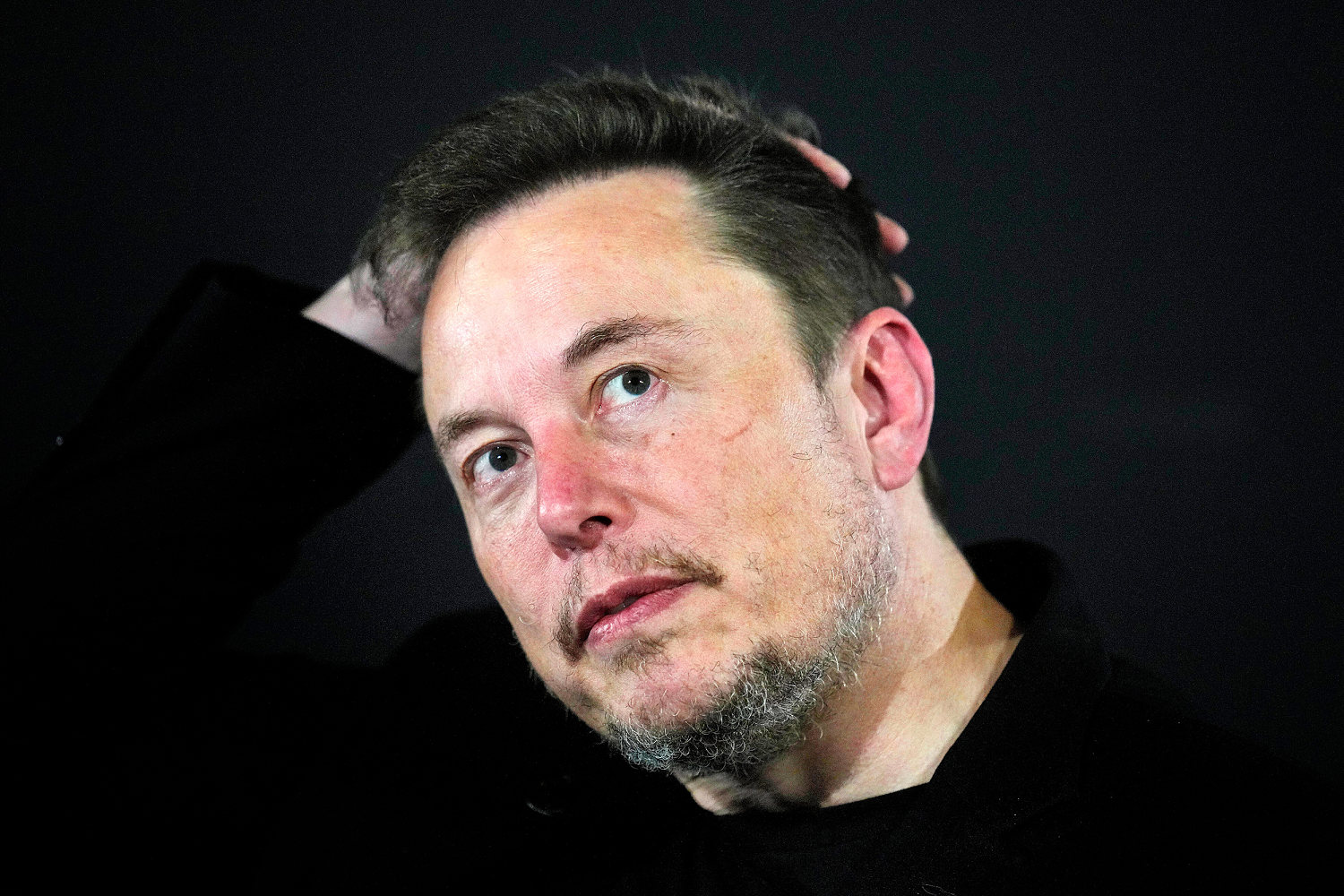
Elon Musk’s X changed its privacy policy this week to ban users from publishing the real names of people behind anonymous accounts after some users appeared to unmask a pseudonymous cartoonist who drew antisemitic images.
The social media platform updated its privacy policy to say people “cannot share … the identity of an anonymous user, such as their name or media depicting them,” without that person’s permission. The company said it was doing so to maintain a safe and secure platform.
X users expressed mixed feelings about the change, because the catalyst appeared to be someone involved in antisemitism, but, depending on how it is applied, it could benefit other people, such as anonymous dissidents in repressive countries.
The policy change added to what some X users and critics have said is a growing list of examples of Musk going out of his way to defend neo-Nazis, antisemites and white supremacists. Musk has embraced an antisemitic conspiracy theory, and, since he bought the app then known as Twitter in 2022, he has welcomed back antisemitic accounts that Twitter’s previous management had suspended for breaking its rules. Musk has also second-guessed law enforcement officials after they said a mass shooter was a suspected neo-Nazi sympathizer.
The policy also clashes with Musk’s ongoing claims that X is dedicated to free speech, because journalists have a long history of unmasking powerful people who avoid public scrutiny. Since he bought the platform, Musk has suspended journalists and filed lawsuits targeting his critics while continuing to state that X is a bulwark against censorship.
“Twitter’s policies have officially been changed to aid a neo nazi,” Alejandra Caraballo, a clinical instructor at the Harvard Law Cyberlaw Clinic and a vocal Musk critic, wrote on the rival platform Threads.
In a phone interview, Caraballo said that the new policy was poorly thought-out and that she doubted that X would apply it evenly.
“If this had been a long-term policy that would be consistently enforced, I don’t think it would necessarily be a bad thing,” she said.
Other X users also expressed doubt that Musk would apply the new policy in an even-handed manner, given his own extreme views.
X did not immediately respond to a request for comment or further information. In a post on X, it described the change as a clarification of its existing rules against posting other people’s private information.
“We’re further clarifying our external policy to explicitly include provisions for user anonymity reinforcing X’s commitment to maintaining a safe and secure platform,” the post said.
The change came a day after Wired magazine reported that X was already following the policy in at least one case without having put it in writing. The magazine reported that X was suspending the accounts of some journalists and researchers who posted the possible identity of an antisemitic cartoonist going by the pseudonym Stonetoss.
The person behind the Stonetoss online comics was the subject of a report March 12 by the Anonymous Comrades Collective, an antifascist research group. It said Stonetoss is the creation of a Texas man who works in information technology, and it named him and his employer, as well as documenting comments he had made on podcasts and social media.
The cartoons by Stonetoss are extreme. One shows a Jewish man drinking the blood of an infant, which is a common antisemitic trope. Others use the deaths by suicide of transgender people as punchlines. Stonetoss posts the cartoons on X, where they often attract millions of views.
NBC News has not confirmed the identity of the person behind Stonetoss, and the Stonetoss account did not immediately respond to a request for comment Thursday. Stonetoss’ X account posted this week that they had been wrongly labeled a “Nazi” and they said they were making money off the dispute by selling plushie dolls online.
Despite the new policy, hundreds of X users were posting the alleged name of Stonetoss this week.
The platform previously known as Twitter has had a long history with anonymous and pseudonymous accounts. While Facebook has in general required people to use their real names since it opened to the public in 2006, Twitter has never had such a requirement. At times, Twitter went to court to prevent attempts by governments to unmask critics, moves that human rights advocates welcomed as evidence of a commitment to protect dissidents.
Anonymous accounts played pivotal roles in some of Twitter’s key moments in history, including the Occupy Wall Street protests, which began in 2011. Saudi Arabia hired a Twitter employee as a spy to try to unmask dissidents, with a jury in California later convicting the man of acting as an unregistered agent.
In 2021, Twitter’s then-safety team published an essay in defense of anonymity, although Twitter at that time was different in other ways, including its enforcement of a policy against hateful or dehumanizing imagery. Now, some antisemitic posts on X get hundreds of thousands of views and are not taken down after people flag them, according to a review by The Washington Post.
Corynne McSherry, legal director of the online rights group Electronic Frontier Foundation, said platforms are free to make their own decisions about moderation policies and what speech they will host. But she expressed concern about inconsistency at X.
“Policies protecting users’ anonymity (which can be critical to free expression) are important, but should be carefully and consistently enforced, especially when there are competing speech interests. If Wired’s reporting is correct, that’s not happening here,” she said in a statement to NBC News.
McSherry added that X has unmasked users at the behest of governments under Musk. She cited a report last year from the website Rest of World finding that, during the first six months of Musk’s ownership, Twitter said it fully complied with 808 of 971 requests from governments and courts, including orders to remove posts and demands for private data. It said it partially complied in 154 other cases.
Broadly speaking, the privacy policies of X and other sites are designed to prevent what is known as doxxing: the release of a person’s identifying information with malicious intent.
The situation around the cartoonist Stonetoss is further complicated because X is under investigation in the European Union over the spread of illegal content such as hate speech. New rules against hate speech took effect there in August.