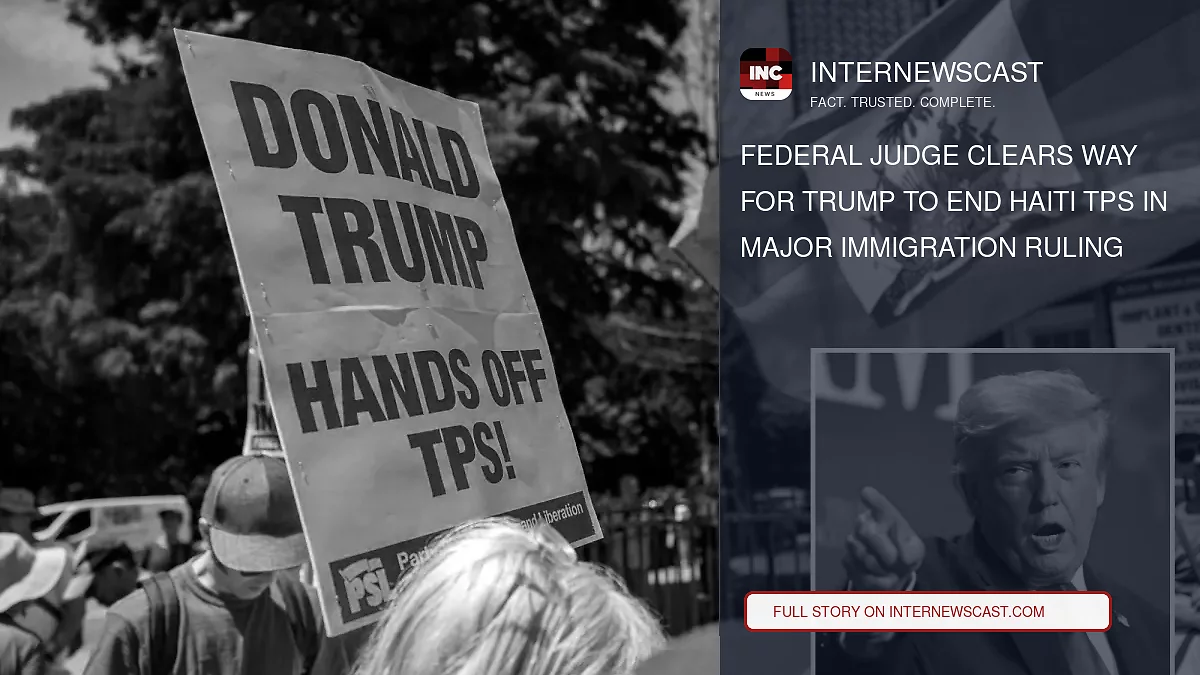

President Donald Trump secured a significant win on immigration Wednesday after a federal judge recognized that a court order preventing his administration from ending temporary protected status, or TPS, for hundreds of thousands of Haitians is no longer operative following the Supreme Court’s decision in Mullin v. Doe.
The development brings a pivotal phase of a long-running legal fight over the Biden administration’s expanded TPS designation for Haiti to a close, handing Trump a major policy victory on an issue he repeatedly highlighted while campaigning against the expanded protections for Haitian nationals.
Haiti TPS became a flashpoint in the 2024 presidential race after Trump and his running mate, JD Vance, linked the Biden administration’s policy to the arrival of Haitian migrants in Springfield, Ohio. Some residents there had voiced worries about traffic safety, pressure on local services and cultural tensions.
The dispute drew even broader national attention after Trump referred to residents’ allegations that migrants were taking ducks and geese from public parks and eating household pets.
The White House had not responded to Fox News Digital’s request for comment by the time of publication.
In a Wednesday order, U.S. District Judge Ana Reyes wrote that her prior decision pausing the Department of Homeland Security’s termination of Haiti’s TPS designation “is no longer in effect” in light of the Supreme Court ruling and the D.C. Circuit’s subsequent mandate.
Although the broader lawsuit remains active, the injunction no longer blocks the administration from proceeding with plans to end TPS protections for an estimated 330,000 to 350,000 Haitians currently living in the United States.
The remaining legal dispute focuses on whether the administration’s decision to terminate the Haiti TPS designation was driven by unconstitutional racial animus.
The Supreme Court ruled in June that the TPS statute bars judicial review of the administration’s non-constitutional decisions to terminate TPS designations and found the plaintiffs’ equal protection challenge was unlikely to succeed. The court reversed the lower courts and remanded the case for further proceedings.
DHS General Counsel James Percival pushed back on reports suggesting Wednesday’s order itself ended Haiti’s TPS designation, arguing the protections effectively expired when the Supreme Court’s mandate was issued July 27 and that Reyes’ order merely acknowledged that legal reality.
“Haiti TPS ended when the Supreme Court mandate issued on July 27,” Percival wrote on X. “I will give Judge Reyes kudos though for taking the L with grace and not doing something bonkers like many of her colleagues.”
Haiti first received TPS after the country’s devastating 2010 earthquake, but the designation remained in place for 16 years through multiple administrations. The Biden administration later expanded and extended protections for hundreds of thousands of Haitians already living in the U.S.
After reviewing conditions in Haiti, former DHS Secretary Kristi Noem determined the country no longer met the statutory requirements for TPS and announced the administration’s decision to terminate the designation, arguing the humanitarian program had been extended well beyond its intended temporary purpose. The move triggered the legal challenge that ultimately reached the Supreme Court.
After the SCOTUS decision, the DHS announced Haiti’s TPS designation would be terminated, effective July 27, and that employment authorization documents issued under the designation were no longer valid. The department instructed employers to reverify the work authorization of affected employees.
The State Department maintains a Level 4 “Do Not Travel” advisory for Haiti because of widespread gang violence, kidnappings and civil unrest.
Fox News Digital’s Danielle Wallace and Michael Lee contributed to this report.