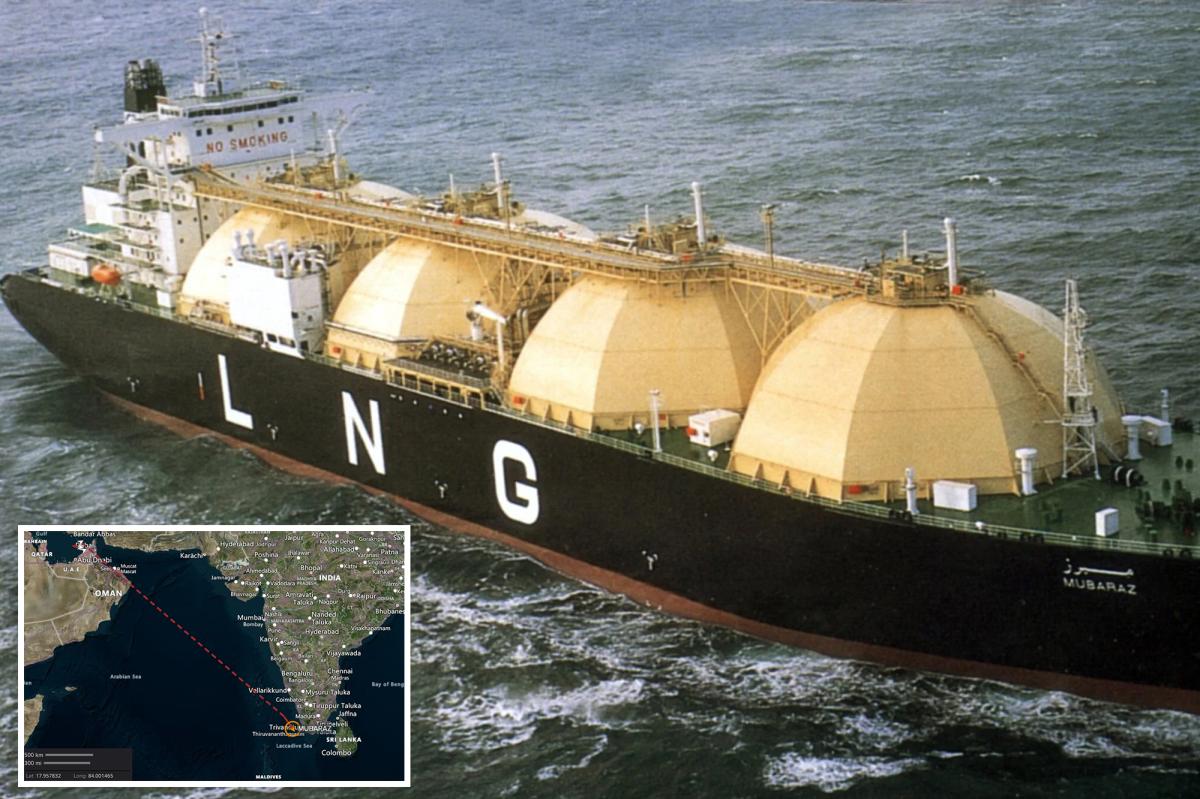

On Monday, a tanker ship successfully journeyed through the Strait of Hormuz, marking the first delivery of natural gas from the Persian Gulf to China since hostilities commenced with Iran.
The liquefied natural gas tanker, Mubaraz, carried over 130,000 cubic meters of gas sourced from the United Arab Emirates. It had been lingering in the disputed waters when its tracking device ceased transmitting in late March, as revealed by financial data firm LSEG.
On Monday, the tanker’s signal resurfaced off the western coast of India, confirming its passage through the Strait of Hormuz—a vital corridor for 20% of global oil and gas exports, according to the Wall Street Journal.

Currently, the Mubaraz is on its way to Tianjin in northern China, as per data from ship-tracking service MarineTraffic.
This vessel is operated by a division of Abu Dhabi’s state-owned oil enterprise, ADNOC.
Earlier in April, another gas tanker, devoid of cargo, successfully crossed the Strait of Hormuz after waiting for several weeks south of Pakistan.
More than a dozen gas tankers are still trapped inside the Persian Gulf, according to analysts.
Last week, the number of ships passing through the Strait fell to its lowest level since the start of the war on Feb. 28, after the US blockaded the waterway to top Iranian-linked tankers.
Iran has previously threatened and attacked commercial ships that tried to pass through Hormuz without paying a toll.

Just 35 transits were made in the week of April 20 to April 26, down from 78 the previous week, according to data from Lloyd’s List Intelligence.
Of the 35 ships, 24 were linked to Iranian trade, including 16 involving vessels belonging to the Islamic regime’s sanction-evading shadow fleet.
Before the war, some 130 ships crossed the Strait every day to reach markets, particularly those in Asia.
It comes as Iran renewed its attacks on commercial ships on April 19, a week after the US blockade began.
Lloyd’s numbers only include large cargo ships of more than 10,000 tons.