

Young people in Florida are stepping up to support those who have served the country.
Building Homes for Heroes, a national nonprofit based in New York, builds, modifies and donates mortgage-free homes to injured veterans, first responders and Gold Star families — relatives of U.S. service members who died while serving.
The organization recently partnered with students at The Villages Charter School’s Construction Management Academy in Florida, giving teenagers the chance to play a direct role in that mission.
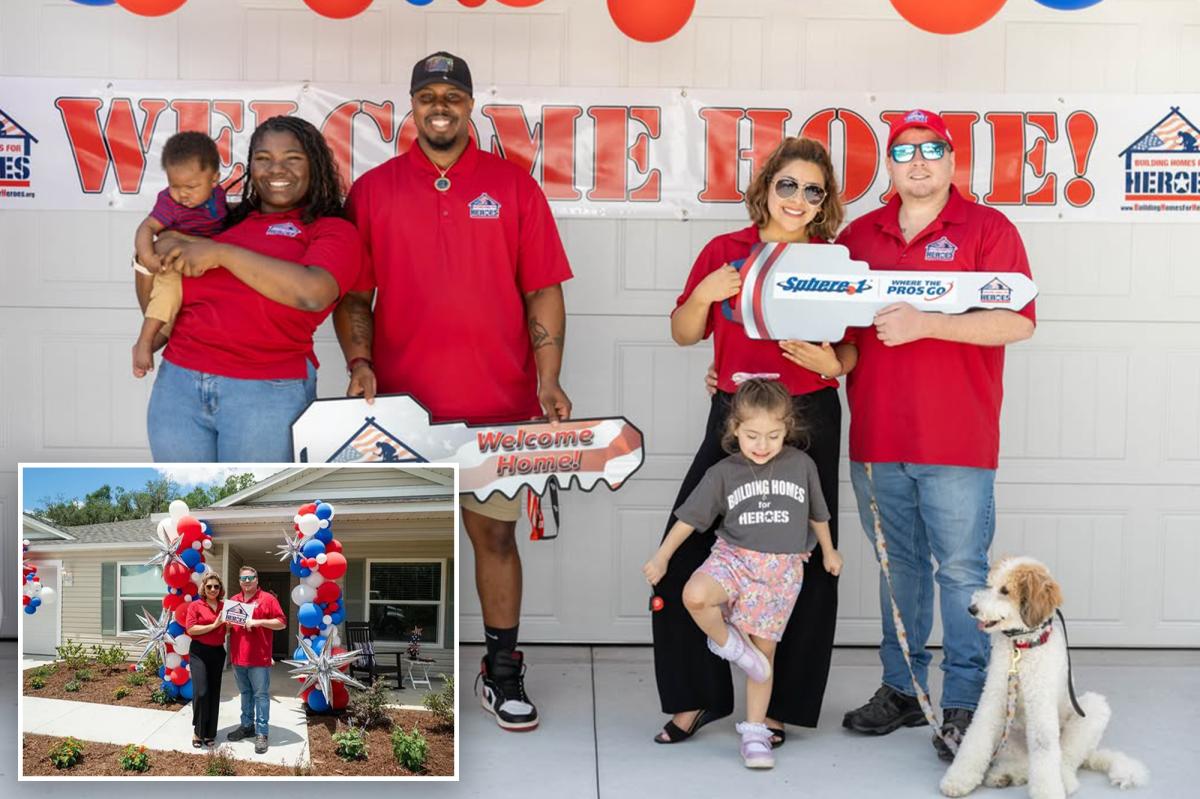
In May, Building Homes for Heroes presented two newly completed homes in Lake Panasoffkee, Florida, to U.S. Army Specialist Rajae Jones and U.S. Army Sergeant James Tabares and their families.
The houses were constructed from the ground up by students at the charter school, working alongside the nonprofit. The effort gave students hands-on experience in the building trades while also allowing them to serve veterans in their own community.
Kim Vesey, president and general counsel of Building Homes for Heroes, said the recent projects highlight the impact of the organization’s partnership with The Villages Charter School.
“It’s a really phenomenal program, and we’re so lucky to have been able to partner with them,” she said in an interview with Fox News Digital.
Together, the organization and student program have built several houses for veterans, starting in 2024 with a family who had been “really struggling,” Vesey said.
The family had reportedly lived in transitional housing while the husband struggled with a military injury and PTSD, which made it difficult to keep a job.
“They just found themselves in this cycle of endless struggle,” Vesey said. “They had two young boys, and they were really trying so hard.”
The family was gifted the first home built by TVCS students and BHH. Now, both sons work at the school, and the veteran runs a program at the School of Autism.
“I really can’t say enough great things about the opportunity that the school is giving to these students,” Vesey said. “The hands-on ability to not just go into a classroom and learn a trade, but to also give back to their community at the same time and to change people’s lives and see it firsthand … being able to have that kind of impact on the world and realizing that what you do matters — I can’t imagine how much that helps.”
Recent TVCS graduate Blake Tart, 18, shared his experience in a separate interview with Fox News Digital.
“My experience with Building Homes for Heroes was very cool – seeing the project go from a spot of sand to a finished and decorated house,” he said. “I will take the hard work and lessons learned with me into my next career path, and the most valuable lesson is that I can work on all of this myself at my own home one day.”
Tart, who comes from a family of veterans, said he and his fellow classmates showed up every day and “worked our hardest” for the veterans receiving homes.
“We were never satisfied with good enough – we wanted it to be perfect,” he said. “The community should always lend a helping hand to those who have served and need some help.”
BHH has a presence in 37 US states, but Florida has seen the highest demand for housing among veterans, according to Vesey. She emphasized the importance of people having a wider understanding of why former service members may need extra help.
“People don’t find themselves in situations where they can’t provide for their family out of intent,” Vesey said. “Any one of us are just a few paychecks away from being in a situation where we are unable to provide for our families.”
“Our veterans go into the military to serve their country for so many different reasons, and many of them go into that thinking it’s going to be a full-time career, just as if you’re a teacher or a lawyer or a doctor… and that’s your retirement, that’s your savings, that’s everything you need to support your family,” she went on.
“So, when you go into the military thinking you’re going to put 30 years into that career, and it gets cut short because you’re injured, it’s a high risk.”
Many veterans who leave the military after an injury don’t have a stable place to live, a college degree or a back-up career.
“You haven’t put down roots because you’ve served your country for 10 years … There is no fallback plan,” Vesey said. “When people enter this high-risk career and that career is cut short through no fault of their own to serve our country, I think it’s paramount that our country is there to serve them.”