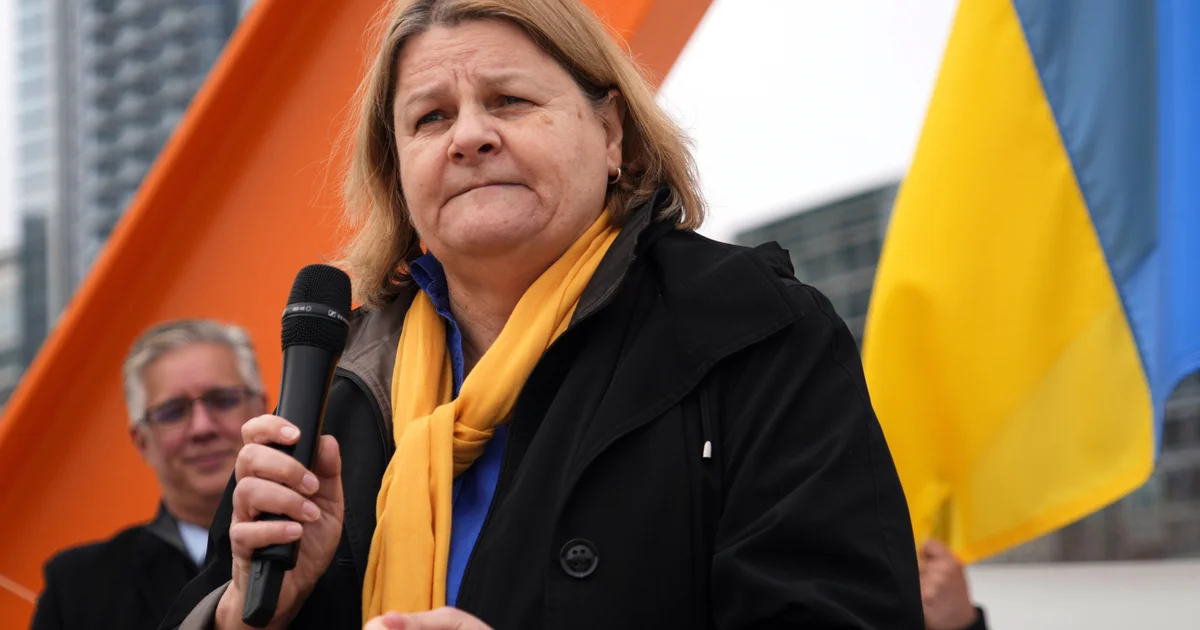
Former Wisconsin Judge Hannah Dugan avoided a prison sentence Wednesday after being found to have helped a Mexican defendant leave her courtroom to avoid U.S. Immigration and Customs Enforcement agents. Instead, a federal judge imposed a $5,000 fine, pointing to her otherwise law-abiding record in deciding the punishment.
“I think this is a situation where an otherwise good person, upset by immigration policies in this country, made a bad decision in the moment,” U.S. District Judge Lynn Adelman said.
Dugan, 67, was found guilty of felony obstruction in December. At trial, her defense team argued that President Trump’s administration sought to “crush” Dugan as part of a broader effort to force judges into line with an ICE approach that targeted immigrants when they appeared for court proceedings.
Dugan stepped down in January from the Milwaukee County circuit judgeship she had held for nine years, following impeachment threats from Republican state lawmakers who accused her of acting as an activist judge. In her resignation letter, she warned that the case against her endangered “the independence of our judiciary.” Republican U.S. Rep. Tom Tiffany, a staunch Trump ally now running for Wisconsin governor, had called on authorities to “lock her up.”
Two Marquette University law professors appeared in support of Dugan, among them a former state Supreme Court justice and a Jesuit priest, who read a statement portraying her as an advocate for people facing oppression and said he did not believe punishment was necessary. “Hannah models what it means to be a Christian,” Gregory O’Meara said.

Lee Matz/Milwaukee Independent via AP
Dugan says she was just trying to do her job
Dugan then spoke to the court, saying she had always tried to serve responsibly as a judge and that her actions in April 2025 were not driven by malice, but by a desire to preserve the “decorum and safety of the courtroom.”
“I have been cast as both a scofflaw and a hero. I am neither. I am a public servant who’s just trying to do my job,” Dugan said, noting that threats directed at her and her family have forced her to withdraw from public life.
Executive Assistant U.S. Attorney Richard Frohling said he recognized that “she has experienced collateral damage because of her conduct,” but emphasized that “judges can’t choose to disregard the law.”
The judge then said he doesn’t believe prison is necessary, noting that Dugan lost her job, now has a felony conviction and experienced threats that forced her to move and stop attending community events. He also noted that Dugan’s actions didn’t stop the ICE agents from arresting the defendant outside the courthouse.
“This is a few minutes of conduct for someone who has dedicated her life to public service,” Adelman said. “It’s a marked deviation from an otherwise law-abiding life.”
Prosecutors had pushed for a “serious sentence”
Prosecutors had argued in a sentencing memo that Dugan violated her oath as a judge and put both law enforcement and the public at risk.
“Judges are entrusted with tremendous discretion, but there is a line they cannot cross,” Frohling wrote. “The defendant crossed that line.”
Dugan’s attorneys argued she has been “punished enough,” and should not be sentenced to any jail time beyond the hours she spent in federal custody.
Federal sentencing guidelines called for 15 to 21 months behind bars, but the judge, who was appointed by President Bill Clinton in 1997, wasn’t bound by them. Prosecutors did not recommend a sentence, but Frohling wrote that “this was a serious offense, and it warrants a correspondingly serious sentence.”
Attorney Jason Luczak said after the sentencing that they would still appeal Dugan’s felony obstruction conviction. Jurors acquitted her at trial of concealing an individual to prevent arrest, a misdemeanor.
What happened in the courthouse that day
On April 18, 2025, immigration officers went to the Milwaukee County courthouse after learning Eduardo Flores-Ruiz, 31, had reentered the country illegally and was scheduled to appear before Dugan for a hearing in a state battery case.
Dugan confronted agents outside her courtroom and directed them to the chief judge’s office, saying their administrative warrant wasn’t sufficient to arrest Flores-Ruiz. Her attorneys said she was following protocols that called for court employees to report any immigration agents to their supervisors.
After the agents left, she led Flores-Ruiz and his attorney out a private jury door. Agents spotted Flores-Ruiz in the corridor, followed him outside and arrested him after a foot chase. A week later, FBI agents arrested Dugan in the courthouse, leading her outside in handcuffs.
Flores-Ruiz was deported in November.