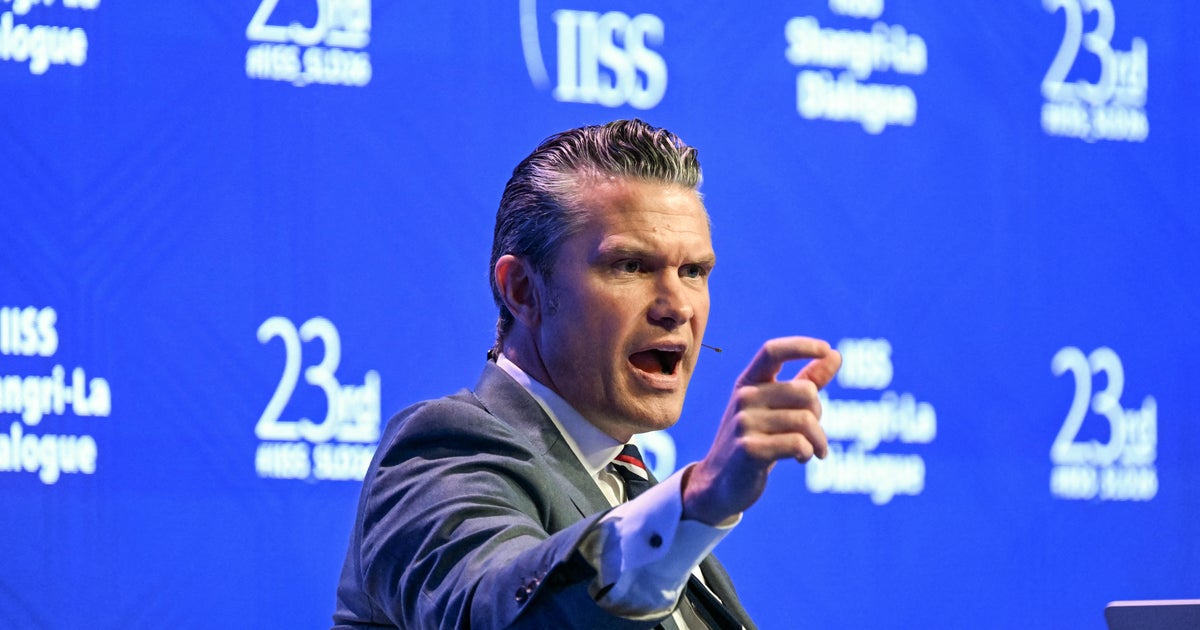
During a visit to Singapore on Saturday, Defense Secretary Pete Hegseth softened his previous stance of labeling China as a threat, although he emphasized to allies that the region holds significant implications for U.S. security and prosperity.
Hegseth, aligning with decades of U.S. policy, sought to balance diplomacy by avoiding antagonizing Chinese leaders while still supporting Taiwan. In a departure from last year’s tone, he acknowledged that the U.S. respects China’s regional ambitions.
“I believe our message today aligns closely with the president’s goals: to maintain strength while communicating diplomatically, acknowledging areas where collaboration with China is possible,” Hegseth explained to reporters post-speech. “We recognize their ambitions and their considerable military expansion, which requires us to prepare for any potential scenarios as a sovereign nation. Nonetheless, our stance on Taiwan remains unchanged.”
Addressing an assembly of global leaders, diplomats, and top security officials at the Shangri-La Dialogue in Singapore, Hegseth stated that Washington’s main focus is to establish a lasting and advantageous power balance in the Pacific.
This marked his second appearance at the forum hosted by the International Institute for Strategic Studies. The previous year, Hegseth stirred tensions with China by directly labeling it as a “threat” to Taiwan, a region China claims as part of its territory, although Taiwan maintains it is independent.
“We are not going to sugarcoat it — the threat China poses is real,” Hegseth declared last year. “And it could be imminent.”
Those comments generated a rebuttal from a Chinese military official, who called some of Hegseth’s claims “completely fabricated.”
This year, however, the meeting comes only about two weeks after U.S. President Donald Trump visited Chinese leader Xi Jinping in Beijing, following which Trump called Xi a “great leader” and said they were going to have a “fantastic future together.”
Hegseth says China won’t be allowed to dominate the region
Hegseth, who was with Trump in Beijing, said the two leaders had agreed China and the U.S. should “build a constructive relationship of strategic stability, based on fairness and reciprocity, reaffirming that while our nations will vigorously protect our respective interests, we can secure practical, mutually beneficial agreements where our interests align.”
However, he said it was still an American priority to ensure China is not allowed to dominate the Indo-Pacific.
“There is rightful alarm regarding China’s historic military buildup and the expansion of its military activities in the region and beyond,” he said.
“We share a clear-eyed assessment of that security environment and a mutual understanding that a Pacific dominated by any hegemon would unravel the regional balance of power and undermine the equilibrium we all seek to preserve.”
Later in the day, Chinese Maj. Gen. Meng Xiangqing praised Hegseth’s remarks about the meeting between Xi and Trump, saying the consensus the leaders reached “should provide strategic guidance for China-U.S. relations over the next three years and beyond.”
“During his meeting with President Trump, President Xi Jinping made it clear that such constructive strategic stability should be a positive form of stability centered on cooperation, a healthy form of stability in which competition remains within reasonable bounds, a normal state of stability in which differences are managed and kept under control, and a lasting form of stability that offers the prospect of peace,” he said.
U.S. Sen. Tammy Duckworth, part of a congressional delegation to the conference, accused the Trump administration of “cozying up” to China.
“I worry that this administration is being distracted into wars that they’ve started in other parts of the world at the expense of our commitment here in the Indo-Pacific,” the Illinois Democrat told reporters on the sidelines.
“I am concerned that it seems like our president is entering into, you know, policies where he’s doing what Beijing wants him to do,” she added.
After the meetings between Xi and Trump, the American president raised questions about Washington’s willingness to defend Taiwan, calling a new $14 billion arms package that he has yet to greenlight “a very good negotiating chip for us” with China.
China claims the democratic self-governing island as its own, and Xi has not ruled out using force to take it. The U.S. is required by law to help provide Taiwan with the means to defend itself, though follows a policy of “strategic ambiguity” on whether it would intervene militarily if China were to attack the island.
Hegseth told the forum that there was “no change in our status” toward Taiwan, but would not comment on the arms deal.
“Any decision about future Taiwan arms sales, as the president said, will rest with him,” he said.
US praises countries that spent more on defense
He underscored the Trump administration’s insistence that allies increase defense spending, saying “we need partners, not protectorates.”
He lauded several countries in Asia for their efforts, while reiterating criticism of European allies, without naming names, who he suggested got “distracted by empty globalist rhetoric about the rules-based international order.”
“Our partners in Asia have long understood that the bedrock of a durable partnership is not based on idealistic values but on the concrete alignment of national interests,” he said.
“When our interests diverge, we adjust pragmatically, without the drama or the moralizing,” he added. “I think Western Europe might take note — this is a mindset we fully embrace.”
Hegseth did not mention either the war in Ukraine or Iran war in his speech. When asked about Iran, he only said that Trump had assured him that when negotiations with Tehran had concluded, “any deal will be a good deal.”
Australian Defense Minister Richard Marles, whose country was among those Hegseth praised for increased military spending, said that while the international rules-based order is not perfect, the “task before us, all of us, including the great powers, is the renovation of that order, not its dismemberment.”
“When the rules apply, smaller states have agency,” Marles said in a speech that followed Hegseth’s. “When the rules yield to power, sovereignty becomes, as others have put it, the purview of the powerful, and no state in this room today, whatever its size, is well served by that outcome.”
UK, US and Australia announce new undersea drone initiative
At an event held outside the conference, Hegseth, Marles and British Defense Secretary John Healey announced a new initiative in their AUKUS partnership, whose primary focus has been the development and construction of nuclear-powered submarines.
Under the so-called second pillar of AUKUS, the three said they would together invest in the development of improved capabilities for underwater drones.
“Together we produce a range of cutting-edge sensors or weapons systems for undersea drones,” Healey said, adding it will help detect threats including to underwater cables and pipelines.