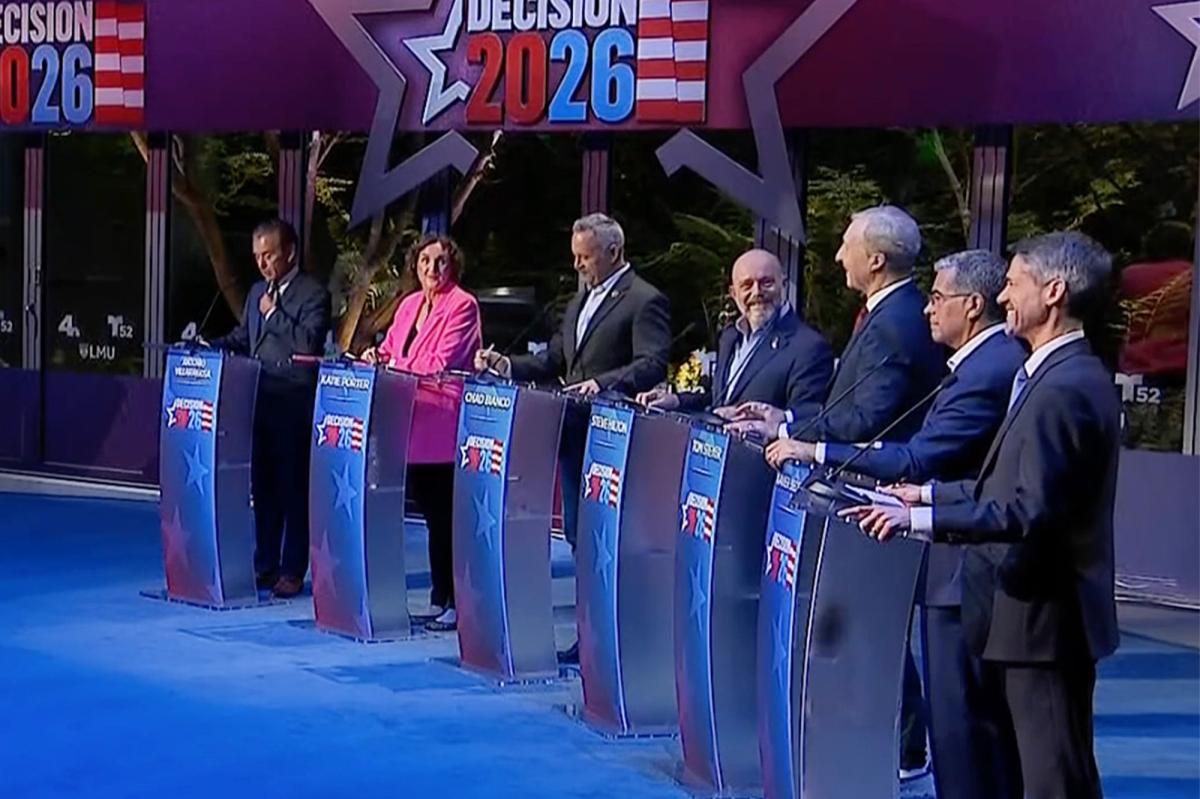

The race for California’s governorship, already marked by tension, escalated dramatically on Wednesday night as candidates clashed in Los Angeles over pressing issues like housing, a crisis in the insurance sector, and the long-delayed high-speed rail project.
This fiery encounter took place at the Skirball Cultural Center, merely hours after a separate debate for LA’s mayoral hopefuls. It followed a contentious CNN debate the previous evening, where personal rivalries among the candidates were already on full display.
Moderating the event were Colleen Williams and Conan Nolan from NBC4, joined by Enrique Chiabra from Telemundo 52, guiding the discourse through a night filled with pointed exchanges.
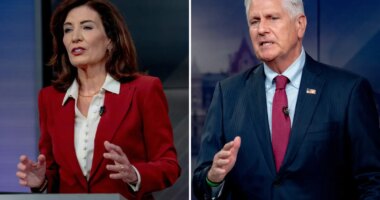
On the stage were Republican contenders Chad Bianco and Steve Hilton, alongside Democrats Xavier Becerra, Matt Mahan, Katie Porter, Tom Steyer, and Antonio Villaraigosa. With California’s “jungle primary” system in play, where only the top two will advance to the November election, every argument carried significant weight.
Housing costs emerged as a hot-button issue, sparking some of the night’s most intense debates. Steve Hilton, once a Fox News host, emphasized the need to return to building “starter homes” to boost first-time homeownership. Meanwhile, billionaire Democrat Tom Steyer proposed accelerating the permitting process and vowed to close a corporate real estate loophole he believes exacerbates the problem. Republican Chad Bianco argued that the crux of the issue is the prohibitive cost for builders to construct new housing under the existing system in California.
Steve Hilton, the former Fox News host, argued California must return to building “starter homes” to revive first-time homeownership. Tom Steyer, the billionaire Democrat, focused on speeding up permitting and pledged to close what he described as a corporate real estate loophole. Chad Bianco countered that the real issue is that builders themselves can’t afford to construct housing under California’s current system.
Xavier Becerra, a former Biden administration official, pushed for expanded down payment assistance and said he would block Wall Street from outbidding everyday buyers. Katie Porter warned bluntly about the human cost, saying she fears her teenage son could end up living on her couch due to rising prices, and backed a 5% down payment plan.
Matt Mahan pointed to San Jose as proof the state can deliver results, while Antonio Villaraigosa highlighted his tenure as Los Angeles mayor, claiming he streamlined permitting and helped transform 20,000 downtown units into 60,000. Hilton later took a swipe at Mahan, accusing him of “trying to remember his lines.”
The debate also turned sharply to California’s insurance crisis following the 2025 fires and widespread complaints about State Farm’s handling of claims. Becerra said his mother lost coverage unexpectedly and floated a controversial “freeze” on rates — prompting criticism from rivals who said a governor lacks that authority.
Porter rejected the idea outright, saying “we can’t afford to freeze rates,” and instead called for bringing insurers back into the market.
Mahan went further, saying, “The state of California broke the insurance market.” Hilton argued the system once worked under Republican leadership, while Steyer said insurers must be enticed back through hardened homes and reduced wildfire risk. Bianco warned, “The insurance companies are not going to come back if another democrat is elected.”
California’s Democrat contenders went full “sanctuary state” at the debate, doubling down on protections for illegal immigrants while sparring over who’s toughest on ICE.
Bianco warned the state needs to get tougher on illegal immigration and stop “waiting until somebody dies” before deporting criminal offenders.
But fellow candidate Porter pushed back, insisting California should simply enforce the sanctuary policies already on the books.
The clash comes as California remains a sanctuary state under the California Values Act (SB 54), which took effect Jan. 1, 2018, limiting cooperation between local law enforcement and federal immigration authorities.
Becerra took credit for helping preserve the law, and vowed he’d aggressively challenge ICE if elected governor.
In the end, every Democrat on stage stood united behind keeping California a sanctuary state, despite growing voter concerns over crime, border security and deportations.
Steyer warned that “no one gets better on the street” and argued California must stop people from becoming homeless in the first place.
Bianco blasted the state’s approach, saying homeless people are being used as “pawns” and claiming there is “zero intent” to actually help them.
He argued the crisis “is not about homes,” insisting the real issue is untreated mental illness and addiction.
He called for more treatment centers for drugs, alcohol and mental health, adding that “putting a roof over someone’s head is the same as putting a tent over their head.”
Hilton claimed homelessness has increased in San Jose, while Mahan pushed back, saying the crisis has “flattened.”
Becerra dismissed criticism over reports that the Department of Health and Human Services lost contact with more than 85,000 unaccompanied migrant minors during his tenure.
Becerra said claims surrounding the controversy, amplified by President Donald Trump, were “a lie.”
The tone was frequently personal, reflecting a race increasingly defined by friction.
Republicans Bianco and Hilton largely avoided attacking each other and even appeared aligned at points, while Democrats remained split as Becerra and Steyer jockeyed for position after the collapse of Eric Swalwell’s campaign. Villaraigosa struggled to gain traction, and Mahan attempted to carve out a centrist identity in a crowded field.
The event followed a CNN-hosted debate Tuesday night that already set a combative tone, with anchors Kaitlan Collins and Elex Michaelson steering a volatile exchange.
The broader backdrop to the debate was sobering: only about one in three Californians, 33% as of late 2024, still believe in the American Dream, often referred to locally as the California Dream.
With just weeks before the June 2 primary, the race remains wide open, fractured, and increasingly combative as candidates fight for just two spots on the general election ballot.